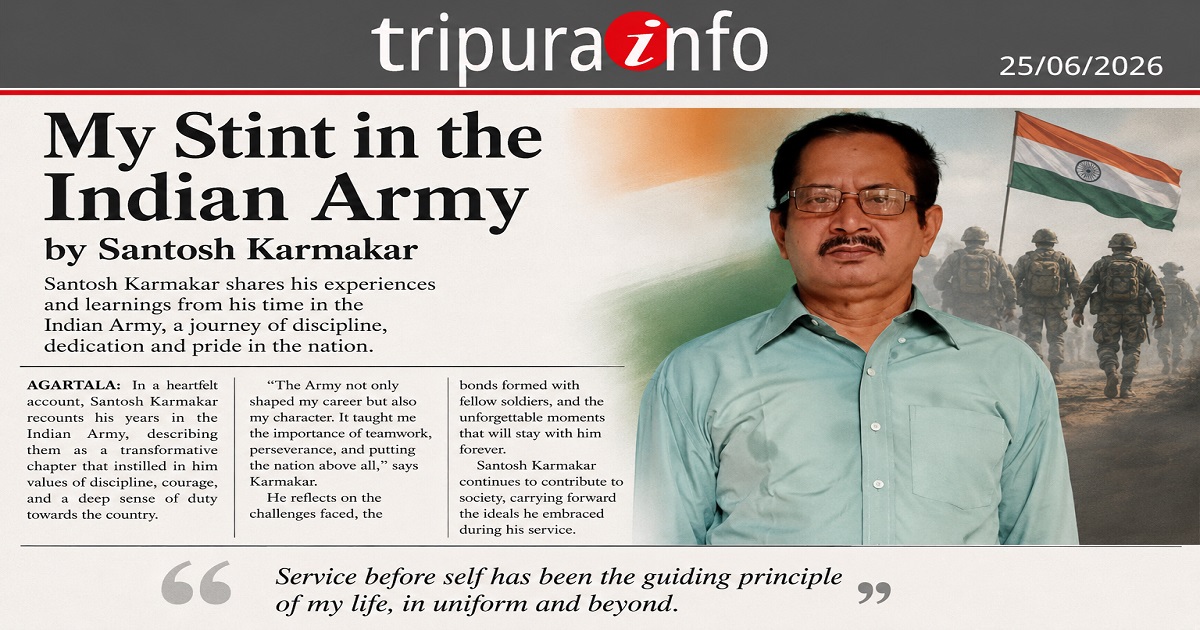
My Stint in the Indian Army
Santosh Karmakar
June 25, 2026
 I joined as Revenue Inspector in the O/o SDO, Amarpur, in June 1983. From 3rd June, my training started as per the kind instruction of SDO Amarpur, Chandrasekhar Chattopadhyay, TCS. I learnt all the required subjects, including Chain Survey, Diagonal Scale, Mutation, etc., and different provisions of the TLR & LR Act, 1960. Training was also imparted on Accounts, Food, and Election matters.
SDO Sir dictated an Order of Restoration case over 2 days. I noted it in the order sheet as dictated by him.
Thereafter, in the month of November 1983 (last week, as I remember), I was asked to accompany the Indian Army engaged in artillery field firing practice. The place of firing practice was at Deotamura Field Firing Range, located at a distance of about 15 km from Amarpur town.
For that, I had to wake up at about 0400 hours and get ready by 0500 hours. It is mentionable that the Army arranged my transportation from Amarpur to the Range. After reaching the Range, the task of vacating 8 villages was given to me with police assistance. Thereafter, I had to issue a certificate stating that the villagers had been evacuated. Then the firing practice used to start. At about 5.00 p.m. or 5.30 p.m., the practice concluded. It is mentionable that the evacuated villagers used to get compensation for the loss of mandays. The Army used to pay the compensation.
I became habituated to rising at 3.45 a.m. and getting ready by 4.45 a.m., eagerly awaiting the Army vehicle scheduled to come by 5.00 a.m. In the event of a delay, there was no chance of getting another vehicle before 9.00 a.m., as vehicular movement on that route used to start only from 9.00 a.m.
The Army used to conduct field firing with the following:
75/24 Howitzer
105 mm Gun
120 mm Mortar
RCL Gun
The infantry also carried out firing practice. Their weapons were:
2-inch Mortar
3-inch Mortar
HG
81 mm Mortar
In the Army, I got the chance of working with a 2nd Lieutenant, Lieutenant, Captain, Major, Lieutenant Colonel, and Colonel. Rarely, I met the Commander (Brigadier rank).
It is mentionable that the post of 2nd Lieutenant no longer exists; it now begins with Lieutenant. Likewise, the head of a regiment is now of Colonel rank.
In the Army, secrecy is the prime thing. Things are camouflaged. Their map is different from our map. Sometimes, during operations, the Army puts a cover on the actual number of vehicles and also applies mud or something similar on the regiment identity. The vehicle used by the Commanding Officer has a different identity, the 2nd-in-Command's vehicle has another type of identity, and the Major's vehicle has yet another identity.
The Commanding Officer is called "Tiger." Similarly, the doctor has another nickname, the Second-in-Command has another name, and the Adjutant also has a different name. For some genuine reasons, all these are not narrated here.
Every Army unit has a different identity. Tac signs are used by different wings. For example, the wing responsible for ensuring the delivery of goods, ration, etc., uses one Tac sign. The Medical Unit has another Tac sign, and the Communication Wing uses another Tac sign.
The unit has a numerical identity (and also a duplicate name). Suppose it is the 176 Field Regiment; it has another name. For some genuine reasons, all details are not explained here.
This firing practice used to start at the end of November and continued up to the first week of March every year.
I had the responsibility of making payment to the evacuated villagers. For that, acquaintance rolls for all the villagers were prepared by me. The payment was made by Army officers in my presence. The amount paid during 1983–84 was Rs. 8/- per head per day. During 1993–94, it was enhanced to Rs. 14/- per head per day.
On the last day of field firing, the Army unit conducted a campfire. The jawans used to perform dances, solo songs, and sometimes duets. The Army officers deliberated on Indian culture and heritage.
To add variety, some local tribal cultural troops were invited. I remember that once, in 1984–85, the team led by Brajendro Koloy was invited. Shri Koloy performed the Molsom dance. On another occasion, the team led by Ashapurna Koloy of Dhanlekha also performed the Koloy dance. Both teams received prizes from the Army in recognition of their exemplary contribution.
আরও পড়ুন...