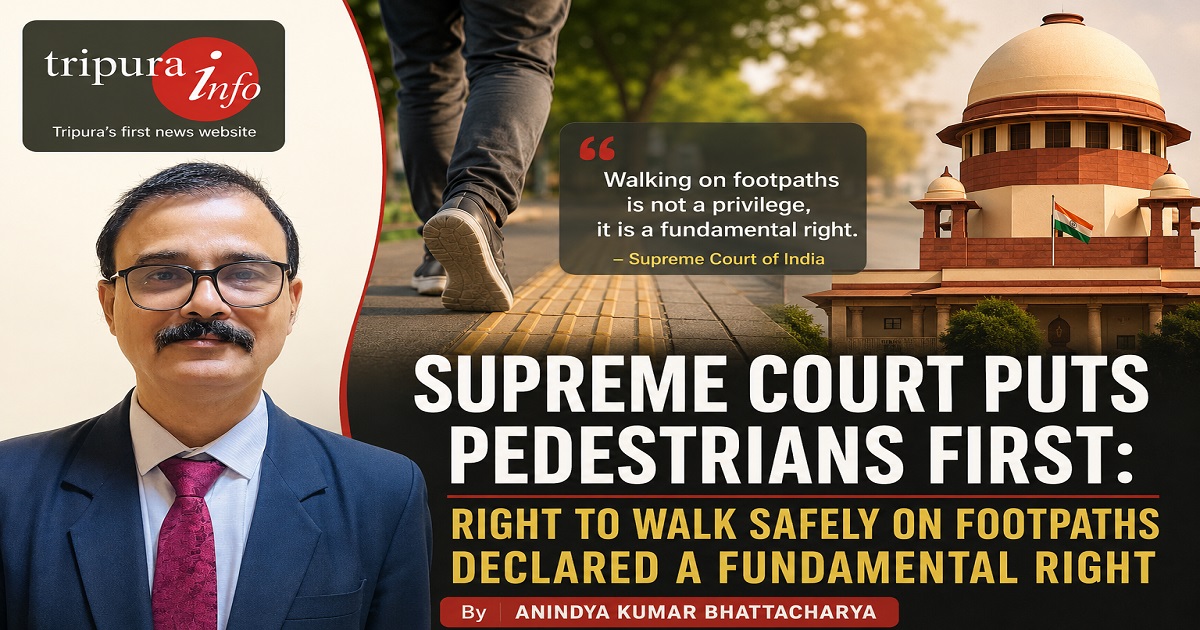
Supreme Court Puts Pedestrians First: Right to Walk Safely on Footpaths Declared a Fundamental Right
ANINDYA KUMAR BHATTACHARYA
June 20, 2026
 A Landmark Judgment for Every Citizen
In a significant judgment that will impact millions of Indians who walk on roads every day, the Supreme Court of India has emphatically declared that pedestrians are not second-class users of public roads. The Court has held that where a road exists, the authorities have a corresponding duty to provide and maintain safe, demarcated footpaths for pedestrians.
Justice P. S. Narasimha, authoring the judgment, made a powerful observation:
“If a road exists, there must then be a duty to ensure that a footpath is demarcated and maintained for the walkers. This is an enforceable duty. The fundamental right to walk on demarcated footpaths shall override the privilege of a motorised vehicle.”
The ruling marks a major shift in urban governance by recognizing that roads are not meant exclusively for cars, motorcycles, buses, and other vehicles. They belong equally—if not more fundamentally—to pedestrians.
Walking Is a Fundamental Right
The Supreme Court linked the right to walk safely with the constitutional guarantee of life and personal liberty under Article 21 of the Constitution.
For decades, city planning in India has largely focused on accommodating motor vehicles. As a result, pedestrians often face unsafe conditions, including encroached footpaths, broken pavements, open drains, parked vehicles, and the absence of dedicated walking spaces.
The Court has now made it clear that walking is not merely a convenience but an essential component of human dignity, mobility, and access to public spaces.
Every citizen—whether a student, senior citizen, office worker, homemaker, or person with disability—has the right to move safely without being forced onto busy roads.
A Duty on Governments and Local Authorities
The judgment places an enforceable obligation on governments, municipal corporations, development authorities, and road-owning agencies.
The Court emphasized that whenever a road is constructed or maintained, corresponding pedestrian infrastructure must also be provided. Authorities can no longer treat footpaths as optional amenities.
This means local bodies must:
• Construct proper footpaths along roads.
• Clearly demarcate pedestrian areas.
• Maintain footpaths in usable condition.
• Remove encroachments and illegal occupations.
• Prevent parking of vehicles on walkways.
• Ensure accessibility for senior citizens and persons with disabilities.
Failure to perform these duties may invite judicial scrutiny because the Court has characterized them as enforceable public obligations.
Why This Judgment Matters
According to various road safety studies, pedestrians constitute a substantial percentage of road accident victims in India. Many accidents occur because people are compelled to walk on carriageways due to the absence of safe footpaths.
The judgment recognizes an often-overlooked reality: every motorist is also a pedestrian at some point. Whether walking to a bus stop, crossing a road, entering a school, visiting a market, or reaching a workplace, citizens depend upon safe walking infrastructure.
The Court's observation that the “fundamental right to walk” overrides the “privilege of a motorised vehicle” sends a strong message that urban planning must prioritize human beings over machines.
Benefits for Senior Citizens, Children and Persons with Disabilities
The ruling is particularly beneficial for vulnerable road users.
Senior citizens frequently face difficulties navigating uneven pavements or roads without sidewalks. Schoolchildren are often forced to walk close to fast-moving traffic. Persons with disabilities encounter even greater challenges when footpaths are obstructed or poorly designed.
By mandating demarcated and maintained footpaths, the Court has reinforced the principle of inclusive mobility. Public infrastructure must serve all citizens, not merely vehicle owners.
Implications for Smart Cities and Urban Development
The judgment is likely to influence future urban development projects across India.
Smart city initiatives, municipal master plans, and road construction projects may now be required to place greater emphasis on pedestrian infrastructure. Authorities may need to revisit existing road designs and allocate resources for creating walkable cities.
Globally, successful cities prioritize pedestrians, cyclists, and public transport users. The Supreme Court's ruling aligns India with these modern principles of sustainable urban planning.
A Step Towards Safer and Healthier Cities
Walking is one of the healthiest and most environmentally friendly modes of transport. Encouraging walking reduces traffic congestion, lowers pollution levels, and improves public health.
By protecting pedestrians' rights, the Court has not only advanced constitutional values but also promoted safer, cleaner, and more livable cities.
Conclusion
The Supreme Court's judgment is a powerful affirmation that roads are public spaces meant for people first and vehicles second. By recognizing the right to walk safely on demarcated footpaths as part of the constitutional guarantee of life and dignity, the Court has strengthened the rights of ordinary citizens.
The message is clear: footpaths are not luxuries. They are a legal necessity. When a road exists, a safe footpath must exist too. The pedestrian's right to walk with safety and dignity now stands protected at the highest constitutional level.
আরও পড়ুন...