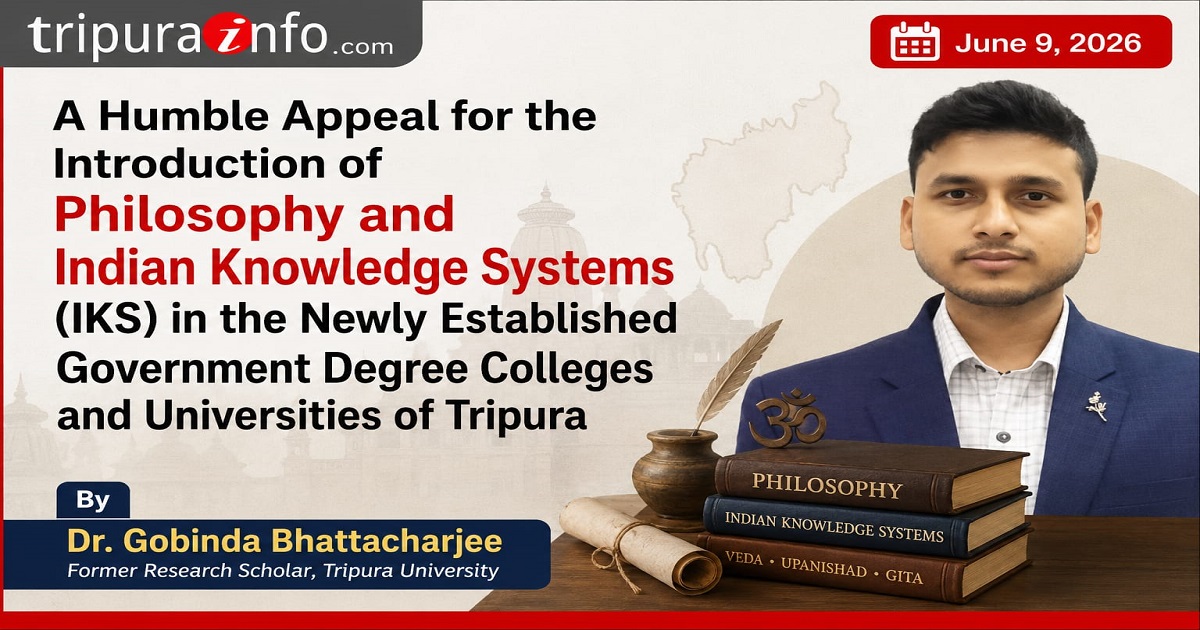
A Humble Appeal for the Introduction of Philosophy and Indian Knowledge Systems (IKS) in the Newly Established Government Degree Colleges and Universities of Tripura
Dr. Gobinda Bhattacharjee
June 9, 2026
 “Education is not merely the accumulation of information but the cultivation of wisdom. A university worthy of its name must preserve the past, engage with the present, and illuminate the future.”
The recent establishment of new Government Degree Colleges and the expansion of higher education institutions in Tripura represent a landmark achievement in the educational development of the state. These initiatives reflect a commitment to democratizing access to quality education and creating opportunities for the intellectual, social, and economic advancement of future generations. As these institutions take shape and define their academic identities, it is imperative that they embody the principles of holistic, multidisciplinary, and value-oriented education envisioned in the National Education Policy (NEP) 2020. In this context, the introduction of Philosophy and Indian Knowledge Systems (IKS) as academic disciplines deserves earnest consideration by policymakers, educational administrators, and academic planners. The inclusion of these subjects would not merely add to the diversity of academic offerings but would significantly enrich the intellectual and cultural landscape of higher education in Tripura.
Philosophy: The Foundation of Human Knowledge
Philosophy has long been regarded as the “Mother of All Disciplines.” Historically, the origins of nearly every branch of knowledge – including mathematics, natural sciences, social sciences, economics, political science, psychology, linguistics, law, and even technology – can be traced to philosophical inquiry. Before these subjects emerged as specialized disciplines, they were integral parts of humanity's broader quest for truth, wisdom, and understanding. The study of Philosophy develops essential intellectual capacities such as critical thinking, logical reasoning, analytical skills, ethical reflection, conceptual clarity, and independent judgment. It encourages students to question assumptions, examine evidence, appreciate multiple perspectives, and engage constructively with complex issues.
In an age characterized by rapid technological advancement, artificial intelligence, environmental crises, social inequalities, and ethical dilemmas, the relevance of Philosophy has become more pronounced than ever. Contemporary societies require citizens who can think critically, reason ethically, and navigate uncertainty with wisdom and intellectual responsibility. Philosophy equips students with these indispensable qualities. Moreover, Philosophy contributes significantly to the cultivation of democratic values, social harmony, tolerance, and respect for diversity. It fosters dialogue rather than dogmatism and encourages the pursuit of truth through rational discourse. Such values are particularly important in pluralistic societies like India, where diverse cultures, traditions, and worldviews coexist.
Philosophy and Employability
A common misconception is that Philosophy lacks practical relevance or career prospects. In reality, graduates in Philosophy possess highly transferable skills that are increasingly valued in the modern world. Their training in critical analysis, communication, ethical reasoning, and problem-solving prepares them for careers in education, civil services, law, journalism, public administration, social work, public policy, diplomacy, research, publishing, corporate ethics, media, and emerging fields such as artificial intelligence ethics and data governance. Globally, many leading universities recognize Philosophy as one of the most intellectually rigorous disciplines that prepares students for leadership roles across diverse sectors. The development of analytical and ethical competencies aligns well with the twenty-first-century demands of innovation, creativity, and responsible decision-making.
Indian Knowledge Systems: Reconnecting with India's Intellectual Heritage
Equally significant is the introduction of Indian Knowledge Systems (IKS), which encompass India's rich and diverse intellectual traditions developed over thousands of years. Indian civilization has made profound contributions to philosophy, mathematics, astronomy, medicine, linguistics, logic, political thought, ethics, education, architecture, ecology, agriculture, psychology, and governance. The National Education Policy 2020 explicitly emphasizes the integration of Indian Knowledge Systems into mainstream education. This initiative seeks not merely to preserve ancient traditions but to engage with them critically, scientifically, and creatively, making them relevant for contemporary scholarship and innovation.
Indian Knowledge Systems encourage interdisciplinary learning by connecting traditional wisdom with modern scientific and social inquiries. They promote a deeper understanding of indigenous methods of knowledge production and contribute to the decolonization of education by recognizing India's own intellectual traditions alongside global perspectives. The introduction of IKS would create opportunities for innovative teaching, research, and collaboration across multiple disciplines, fostering an educational environment that is both globally informed and deeply rooted in India's cultural heritage.
Learning from Great Indian Thinkers
The study of Indian intellectual traditions should include the works of influential modern thinkers whose contributions continue to shape contemporary India and the world. The educational philosophy of Sri Aurobindo emphasizes the integral development of the human personality and the harmonious growth of body, mind, and spirit. Mahatma Gandhi’s ideas on truth, non-violence, self-reliance, ethical politics, rural development, and education remain highly relevant in addressing present-day social and environmental challenges.
Pandit Deendayal Upadhyaya’s concept of Integral Humanism offers an indigenous framework for understanding human welfare, social harmony, sustainable development, and balanced economic progress. The ideas of thinkers such as Swami Vivekananda, Rabindranath Tagore, Dr. B. R. Ambedkar, Sarvepalli Radhakrishnan, Bal Gangadhar Tilak, Acharya Vinoba Bhave, and many others can further enrich academic discourse and provide students with diverse perspectives on ethics, education, democracy, social justice, and nation-building.
Relevance to Tripura
The introduction of Philosophy and Indian Knowledge Systems would be particularly meaningful for Tripura, a state known for its cultural diversity and rich indigenous heritage. Tripura’s tribal communities possess unique traditions of ecological knowledge, social organization, ethical practices, folklore, spirituality, and environmental stewardship. These living traditions constitute valuable intellectual resources that deserve systematic academic study and preservation.
Establishing programmes in Philosophy and IKS could encourage research on:
• Tribal philosophies and indigenous worldviews;
• Oral traditions and folk wisdom;
• Environmental ethics and sustainable living;
• Indigenous governance systems;
• Cultural heritage and identity;
• Traditional ecological knowledge;
• Community-based educational practices;
• Comparative studies between local and classical Indian philosophical traditions.
Such initiatives would not only preserve local heritage but also integrate it into national and international academic conversations, giving Tripura a distinctive place in the intellectual map of India.
Alignment with the National Education Policy 2020
The National Education Policy 2020 advocates multidisciplinary education, critical thinking, ethical reasoning, experiential learning, and the promotion of India's rich knowledge traditions. It encourages universities and colleges to move beyond narrow specialization and create educational ecosystems that nurture well-rounded individuals. The introduction of Philosophy and Indian Knowledge Systems directly supports the objectives of NEP 2020 by:
• Promoting critical and creative thinking;
• Strengthening ethical and value-based education;
• Encouraging multidisciplinary learning;
• Preserving and promoting India's intellectual heritage;
• Supporting innovative research;
• Developing culturally rooted yet globally competent citizens;
• Enhancing the quality and diversity of higher education.
The inclusion of these disciplines would therefore represent a practical and meaningful implementation of national educational priorities.
Building a Knowledge Society
Higher education should not merely produce skilled workers for the economy; it should cultivate thoughtful individuals capable of addressing the deeper questions of human existence and social progress. Economic growth and technological advancement alone cannot sustain a just and harmonious society without ethical understanding, cultural awareness, and intellectual maturity. Philosophy teaches us to think critically and live responsibly. Indian Knowledge Systems reconnect us with centuries of accumulated wisdom and encourage a balanced relationship between humanity, society, and nature. Together, they foster the development of informed, compassionate, and responsible citizens.
The newly established Government Degree Colleges and universities of Tripura have a unique opportunity to become centres of excellence where modern scientific education coexists with philosophical inquiry and indigenous knowledge traditions. Such an educational model would truly reflect India’s civilizational ethos and contemporary aspirations.
A Humble Appeal
In view of these considerations, I respectfully appeal to the concerned authorities, policymakers, educational planners, university administrators, and all stakeholders in higher education to give serious consideration to the introduction of Philosophy and Indian Knowledge Systems (IKS) in the newly established Government Degree Colleges and universities of Tripura. Such a step would not merely introduce two new academic disciplines; it would strengthen the intellectual foundations of higher education in the state, encourage interdisciplinary research, preserve cultural heritage, promote ethical and critical thinking, and contribute to the holistic development of future generations.
A society achieves true progress not merely through material prosperity or technological innovation but through wisdom, ethical consciousness, critical reflection, and cultural self-understanding. Philosophy and Indian Knowledge Systems nurture these enduring values and deserve a rightful and prominent place in the future of higher education in Tripura. (Dr. Gobinda Bhattacharjee, Former Research Scholar, Tripura University)
আরও পড়ুন...