IP Gupta : The Quiet Strength of the Republic!!!
Biswanath Bhattacharya
June 3, 2026
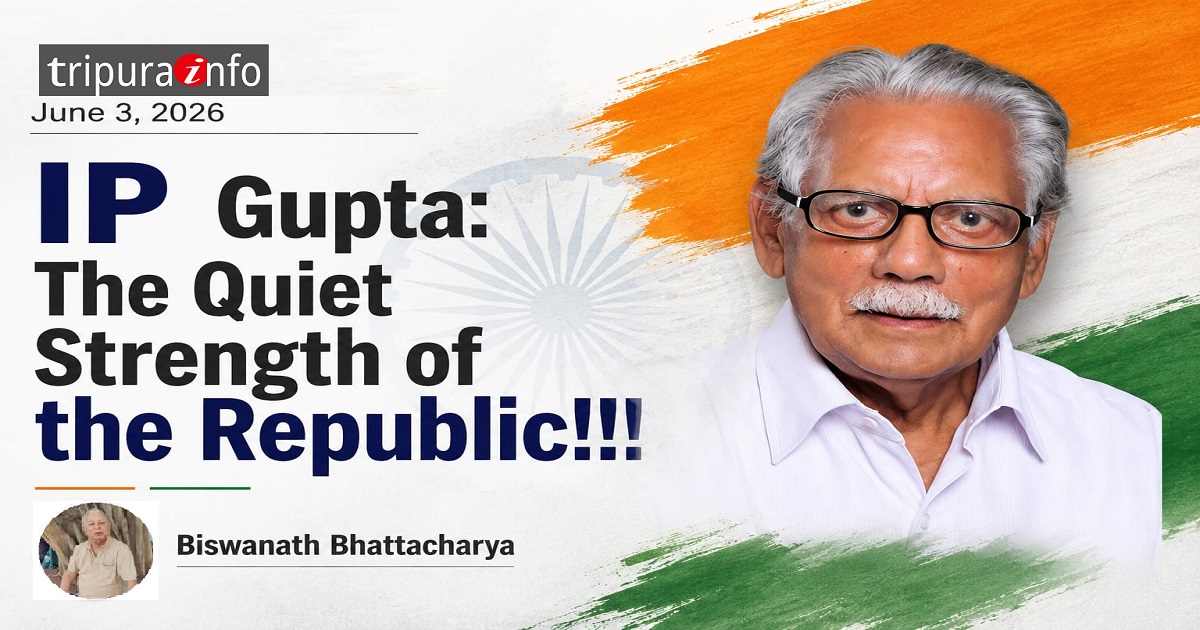 There are public men who blaze through office like summer lightning, bright for a moment and quickly spent, and there are others who move with a steadier light, illumining institutions without ever trying to dazzle the eye. Ishwari Prasad Gupta belonged unmistakably to the second order. In a public life that carried him from Bihar to the difficult administrative theatres of the Northeast, from the Union Home Ministry to the Andaman and Nicobar Islands, he fashioned a career marked not by theatrical power but by disciplined service. Born on 5 February 1931 in Arrah, he came of age in a generation that still understood the State not as a stage for self-display but as a demanding arena of duty. A brilliant student who studied mathematics with distinction and later trained in law, Gupta entered the Indian Administrative Service in the 1958 batch of the Manipur-Tripura cadre and built, over the decades, a reputation for competence, restraint and unusual moral poise. He was not merely a bureaucrat in the narrow sense of the word. He was part of that older civilisational ideal of public service in which intellect was expected to be tempered by character, and authority by self-command. To write about him today is therefore to write not only about one man’s career, but about a fading ethic in Indian governance: the ethic of quiet strength.
That ethic revealed itself in the range and seriousness of the offices he held. Gupta served as Chief Secretary of Tripura, later as Chief Secretary of Arunachal Pradesh, and went on to occupy important positions in the Ministry of Home Affairs, including Joint Secretary and Additional Secretary. He also served as Adviser to the Governor of Assam, was a Member of the Central Administrative Tribunal in New Delhi, and eventually became Lieutenant Governor of the Andaman and Nicobar Islands. Each posting belonged to a demanding chapter of India’s administrative story, especially in regions where governance was never a matter of routine file-work alone, but of tact, patience, historical understanding and constitutional balance. His career touched some of the most complex fault lines of the Indian Union—the Northeast with its layered ethnic, political and strategic sensitivities, Delhi with its exacting bureaucratic culture, and the islands with their distinct geography and governance challenges. Yet the record of his life suggests that he never allowed complexity to harden into cynicism. If anything, the deeper one looks, the clearer it becomes that his public service drew strength from an interior discipline. Those who remembered him intimately spoke not first of rank but of temperament: a quietly religious man, guided by karma rather than pronouncement, inwardly formed by a belief that the worth of a life lies in work honestly done and in harm consciously avoided. That moral reserve gave to his official life a rare texture. He was, by all accounts, gentle without being weak, civil without being evasive, and firm without turning harsh. In a nation where public language is often swollen with performance, his style appears almost radical in retrospect: he governed without noise.
The private tribute to him as a father offers the key to understanding the public man. It recalls a person who did not criticise others, who refused to speak ill of anyone, who wore his convictions lightly and did not burden others with instruction. The image is striking because it is so rare: a man of power who practised non-injury not merely in action, but in speech; a man whose religiosity did not seek applause; a man whose Gandhian gentleness coexisted with a very human competitive spirit that surfaced delightfully on the tennis court, where he played not for appearance but to win. It is precisely these seemingly smaller details that rescue his memory from official marble and return it to the living world. They reveal a personality at once disciplined and warm, principled and unpretentious. He also wrote on political and diplomatic questions, including issues central to the Northeast, suggesting a mind that remained engaged with the larger national conversation beyond office itself. In 2012, he was among those honoured by Bangladesh for their support connected with the Liberation War, an acknowledgement that widened the frame of his life beyond administrative titles alone. When he died in New Delhi on 12 December 2018, he left behind more than a distinguished résumé. He left behind a standard of conduct. For an all-India readership, that is where his relevance now truly lies. Ishwari Prasad Gupta reminds us that the Republic has also been built by men who did not clamour for attention; by administrators whose deepest authority came from balance, decency and inward clarity; by individuals who knew that power, unless chastened by humility, eventually coarsens both institution and self. His life stands as a quiet rebuke to the age of excess. It suggests that the most enduring force in public life may not be spectacle, but steadiness; not rhetoric, but conscience; not the raised voice, but the stainless one. Long after offices are reassigned and names fade from letterheads, such lives remain in the civic memory like the afterglow of a lamp at dusk—calm, unwavering, and enough to guide the way.
He moved through the world like a steady flame — never flickering, never faltering — illuminating the lives around him with warmth rather than heat.
Some men leave behind achievements. He left behind a way of living.
This photo frame was graciously shared by Shri Promode Gupta, son of the late I. P. Gupta, Sir. I have requested him to share further anecdotes about this remarkable and legendary figure. Tripura remembers him — and will continue to remember him — for all time to come !!!
আরও পড়ুন...