A Light Extinguished Over Tripura: Farewell to Pradip Chakravorty!!!
Biswanath Bhattacharya
May 19, 2026
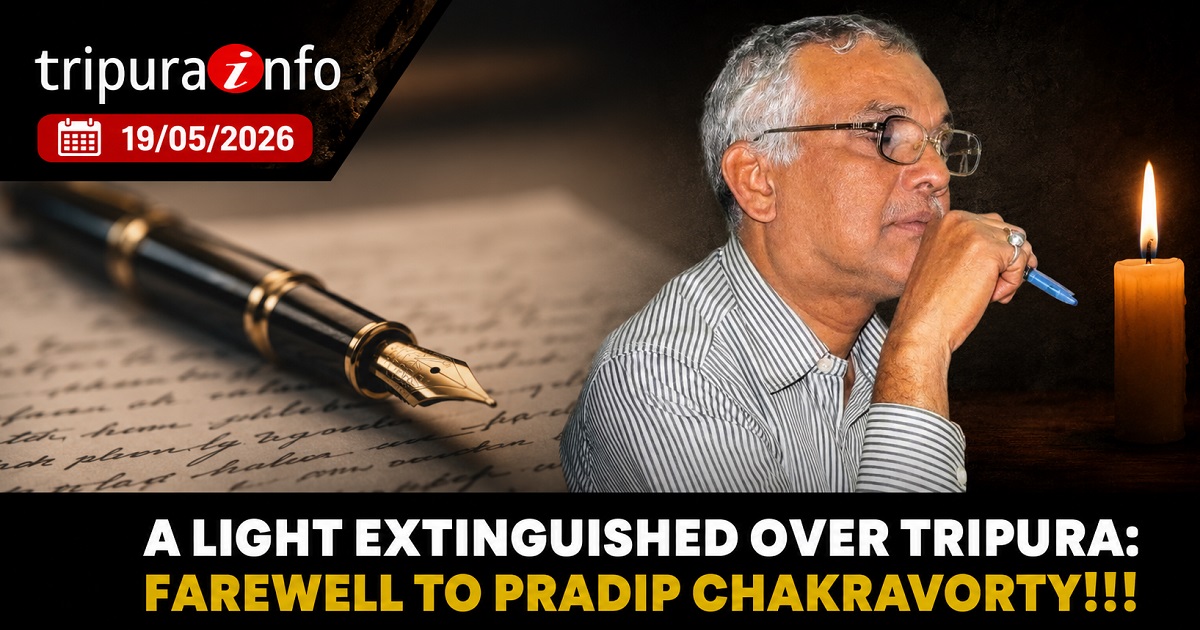 The news came like a cold wind through a half open door—quiet, sudden, and devastating. Through the column of Shri Jayanta Debnath, CEO of Triourainfo.com, I learned that Pradip Chakravorty, one of Tripura’s most articulate and uncompromising journalists, has left this world. It felt as though a star had slipped from the universe, leaving behind a darkness that words struggle to fill. I first met Pradip almost twenty years ago in a modest Xerox shop—one of those cramped little corners where paper dust floats like pale snow and the hum of machines becomes a kind of heartbeat. He stood there, puffing Wills Flake cigarettes one after another, as if each drag helped him wrestle with the world he chronicled. Curiosity nudged me toward him. When he told me his name and profession, recognition struck like a spark. Here was the man whose columns in Dainik Sambad Patrika I devoured with the eagerness of a pilgrim seeking truth.He wrote under the guidance of the legendary editor Bhupen Datta Bhowmick—a man whose editorials carried the weight of thunder and the clarity of a mountain stream. Bhowmick’s pen could slice through illusion, and Pradip’s writing flowed beside it, like a tributary carrying its own fierce current. Together, they shaped a generation of readers who learned to expect honesty, courage, and craft from journalism. Pradip’s pen was a river—restless, lucid, and alive. There was something of Sharadindu Bandyopadhyay’s Tungabhadrar Tire in his prose: that effortless weaving of human frailty, social truth, and quiet sorrow. His stories did not merely inform; they breathed. They carried the scent of red earth, the ache of forgotten villages, the pulse of a land both beautiful and bruised.
I waited for his columns the way one waits for dawn after a long night.
In those days, Tripura’s intellectual landscape was shaped by giants. Shyama Charan Tripura—political icon, visionary, and a man of rare depth—was one of them. Often I felt that had Shyama da chosen the path of literature instead of politics, he might have carved epics from the very soil of the hills. His speeches carried the cadence of poetry, and his thoughts bore the weight of lived truth. Men like him and Pradip belonged to a generation that believed words were sacred, not commodities.
Pradip wrote fearlessly about North Tripura—the abject poverty of tribal communities, the silent suffering tucked away in bamboo huts, the hunger that clung to children like a second skin. He wrote of villages where the night arrived early because electricity did not. Of mothers who measured hope in handfuls of rice. Of young men who walked miles for work that paid barely enough to keep dreams alive. His words were not decoration; they were wounds laid bare. And because he refused to sell his soul to the establishment, he lived a life of poverty—but with his head held high, like a lone tree refusing to bow to the storm. His writing was sharp as a razor, slicing through hypocrisy, corruption, and the comfortable lies that power prefers. He never sought wealth, nor did wealth ever seek him. Truth was his only currency.
While today’s journalists often build homes before they build convictions, Pradip remained rootless for most of his life. Only a few days ago, he managed to set up a small home in a remote corner—far from the noise of the city, far from the applause he never asked for. His son, Gaurav, now settled in Vadodara, carries forward the quiet dignity of his father’s legacy.
I loved Pradip—his simplicity, his stubborn honesty, his unvarnished humanity. But I loved his writings even more. They were windows into a world many preferred not to see, mirrors held up to a society that often flinched from its own reflection. His words lingered long after the page was turned, like the aftertaste of truth—bitter, necessary, unforgettable.
Today, as Tripura mourns him, I feel the weight of an absence that cannot be filled. A voice has fallen silent, but its echo will continue to move through the hills, the markets, the tea stalls, the dusty roads, and the hearts of those who once waited for his columns with reverence.
May his journey onward be peaceful.
Om Mani Padme Hum!!!
আরও পড়ুন...