The Court That Called Its Citizens “Cockroaches”!!!
Biswanath Bhattacharya
May 16, 2026
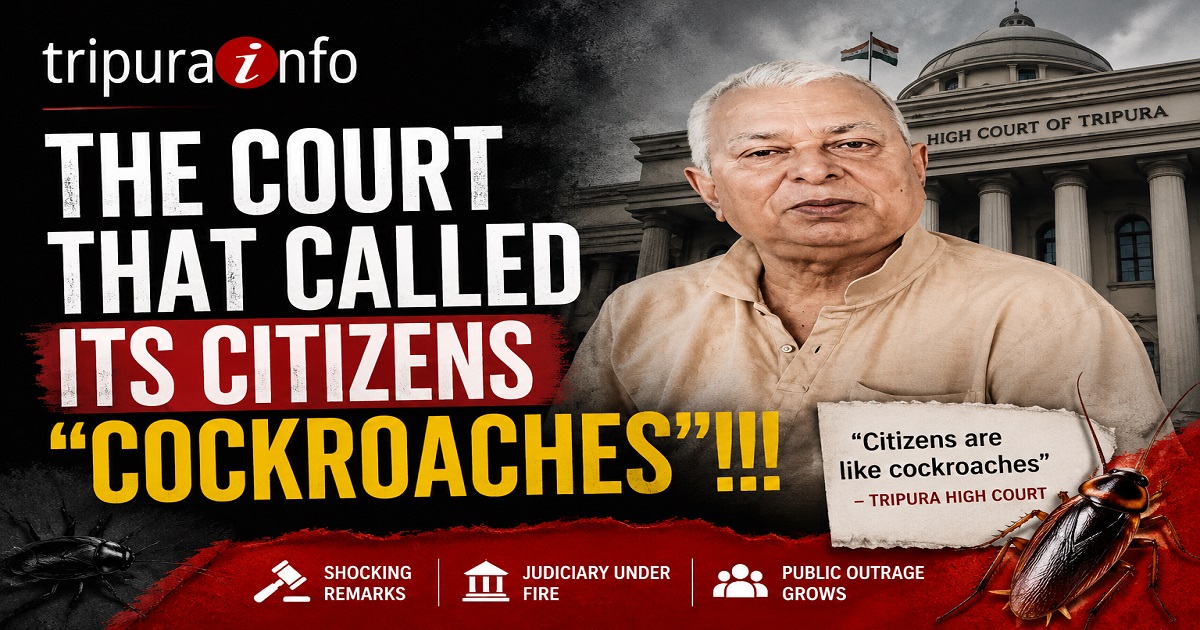 A constitutional democracy doesn’t implode in a single, cinematic collapse. It rots from the top — in the quiet, chilling moments when those entrusted with safeguarding dignity decide instead to spit on it. On May 15, Chief Justice Surya Kant delivered one such moment. With a few contemptuous sentences, he branded unemployed young lawyers, RTI users, journalists, and legal commentators as “cockroaches” and “parasites of society.” It wasn’t a judgment. It wasn’t binding. But it was venomous — a stain on the Court’s moral authority and a betrayal of its own constitutional lineage.
For decades, the Supreme Court insisted that the Constitution’s promises mean nothing unless ordinary people can challenge power. Justice Krishna Iyer warned in Fertilizer Corporation Kamgar Union that the individual stands “pitted against the State — always an unequal contest.” Justice Bhagwati, in S P Gupta, declared that “any member of the public acting bona fide” could approach the Court on behalf of the voiceless. These weren’t rhetorical flourishes. They were the foundation stones of public interest litigation — the very architecture that allowed the powerless to speak in a system engineered for the powerful.
And yet, forty years later, the country’s top judge chose to describe those very citizens — the ones who file RTIs, write legal analysis, or pursue public interest cases — as vermin.
The irony is blistering. In 2019, a Constitution Bench held that even the Chief Justice’s office falls under the RTI Act. The Court itself affirmed that transparency is not an attack on the institution but a constitutional expectation. RTI activists are not saboteurs. They are participants in a democratic structure the Court helped design.
But the CJI’s words sketched a different, darker narrative: that those who use these tools do so not out of right, but out of deficiency. That young lawyers — scraping by in a profession where many earn ₹2,000 to ₹5,000 a month — are somehow leeches for staying connected to the law through RTIs, journalism, or PILs. This isn’t just wrong. It is cruel. The Bar Council itself acknowledges the brutal precarity of the junior bar. For many, these avenues are not indulgences. They are lifelines.
To call that parasitism is to spit on the Court’s own jurisprudence.
The context makes the insult even more grotesque. The remark came during a case about transparency in Senior Advocate designations — a process the Court itself reformed in Indira Jaising. A citizen invoked the Court’s own accountability framework, and the response was a sweeping denunciation of citizens who invoke accountability frameworks. The contradiction is staggering.
Language is not ornamental. It is operational. When the Chief Justice of India calls certain citizens “cockroaches,” the insult does not remain trapped within courtroom walls. It seeps outward — into police stations, lower courts, bureaucratic corridors, and public discourse. It signals who deserves dignity and who deserves contempt. It tells the system whom to listen to and whom to crush.
Justice Chandrachud once wrote that India’s freedoms survive only if journalists can speak without fear. That principle applies not just to prime time anchors but to every citizen who dares to question power through “unconventional or inconvenient means.” The Court’s legitimacy has always rested on the belief that it is open to everyone — the privileged, the precarious, the loud, the inconvenient, the persistent.
When the Court’s own language begins to divide citizens into the “legitimate” and the “parasitic,” it corrodes that belief.
The danger is not that one remark will rewrite the law. The danger is that it will rewrite the culture of constitutional engagement — turning rights into favors, and citizens into supplicants.
A democracy cannot afford a judiciary that sneers at those who use the very tools the judiciary created. The Court spent decades widening the democratic space. It must not now be the institution that shrinks it.
Before this contempt becomes normalized, it must be named clearly and without hesitation: a betrayal of the Court’s own constitutional imagination.
আরও পড়ুন...