“Jana Gana Mana” and the Idea of Modern India
DR. SUMON ALI
May 10, 2026
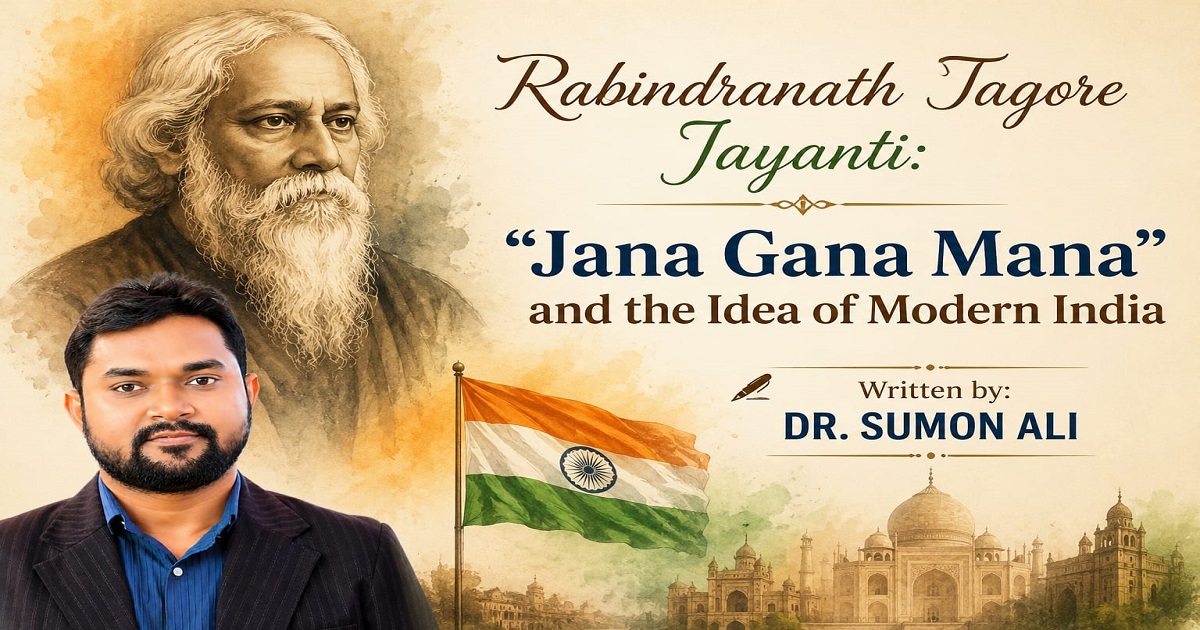 Does the “Adhinayak” in “Jana Gana Mana Adhinayak Jaya He, Bharata Bhagya Vidhata” refer to a ruler, or to the collective consciousness of the people of India? Did Rabindranath Tagore merely compose a national anthem, or did he also lay the foundation of a humane and democratic vision of modern India? At a time when division and intolerance are increasing, can Tagore’s idea of India show us a new path? To seek answers to these questions, it is essential to revisit the thoughts of the Poet Laureate and the underlying philosophy of “Jana Gana Mana.”
Rabindranath Tagore was not only the greatest poet of Bengali literature; he was also a philosopher, educationist, social thinker, humanist, and political intellectual. At the centre of his literature, music, and philosophy stood humanity, human dignity, and the free development of civilization. Every year, the 25th day of Baishakh is celebrated as Rabindra Jayanti. Rabindra Jayanti is not merely the remembrance of the birth of a poet; it is a special occasion for rediscovering Indian culture, human consciousness, and national identity. India’s national anthem, “Jana Gana Mana,” remains an eternal symbol of Tagore’s idea of India. This song is not merely a musical composition; it is a unique expression of India’s pluralistic culture, unity, democratic consciousness, and humane vision of the state. At a time when division, intolerance, and narrow nationalism are increasing in society, Tagore’s “Jana Gana Mana” once again reminds us of the true identity of India.
“Where the mind is without fear and the head is held high.” Through this famous line, Tagore envisioned an India where people could think and express themselves freely without fear. The foundation of modern democratic India is likewise based on freedom, dignity, and free thought. Therefore, Tagore’s ideas continue to strengthen the moral foundation of Indian democracy even today.
In 1911, Rabindranath Tagore composed the song titled “Bharata Bhagya Vidhata,” the first stanza of which was later adopted as the National Anthem of India. The song was first performed at the session of the Indian National Congress held in Calcutta in the same year, and after independence, “Jana Gana Mana” was officially adopted as the National Anthem on 24 January 1950.
In the line “Jana Gana Mana Adhinayak Jaya He, Bharata Bhagya Vidhata,” Tagore did not praise any individual or ruler; rather, he emphasized the collective consciousness, unity, and inner strength of the people of India. In his view, the people themselves formed the true foundation of the nation. Therefore, “Jana Gana Mana” is not merely a patriotic song but also a symbol of India’s pluralistic and democratic spirit.
Although at various times attempts have been made to interpret the song as praise for the British monarch, Tagore’s own statements and his broader political philosophy clearly indicate that the term “Adhinayak” refers to the eternal democratic consciousness and historical journey of the people of India. For Tagore, India was a meeting ground of humanity where the collective strength of the people was the true driving force of the nation.
India as Unity in Diversity:
“Punjab, Sindh, Gujarat, Maratha, Dravida, Utkala, Banga…” Within these lines, Tagore beautifully wove together the geographical and cultural diversity of India. He never viewed India’s different languages, cultures, regions, and communities through the lens of division; rather, he discovered India’s true strength within this diversity itself.
For Tagore, India was not merely a geographical territory on a political map. India represented a civilizational and cultural entity shaped by the coexistence of multiple languages, religions, races, and cultures. This idea is deeply connected with the constitutional philosophy of modern India. Just as the Constitution of India upholds secularism, pluralism, and equal rights, Tagore too placed the highest importance on human bonds and coexistence.
The People as the Soul of the Nation:
The phrase “Jana Gana Mana” itself contains the essence of Tagore’s political philosophy. He did not perceive the state merely as an administrative machinery; he believed that the people constituted the real strength of the nation. Neither kings, rulers, nor empires determine the destiny of a nation—rather, it is the collective will and consciousness of the people that shape its future.
Tagore’s vision was consistent with modern democratic thought. In his view, the purpose of the state was to ensure the development of human creativity and freedom. He opposed systems where individual liberty was suppressed or where human beings were reduced to mere instruments of administration. This is why he was a sharp critic of colonialism and imperialism. By renouncing the title of “Knighthood” conferred upon him by the British government in protest against the Jallianwala Bagh Massacre, Tagore demonstrated a rare example of moral courage before the world.
Tagore may not be described as a direct political leader, but his political philosophy was profound and far-reaching. He never placed the state above human beings. According to him, the state exists for human beings; human beings do not exist for the state. He considered the modern Western state system to be excessively mechanical and power-centric. In his famous lectures on “Nationalism,” Tagore argued that Western nationalism often narrows the human spirit. When the state becomes excessively powerful, individual freedom, morality, and human values suffer.
Therefore, Tagore envisioned a society and a state where human relationships, cooperation, and moral consciousness would play the central role. The core principles of his political philosophy were human liberation, individual freedom, social harmony, cultural pluralism, and universal humanity. He believed that political freedom alone was insufficient; true freedom could only emerge when human thought, culture, and spiritual strength were allowed to develop freely.
Humanism Beyond Aggressive Nationalism:
Tagore was a patriot, but he never supported aggressive or narrow nationalism. According to him, any nationalism that creates hatred toward other nations or cultures is dangerous. In this context, Tagore famously stated: “Patriotism cannot be our final spiritual shelter; my refuge is humanity.”
Tagore believed that while patriotism is important, humanity is the highest ideal. Narrow nationalism divides people, whereas humanity unites them. In the context of present-day religious and political polarization, this idea remains extremely relevant.
Tagore closely observed the rise of aggressive nationalism in Europe during the early twentieth century, which eventually led to world wars. He believed that blind nationalism could become a threat to human civilization itself. This is why the idea of “universal humanity” occupied a central place in his thought. He wanted India to remain connected with the wider world. For him, true patriotism meant loving one’s own culture without hating others. At a time when religious polarization, ethnic hatred, and intolerance are increasing globally, Tagore’s liberal humanism acquires renewed significance.
Tagore’s Vision of Education and Society:
Tagore realized that political independence alone could not build a nation; creative and humane education was equally essential. With this vision, he established Visva-Bharati University at Santiniketan. His philosophy of education emphasized harmony with nature, the development of free thought, the practice of art and culture, international cultural exchange, and moral and humane education.
He envisioned an India where education would not merely become a means of employment, but would cultivate truly humane and independent-minded individuals. In today’s highly competitive and market-oriented educational environment, Tagore’s educational philosophy deserves renewed evaluation.
Democracy as a Moral and Cultural Consciousness:
Although Tagore was not a formal theorist of democracy, democratic values are deeply embedded in his thought. He strongly supported individual freedom, freedom of expression, and social coexistence. According to him, democracy is not merely about elections or the transfer of political power; it is also a cultural and moral consciousness. Without tolerance, mutual respect, and humanity within society, democracy becomes merely a formal structure. Therefore, to strengthen democracy in contemporary India, Tagore’s humane and cultural perspective remains profoundly important.
As India’s National Anthem, “Jana Gana Mana” is not merely a formal symbol of the state; it is also a reflection of India’s constitutional ideals. The song reminds us that India is a land of diversity, that the people are the true source of state power, that unity does not mean uniformity, and that cultural pluralism is the soul of India. Just as the Constitution of India upholds justice, liberty, equality, and fraternity, Tagore’s vision of India was likewise founded upon human dignity and collective coexistence.
Relevance of Tagore in Contemporary Times:
Today, both India and the wider world are passing through a complex phase. Despite technological advancement, intolerance, violence, division, and misinformation have increased within society. Politics based on divisions of religion, caste, and language is weakening the foundations of democracy. In such a situation, Tagore’s ideas can offer a new direction. His philosophy teaches us to see human beings as human beings, to respect diversity, to value free thought, and to place humanity and morality at the centre of public life.
Therefore, “Jana Gana Mana” is not merely a song to be sung ceremonially; it is a living document of India’s identity, unity, and humane vision of the state.
Ultimately, Rabindranath Tagore’s idea of India was profound, liberal, and deeply humanistic. He dreamed of an India where people would transcend divisions of religion, language, and region and unite through a bond of humanity. His “Jana Gana Mana” is the melodious expression of that dream. To remember Tagore on Rabindra Jayanti does not simply mean organizing cultural programmes; it means re-establishing his ideas, philosophy, and human values within society and state life. If India truly wishes to move forward as a strong, democratic, and humane nation, Tagore’s liberal humanism, cultural pluralism, and people-centric vision of the state will become increasingly relevant.
“Even today, when ‘Jana Gana Mana’ resonates, it is not merely the tune of a national anthem; it echoes as the collective voice of India, shaped by multiple languages, cultures, and beliefs. Tagore’s India continues to teach us that the true strength of the state lies not in power, but in the humane unity of its people.” (Guest Faculty, Department of Political Science, Tripura University)
আরও পড়ুন...