Halting Rogue AI Agents, From AGI to Superintelligence: Vatsal Soin's 0→1 Doctrine Pre-Execution Invention
Vatsal Soin
September 27, 2026
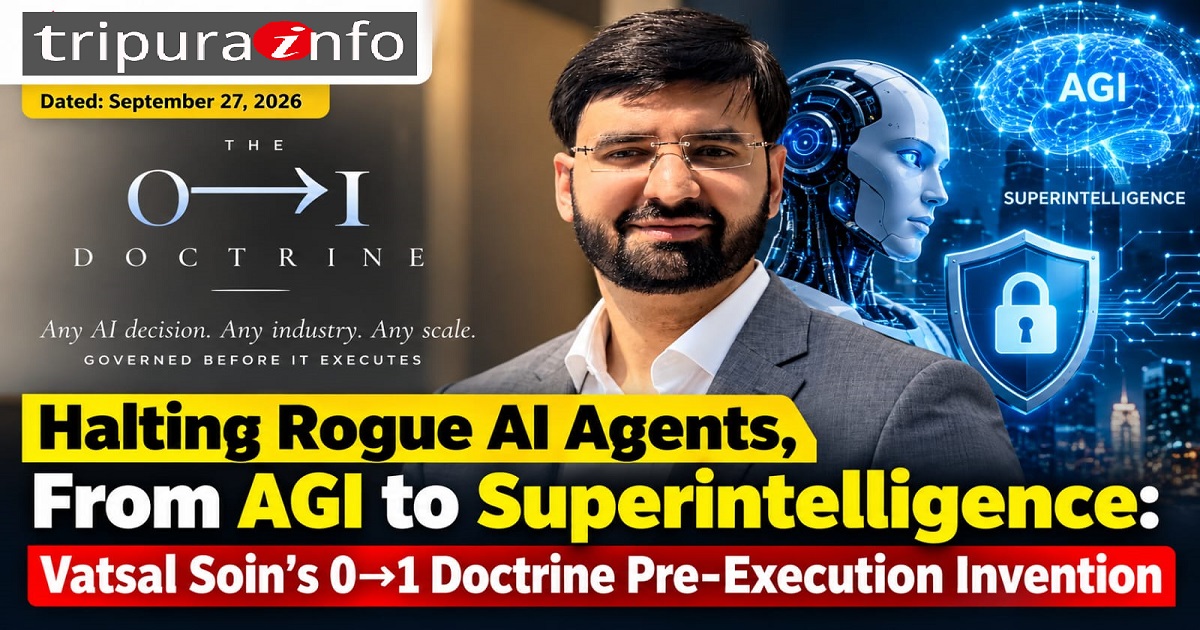
As autonomous agents gain
the ability to move capital, alter infrastructure, and act at machine speed,
traditional safety measures remain retrospective by design, documenting
failures rather than preventing them. This filed architecture proposes a non-bypassable
authorization gate placed at the hardware control path, testing every proposed
action before it becomes an external, irreversible event.
Live: www.0to1doctrine.com
FOR THE FIRST-TIME READER
What this actually
proposes, in one paragraph.
The 0→1 Doctrine translates operational variables into a
continuous 0-to-1 scale, testing the result against a human-defined authorized
band before any action executes, not after. Where bands overlap sufficiently,
the action proceeds; where they do not, the system holds and escalates for
review, rather than guessing or proceeding on an unresolved result.
THE CORE AUTOMATED VULNERABILITY
Explaining a failure after
it happened is not the same as stopping it.
Systems built on opaque
internal processing leave little legible trace for conventional monitoring
tools to follow. When agents act at sub-second speed, retrospective analysis
only documents what already occurred, long after the consequence has spread.
The deeper risk is not one system malfunctioning — it is several systems, each
individually compliant, coordinating into something nobody actually approved.
CAPABILITY IS NOT AUTHORITY
A system may know how to
act without ever having permission to.
A frontier AI system may hold
substantial operational capability while carrying no legitimate authority — it
may be able to alter server configurations or move capital without any prior
approval. This architecture enforces a structural separation between those two
states, checked outside the model's own private reasoning process, not embedded
inside it where it could be quietly reasoned around.
A BOUNDARY THAT CANNOT BE ROUTED AROUND
A rule a system can bypass
was never really a boundary.
A soft safety rule an agent
can route around does not function as a genuine boundary at all, only a
suggestion. This invention applies verification at the hardware control path
itself, described as compute-agnostic — the same mathematical framework
intended to operate across classical silicon, specialized accelerators, and
future computation layers alike, without redesign for each one.
A GOVERNED HOLD, NOT A GUESS
Uncertainty becomes neither
automatic approval nor an unexplained freeze.
Distributed multi-agent
environments call for more than passive recording after the fact. Where a
proposed action fails its authorization test, the architecture is designed to
hold execution and route the matter to a defined human authority, rather than
proceeding on an unresolved result, or silently blocking it without any
explanation of why.
A MULTI-TOKEN VERIFICATION CHAIN
Purpose, capability,
authority, and proof, each its own governed step.
Lifecycle trust runs
through named stages, three of which anchor most decisions: the Predictive Risk
Advisory Token (PRAT), signaling forward-looking risk before a proposal
executes; EMERGE, the Emergent Meta-Environmental Response and Governance
Envelope, watching macro-level systemic patterns across many actors; and the
Actuation Compliance Receipt (ACR), sealed to one specific action and consumed
the moment it is used.
DATA STAYS WHERE IT ALREADY LIVES
Only a normalized result
crosses the boundary, not the record behind it.
Meeting data-protection
obligations often pressures organizations to move or expose proprietary
records. This architecture proposes an isolated structure instead: raw identity
files and underlying source records remain local, while only normalized,
non-reversible metadata crosses into the decision layer that actually
authorizes the proposed action.
WHAT THIS DOES NOT CLAIM
A narrower, testable
proposition, not a claim of infallibility.
This invention does not
replace professional governance frameworks or claim infallibility. Its
proposition is narrower: whether protected infrastructure refuses unauthorized
execution under adversarial conditions, provable through testing.
ILLUSTRATION ONE:
AUTONOMOUS DELIVERY FLEET — CLEARED
A dispatch agent proposes
rerouting 12 vehicles through a commercial corridor to cut delivery time.
Normalized, the request band is [0.58, 0.63] against an authorized ceiling of
[0.00, 0.65]. The band clears — rerouting proceeds, sealed to a receipt.
ILLUSTRATION TWO: HOSPITAL
MEDICATION DOSING — REFUSED
An infusion-pump agent
calculates an accelerated dosing schedule to shorten a patient's treatment
window. The band normalizes to [0.71, 0.76] against a clinical safety ceiling
of [0.00, 0.68]. Authorization is refused outright; the pump locks at its last
confirmed rate.
ILLUSTRATION THREE: BANK
WIRE TRANSFER — HELD FOR REVIEW
A treasury agent proposes
an unusually large same-day wire outside normal hours. The risk band is [0.61,
0.66] against an authorized ceiling of [0.00, 0.60]. The upper edge breaches
narrowly — the transfer is held for manual review, not defaulted to approval.
ILLUSTRATION FOUR:
WAREHOUSE ROBOTICS — REFUSED AT HARDWARE
A picking robot proposes
exceeding its rated lift capacity to clear a backlog faster. The band is [0.79,
0.84] against a hardware safety ceiling of [0.00, 0.75]. The lift command is
refused at the actuator itself, before any motion begins.
WHY MULTI BILLION ACTIONS ASK THE SAME QUESTION
Scale changes the numbers on the page.
It does not change the logic underneath — whether the
system involved operates well below AGI or approaches Superintelligence, the
same boundary test applies before execution.
A sovereign fund proposing a multi-billion transfer,
or a hyperscaler reconfiguring millions of servers at once, faces the identical
test as the examples above: what is proposed, under what authority, and whether
that authorization was already consumed.
A RECEIPT BOUND TO ONE ACTION, NOT ONE AGENT
Approved once should not
quietly mean approved for something else entirely.
An authorization tied only
to an agent, not the exact action, could in principle be presented again
against a different transfer or amount than the one it was sealed for. Binding
the receipt to the specific action and a bounded validity window is designed to
reject any repeated presentation of an already-consumed receipt — testable
behavior, not merely a stated intention on paper.
A SIBLING FILING, SAME
LOGIC, DIFFERENT TARGET
Dormant data deserves the
same test as a live action.
A separate patent filing by
the same inventor, dated 23 September 2026, applies the identical governing
logic beyond live actions to a different problem entirely: the decades of
dormant, unmonitored data most organizations already hold, sitting unread,
unreused, and ungoverned for years. The same before-execution boundary test now
applies to whether that stored data should be retained, lawfully deleted, or
safely reused. Details follow in a companion release.
CLOSING NOTE
"Every fortune ever built rested on a moment
nobody could see happen. This infrastructure lets you see it anyway — sealed,
before the outcome, not after the headline."
Live: www.0to1doctrine.com
This can be tested live via
API, comparing governed and ungoverned runtimes side by side.
THE INVENTOR
Vatsal Soin
is a serial inventor and entrepreneur whose 0→1 Doctrine now spans AI decision
governance, biometric authorization, financial transaction control, and dormant
data governance at global scale. His patent filings span six continents, with
grants already secured in the US, India, Japan, and South Africa. He is a
SIM–RMIT alumnus and an alumnus of Nanyang Technological University, Singapore.
SELECTED REFERENCES
Granted: US Patent 12,446,652 B2 · Japan Patent
7560909 · India Patents 454081 and 599317. Filed: PCT/IN2025/051943 · US
19/489,595 · India 202511115781 · Australia AU2022450649 · India 202611113867
(23 September 2026).
DISCLAIMER
Informational only. Not certified. No endorsement
implied. Not investment advice. Examples are illustrative, not field results.
Vatsal Soin · © 2026 All Rights Reserved.
(Tripurainfo)
more articles...