The Cost of Caution: How Red-Tape Witch Hunts Looms of Ladakh and Kill Bold Governance
VK Bahuguna
October 10, 2026
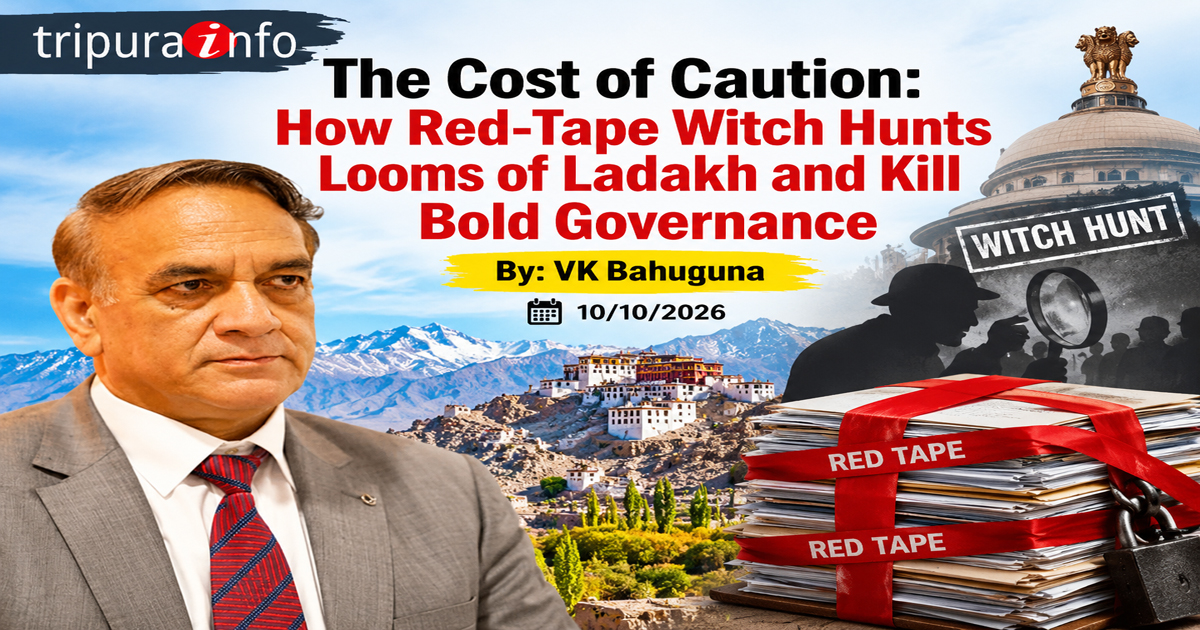
(The writer is former Principal Secretary Government of Tripura and Chairman of Centre for Resource Management and environment)
The Centre for Resource Management and Environment has always been looking for the innovative bureaucratic steps that brings happiness to the face of the people and takes up such cases after proper research. Ladakh the most beautiful border Union Territory had long suffered from neglect and got prominence politically after it was made a Union Territory in 2019 after the abrogation of Article 370. When IAS officer G. Prasanna Ramaswamy toured the windswept heights of Chumur in Leh in 2017, he noticed something that previous generations of bureaucrats had overlooked. Rural women in the harsh terrain of Changthang were quietly hand-knitting exquisite garments using raw Pashmina and yak wool—yet their generational craft earned them pennies while middle-men pocketed millions.
Alongside his wife, a researcher they set out to change the status quo. What began as "Project Laksal" grew into Looms of Ladakh, a pioneering women-owned cooperative designed to shift value creation back to local artisans. instead of celebrating a rare operational success story in a complex border region, hyper-procedural questions, administrative inquiries, and conflict-of-interest allegations have cast a shadow over the initiative. This trajectory highlights a deeply troubling pattern in modern governance: minor procedural anomalies are weaponized to dismantle genuine grassroots progress, sending a chill through officers who dare to innovate.
Before administrative technicalities obscure reality, consider what this initiative of
This cooperative society of women named as “Looms of Ladakh” built and achieved on the ground. The cooperative expanded from an initial pilot of around 15 to 20 local women in 2017 to over 427 women members representing various Self-Help Groups (SHGs) across 16 villages in two districts (Leh and Kargil), including remote high-altitude regions like Changthang. The membership comprises rural herder-artisans, homemakers, and female dependents of ex-servicemen who previously lacked formal access to luxury-tier weaving and design markets.
The cooperative built the grassroots economic ownership as it brought together hundreds of unemployed rural women across remote Ladakhi villages (such as Chuchot and Changthang), training them in natural dyeing, modern weaving, and garment production. And unlike traditional government-subsidized schemes that collapse as soon as funding runs dry, Looms of Ladakh was designed as a self-sustaining entity owned by the women artisans themselves and ensured true financial autonomy. The cooperative used its own earnings to acquire land for its primary Leh hub—without relying on government donations or perpetual leases. No middlemen would like their virtual elimination as this cooperative venture by standardizing high-end Pashmina, yak wool, and camel fleece products under a unified brand, the cooperative ensured that higher-value market returns flowed directly to primary producers rather than regional traders.
Recognizing its viable business model, major development institutions such as NABARD backed the cooperative to scale its impact. Let us discuss what impact it made. Prior to the creation of the cooperative, primary wool producers sold raw Pashmina and sheep/yak wool at low commodity rates, while finished garment margins were captured by external traders. The average monthly earnings of individual women increased from paltry ₹2,000 – ₹3,000 / month to ₹12,000 – ₹15,000 / month on average for active trades . Intermediary margins extracted upfront 37.5% direct return to the artisan from the sale price of each finished product. Further, the cooperative generates its own capital to acquire land and construct its own village-level decentralised processing studios.
What appears in media about the conflict of interest is on account of a marginal procedural matter completely ignoring the innovative nature of the project. The alleged conflict of Interest about the couple being co-founder is at the centre of criticism as the officer was Registrar/DC during registration and his wife’s role as a co-founder. Yet, the cooperative operates under an elected board of local women artisans, with the officer having provided voluntary guidance during setup before stepping aside. We need such hand holding in remote areas. A question has been raised regarding whether formal prior departmental sanctions were attached to the initial Geographical Indication (GI) application for Ladakh Pashmina. The application was pursued openly via the Ministry of Textiles and the Handloom Export Promotion Council, ultimately registering both the UT Industries Department and the artisan cooperative as co-proprietors. The cooperative had vehemently denied any irregularity yet the matter has been referred to Home Ministry.
The officer is an honest and capable IAS officer and none of these inquiries involve missing funds, fake beneficiaries, or land grabs. They revolve around whether papers were stamped in the precise sequence mandated by bureaucratic rules drafted decades ago. When administrative systems prioritize rulebook adherence over tangible social impact, the message to honest, driven officers is clear: do nothing, risk nothing. When an officer takes an active interest in grassroots development, procedural ambiguities are almost inevitable. In remote geographies like Ladakh, waiting for formal sanction cycles can delay critical interventions for years. The activities of Looms Ladakh wereb also praised by the Prime Minister in Man ki Baat. When a nation treats every procedural omission as corruption and every innovative model as a suspect conflict of interest some times at the behest of middle men who were eliminated, officers retreat to safest-path administration: signing files, pushing paper, and avoiding bold reform. It must be remembered that rule of law and procedural discipline matter, but procedure is meant to be a vehicle for public good, not a roadblock to prevent it.
If administrative inquiries choose to punish public servants and civil society partners for minor technical gaps while ignoring transformative, measurable results, society bears the ultimate cost. The hundreds of women artisans across Ladakh who now stand with dignity, earning independent incomes, are living proof of what happens when vision takes precedence over bureaucracy. It is time to reform how public initiatives are judged: evaluate officers by the real-world value created for citizens, not just the perfection of their paperwork. But the vices from Local Artisans must be heard in the corridors of power in Leh.
"Earlier, we only knew how to spin raw yarn or weave crude items for household use. When government exhibitions ended, our income stopped. When we asked, 'What next after skill training?', Project Laksal helped us create our own company so we don't have to rely on middlemen or seasonal handouts." — Artisan Leader, during early transition meetings in Leh. "We are not just workers receiving wages; we are shareholder-owners of Looms of Ladakh. Being able to run our own executive board, manage quality checks, and earn regular income right from our villages in Changthang has given us economic independence we never had before." — Lobzang Lamo, Artisan & former CEO/Design Officer of the Cooperative. "Before this cooperative was formed, local designer garments using our Pashmina were stitched outside Ladakh because we lacked high-count weaving and tailoring skills. Today, we handle the entire process from farm to fashion within our own studios." — Tsering Youdol, Product Officer (Changthang Region).
These voices must be heard and replicated elsewhere.
(Tripurainfo)
more articles...