Ready Reckoner for Financial Frauds
Sougata Saha (Cyber Forensic Enthusiast, Ex-NFSU Student, Masters in Cyber Forensics)
May 27, 2026
In
recent years, India has witnessed an alarming surge in cybercrimes,
particularly financial frauds, driven by rapid digitalization, widespread
adoption of UPI, internet banking, and mobile payments. According to Ministry
of Home Affairs (MHA) data, cybercrime cases rose by 24% in 2025, reaching 28.15
lakh reported incidents compared to 22.68 lakh in 2024. Indians lost
approximately ₹22,495 crore
to these frauds in 2025, with investment scams accounting for over 75% of the
total losses. Common tactics include fake investment apps, UPI spoofing,
digital arrest scams, phishing calls impersonating banks or police, and KYC
frauds.
This
trend reflects the double-edged sword of India’s digital growth. While UPI
transactions have skyrocketed, so have sophisticated social engineering attacks
targeting both urban and rural populations. Even though government initiatives
like the National Cyber Crime Reporting Portal, 1930 helpline, and coordination
between RBI, NPCI, and banks have helped in faster fund blocking and some
recoveries, the sheer volume of cases highlights a growing challenge.
Closer
to home in Tripura, the situation mirrors the national crisis but with
its own regional intensity. The following table shows a brief scenario about
the data of financial fraud in Tripura -
|
Financial
Year
|
Cyber
Crime Complaints Registered
|
Amount
Lost to Cyber/Financial Fraud (₹
Crore)
|
Source
Notes
|
|
2023-24
|
2,255
|
>12.39
|
Tripura
Legislative Assembly data (March 2026 release)
|
|
2024-25
|
3,304
|
~25.73
|
Tripura
Legislative Assembly data
|
|
2025-26
(up to ~March 2026)
|
3,336
|
~38.09
|
Tripura
Legislative Assembly data (partial year)
|
|
Cumulative
(since 2021, as of Aug 2025)
|
-
(269 victims)
|
51.49
(Rs. 33.84 lakh recovered)
|
Tripura
Police DGP briefing (official)
|
Cyber
fraud, especially online cheating and phishing, has increased significantly,
affecting common citizens, students, and senior citizens alike. Northeast
states like Tripura, with improving digital connectivity but varying levels of
cyber awareness, are becoming soft targets for pan-India scam networks often
operated from outside the region.
Financial
fraud is not just a law enforcement problem - it is a shared responsibility.
While agencies like the Indian Cyber Crime Coordination Centre (I4C), State Cyber
Cells, Police, RBI, and NPCI continue to strengthen reporting mechanisms, fund
tracing, and preventive tools, common citizens play an equally critical role.
Awareness, vigilance, and prompt action by individuals can prevent most scams
and improve recovery rates dramatically.
By
educating ourselves and our families, following strict safety protocols,
reporting incidents immediately, and staying updated on emerging threats, we
can collectively reduce the impact of these crimes. This guide is designed to
empower you with actionable Do’s and Don’ts — from the first critical minutes
after a fraud to long-term prevention strategies.
Remember:
Staying safe in the digital world is a continuous habit, not a one-time effort.
Let us build a more aware and resilient Tripura and India together.
Listed here are some majors that
should be followed when any financial fraud takes place -
Phase
1: Immediate Actions (First 30–60 Minutes – Most Critical)
Do’s:
- Stop All Transactions
& Freeze Accounts
- Call your bank’s 24×7
customer care immediately (numbers are on the back of your card or
bank app).
- SBI: 1800-11-2211 /
1800-425-3800
- PNB: 1800 1800 / 1800
2021
- HDFC: 1800-202-6161
- ICICI: 1800-108-0123
- Axis: 1860-419-5555
- Clearly say: “My
account has been fraudulently transacted. Please block my account,
debit/credit card, and UPI instantly.”
- Ask for a Fraud
Reference Number from the bank.
- Report on National
Portal
- Go to https://cybercrime.gov.in
[Available 24*7].
- Click “Report Other
Cyber Crime” → Choose “Financial Fraud”.
- Fill details
carefully: amount, date, time, scammer’s number/UPI ID, how the fraud
happened.
- Upload all screenshots
and evidence.
- You will get an Acknowledgement
Number (save it).
- Call 1930
- Dial 1930
(National Cyber Crime Helpline) [Available from 09:00 AM – 06:00 PM].
- Tell them you want to
report financial fraud. They will guide you and may escalate to the
concerned state cyber cell.
Don’ts:
- Do not wait till morning or
“see if money comes back”.
- Do not try to transfer money
to “safe accounts” suggested by anyone.
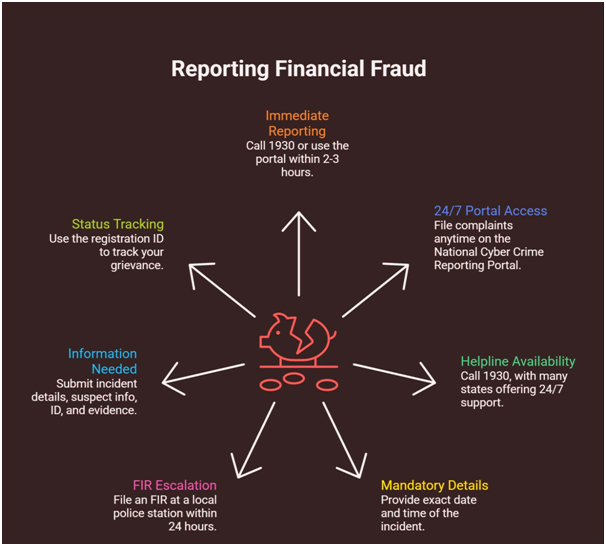
Image – Detailled Flowchart of
Reporting incident to National Cyber Crime Reporting Portal
Phase
2: Next 2–24 Hours
Do’s:
- File FIR
- Visit your local
police station and file an FIR.
- Alternatively, many
states allow online FIR for cybercrime.
- During Visit to Local
PS and filing FIR show the acknowledgement received from Cybercrime
Reporting Portal.
- Carry printed
screenshots and cybercrime.gov.in acknowledgement.
- Secure All Digital
Accounts
- Change passwords for:
- Email (Gmail/Outlook)
- All banking apps
- UPI apps (PhonePe,
Google Pay, Paytm, BHIM)
- Aadhaar, PAN,
DigiLocker
- Enable 2-Factor
Authentication (2FA) or biometric login.
- Check “Linked Devices”
and log out from unknown devices.
- Scan for Malware
- Use trusted apps like
Malwarebytes, Quick Heal, or Google Play Protect.
- Avoid using the same
phone for banking until scanned.
- Preserve Evidence
Properly
- Save everything in a
separate folder:
- Transaction SMS
- Call logs
- WhatsApp/SMS chats
- Bank statement
- UPI transaction ID
- Take photos of
everything with date & time visible.
Don’ts:
- Do not delete any message or
call record.
- Do not click any link sent
by the scammer or “helper”.
Phase
3: Follow-up & Recovery (Next 1–30 Days)
Do’s:
- Track Your Complaint
- Log into
cybercrime.gov.in regularly using your acknowledgement number.
- You can also track via
the Citizen Portal of your state cyber cell (e.g., Delhi,
Maharashtra, Karnataka have dedicated portals).
- Coordinate with Bank
- Share your cybercrime
complaint number with the bank’s fraud team.
- Banks work with NPCI
(for UPI) and RBI for fund tracing.
- Credit Freeze (if
needed)
- If large amount is
involved or identity theft suspected, contact CIBIL/Experian/Equifax to
place a fraud alert.
- Seek Legal Help (if
amount is high)
- Contact a cyber law
expert or approach consumer court / cyber cell senior officer.
Don’ts:
- Do not pay any “recovery
agent”, “ethical hacker”, or person claiming to be from “Cyber Crime
Department” who asks for money.
- Do not share your OTP,
Aadhaar, or bank details with anyone claiming to help.
Common
Recovery Timelines in India
- 0–2 hours:
Highest chance (70–90% in some UPI cases)
- 2–48 hours:
Moderate chance if money is still in mule account
- After 7 days:
Recovery becomes difficult but still possible if traced
- Many cases take 30–90 days
for full investigation
Most
Common Financial Frauds in India Right Now
- UPI QR code / number spoofing
- Fake customer care calls
- Fake investment apps (trading,
crypto, gold)
- Digital Arrest / impersonating
police
- KYC update / SIM swap fraud
- Loan app harassment
Prevention
Tips (Must Follow After Recovery)
- Never share OTP
- Verify every call by calling
official bank number yourself
- Use virtual UPI IDs instead of
phone number
- Avoid public Wi-Fi for banking
- Keep transaction limit low on UPI
- Install apps only from Play Store /
App Store
How
to Stay Safe from Financial Fraud – From Your End
Prevention
is always better than cure. Here’s a detailed, practical checklist you
can follow daily to protect yourself from UPI scams, phishing, fake calls,
investment frauds, and other common financial cybercrimes.
1.
Golden Rules – Never Break These
- Never share
your UPI PIN, OTP, password, CVV, or Aadhaar details with anyone —
not even if they claim to be from bank, police, or tech support.
- You enter UPI PIN only to send
money, never to “receive money”, “verify account”, or “update KYC”.
- Banks/RBI/NPCI never ask for
sensitive info over phone, WhatsApp, or email.
- If someone asks for your PIN/OTP →
It’s a scam. Hang up and verify directly.
2.
UPI & Banking App Safety (Most Important in India)
- Set low transaction limits
in your UPI apps (e.g., ₹5,000–10,000 per day for new contacts).
Increase only when needed.
- Use UPI Lite or wallets for
small daily payments (less risk to main bank account).
- Always verify the receiver’s
name that appears before confirming payment.
- Be extremely careful with “Collect
Request” or payment links sent by others.
- Never scan QR codes received via WhatsApp/SMS
for “receiving money” — scammers use fake ones.
- Enable transaction alerts (SMS +
app push notifications) and check them immediately.
New
RBI/NPCI Rules (2026): Many banks now have extra
verification or cooling periods for high-value or first-time large transfers.
Use this delay wisely if something feels off.
3.
Device & App Security
- Download only official apps
from Google Play Store or Apple App Store (check developer name: Google
Pay by Google, PhonePe, etc.).
- Keep your phone, apps, and OS updated
always.
- Use strong screen lock (biometric +
PIN).
- Install reputable antivirus (e.g.,
Google Play Protect, Malwarebytes).
- Avoid public Wi-Fi for banking. Use
mobile data or trusted networks.
- Never install screen-sharing apps
(TeamViewer, AnyDesk) at anyone’s request.
- Do not root/jailbreak your phone.
4.
Password & Authentication Best Practices
- Use strong, unique passwords (mix
of letters, numbers, symbols).
- Enable 2-Factor Authentication
(2FA) or biometric login everywhere.
- From 2026, many digital transactions
require mandatory two-factor authentication.
- Avoid saving passwords/card details
in browsers.
- Change passwords periodically and
after any suspected issue.
5.
Daily Habits to Avoid Scams
- Ignore unknown
calls/SMS/WhatsApp claiming issues with
your bank, KYC, PAN, Aadhaar, or promising rewards/jobs/investments.
- Verify by calling the official bank
number yourself (from bank website or passbook).
- Use Truecaller or similar to
identify suspicious numbers.
- Think twice before clicking any
link — type the official website/app directly.
- For investments: Only use
SEBI-registered platforms. High returns with “guaranteed” profit = red
flag.
- Avoid clicking “Update KYC” or
“Account Blocked” links sent unsolicited.
6.
Account Monitoring
- Check your bank statements and UPI
history regularly (at least weekly).
- Set up email/SMS alerts for every
transaction.
- If you see an unknown transaction →
Immediately block cards/UPI and report.
- Review linked devices and log out
from unknown ones.
7.
Extra Layers of Protection
- Use virtual UPI IDs (not
directly your phone number) where possible.
- Freeze UPI when not in use (option
available in many apps).
- For large amounts, use NEFT/RTGS
with extra verification instead of UPI.
- Keep a separate low-balance account
for daily UPI use.
- Educate family members (especially
elderly) about these rules.
Quick
Red Flags to Watch
- Urgency (“Act now or account will
be blocked”)
- Too-good-to-be-true offers
- Requests for remote access or
screen sharing
- Fake customer care numbers
- Unsolicited “refund” or “prize”
messages.
Pro
Tip: Pause for 30–60 seconds before approving
any payment. Scammers rely on panic and quick decisions.
Follow
these habits consistently, and your risk of falling for financial fraud drops
dramatically. Most scams succeed because people trust the wrong person or act
in a hurry.
(Tripurainfo)
more articles...