Shri LK Gupta, Former IAS — An Officer of Courage, Compassion and Inspiration
Shri Santosh Karmakar
June 6, 2026
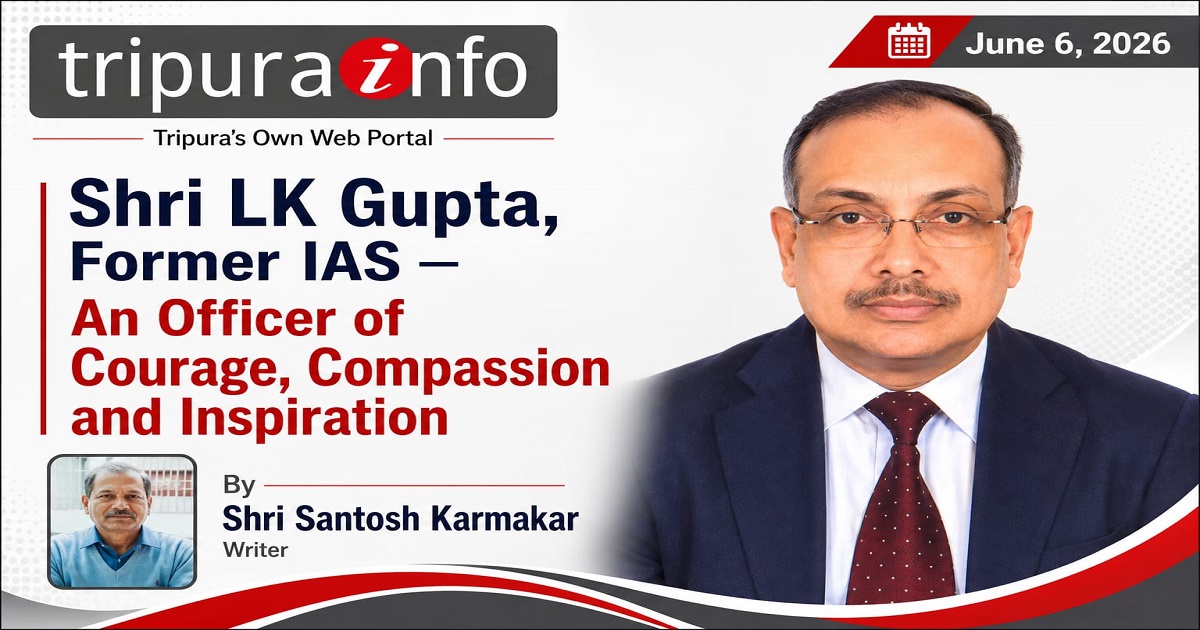
After a gap of nearly 14–15 years, Amarpur Sub-Division was fortunate to get an IAS officer as its Sub-Divisional Officer. Shri Lalit Kumar Gupta, a 1987-batch IAS officer, joined as SDO, Amarpur, in 1989. He served there till March 1991 before being promoted as ADM, South Tripura, Udaipur.
Throughout his distinguished career, except for his postings under the Government of India, he served Tripura in various important capacities. His notable assignments included Commissioner of Taxes and Excise, Director of Industries, Managing Director of TIDC, District Magistrate, Secretary of the Information & Cultural Affairs Department, Principal Secretary, Additional Chief Secretary, and ultimately Chief Secretary of Tripura.
A native of Rajasthan, Shri Gupta was a Post Graduate in Commerce and also a qualified Cost Accountant. He was widely respected for his commitment to good governance, accountability, efficiency, and result-oriented administration.
During his tenure in Amarpur, he left a lasting impact through several developmental initiatives and administrative reforms. Even today, many memorable incidents remind us of his dedication, compassion, and sense of duty.
A Humanitarian Gesture Beyond Official Duty
On 10 November 1989, at around 7 pm, the wife of Shri Harilal Debnath, Tehsildar of Ampi TK, suddenly passed away due to a heart attack. At that time, Ampi, situated about 24 km away, was not easily accessible at night. Efforts to contact the SDO through the Police Radio Station failed due to technical reasons.
With the assistance of Shri Deshbandhu Majumder, CI, and Shri Pradip Bhadra, O/C, Ampi Police Station, I managed to reach Amarpur and inform Shri Gupta about the tragedy. Finding that the regular government vehicle was unavailable, he immediately arranged his own official vehicle (TRG-844) for transporting the mortal remains to Manubazar, Sabroom, nearly 124 km away from Ampi.
His prompt and compassionate decision during a moment of grief remains one of the finest examples of humane administration that I have witnessed.
Detecting a Major Foodgrain Shortage
In 1989, a serious shortage of rice was reported at the Ampi Government Food Godown. Allegations surfaced that a substantial quantity of stock had been misappropriated.
Shri Gupta personally inspected the godown and ordered 100% physical verification through weighment. Possessing remarkable mathematical skills, he carried out the calculations himself without using a calculator. The actual shortage was detected, and appropriate punitive action followed.
It may be recalled that during those days each gunny bag contained nearly 100 kg of rice, unlike the 50 kg bags commonly used today.
Vigilance During TTAADC Election Counting
The election to the TTAADC was held on 8 July 1990, and counting took place on 10 July at Amarpur Boys Higher Secondary School.
During the counting process, attempts were reportedly made to create confusion and manipulate the tabulation. However, Shri Gupta maintained round-wise records in his personal notebook. When an error in tabulation occurred, he immediately detected it from his own calculations. Based on his meticulously maintained records, he prepared the final report and issued the certificate to the winning candidate, Shri Debabrata Koloy of Ampi.
His alertness and commitment to electoral integrity ensured that the democratic process remained fair and transparent.
Firmness with Fairness
During Durga Puja in 1990, the official vehicle of the SDO was stopped near Ampi, and Rs. 200 was forcibly collected from the driver in the name of Puja subscription.
Shri Gupta viewed the incident seriously and warned the persons concerned about its consequences. At the same time, through the intervention of local leaders, youth groups, and civil society members, the issue was resolved amicably. Ultimately, the festival was celebrated peacefully and joyfully in the area.
The incident reflected his balanced approach, firm when required, yet always supportive of social harmony.
Administrative Reforms and Development
Despite being a remote and hilly subdivision with limited economic resources, Amarpur performed remarkably well in the Small Savings Programme during his tenure and earned appreciation from higher authorities.
He also introduced practical reforms in office management. Since all government transactions were then cash-based, Thursdays were kept free from cash transactions (except emergencies) to enable proper reconciliation of accounts and maintenance of cash books. This simple but effective reform improved financial discipline in the office.
Special Concern for Tribal Welfare
Shri Gupta devoted considerable attention to the welfare of tribal communities. He extensively toured remote villages and colonies such as Palku, Changong, Malbasa, Gungia, Sorbong, and Rambhadro. Plantation activities, infrastructure development, and welfare measures received special attention under his leadership.
He also ensured efficient management of the Chakma Refugee Relief Camps located at Takumbari, Karbook, and Silachari.
Bringing Administration to the Doorstep
A firm believer in people-centric governance, Shri Gupta actively implemented the "Administration at Doorstep" programme, an initiative of the Ministry of Personnel and Public Grievances, Government of India, under the leadership of Shri P Chidambaram.
Through camps organized in rural areas, people's grievances were heard and addressed directly, making administration more accessible and responsive.
A Leader Who Shared Credit
One of Shri Gupta's most admirable qualities was his ability to recognize and appreciate the contributions of his colleagues.
When his office received a DO letter from higher authorities praising its performance, he circulated the letter among all staff members with a touching note:
"It would be very selfish on my part if I preserve the DO letter in my personal file and take the whole credit myself. The good work has been possible due to the hard work put in by the staff members of this office."
Those words reveal the character of a true leader who believed in teamwork rather than personal glory.
The incidents narrated above clearly reflect Shri LK Gupta's magnanimity, compassion, integrity, administrative acumen, and farsighted vision. Whether it was helping a bereaved family, detecting irregularities, safeguarding electoral transparency, promoting tribal welfare, or motivating his staff, he always demonstrated a rare combination of efficiency and humanity.
He was not merely an administrator; he was a public servant in the truest sense of the term, a man of duty, purpose, and compassion whose contributions continue to be remembered with respect and admiration.
I had the privilege of working under Shri LK Gupta during my tenure in the Revenue Department at Amarpur Sub-Division (1989–91), when he served as SDO, Amarpur. Later, during 1995–96, I again had the opportunity to interact with him in Dhalai District while I was posted as DC, Kamalpur.
It is worth mentioning that Shri LK Gupta was the first District Magistrate of Dhalai District after the district formally started functioning on Poila Baisakh (15 April 1995).
(Tripurainfo)
more articles...