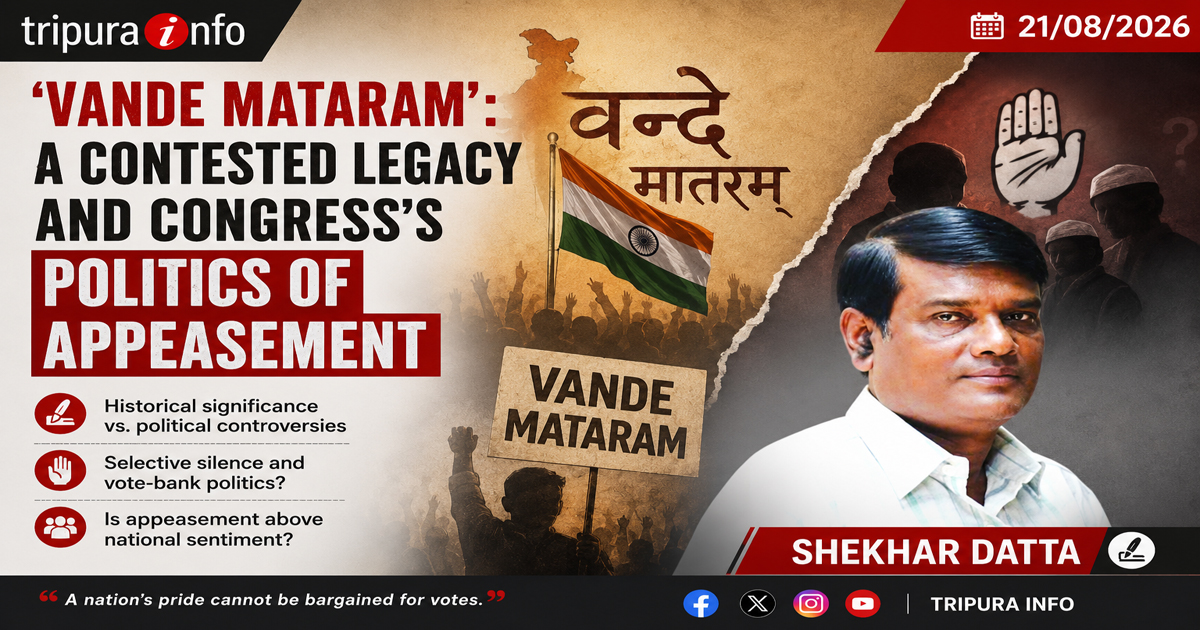
'Vande Mataram' : a contested legacy and Congress's politics of appeasement
Shekhar Datta
August 21, 2026
That history repeats itself first as tragedy and then as farce, as postulated by Karl Marx, seems now all set to come true in the case of Indian National Congress (INC) in so far as its brazen stand on the national song
'Vande Mataram' is concerned. The party leadership finally pulled the cat out of the bag on August 20, stating that only the first two supposedly secular stanzas of the animating national song will be sung by leaders and activists of the party in any assemblages, in clear defiance of the law passed by parliament last month and assented to by president Draupadi Murmu on August 11. This was however preceded by a tragic farce on August 15 when at the time of ritual flag hoisting in the party headquarter in Delhi the longest tenured president of 142 year old party, Madam Sonia Gandhi was seen gesticulating at the music troupe singing
'Vande Mataram' in chorus, apparently asking them to stop short of singing the last two stanzas objected to by Mohammed Ali Jinnah way back in 1937.
Caught red-handed in the act the Congress leadership initially tried to pass this off as Sonia Gandhi's instruction to workers to arrange a chair for octogenarian notional president Mallikarjun Kharge who finds it difficult to stand long because of his advanced age. But the prying audio-visual records made by journalists provided the clinching evidence that Sonia had actually tried to cut short the singing of the
'Vande Mataram'. Subsequent rationalization by the party leaders conveyed the all-important message that the exalted Congress leadership had been sticking to the stand taken by such late icons of freedom movement such as Mahatma Gandhi, Pandit Nehru, Sardar Patel and even Rabindra Nath Tagore.
The soul stirring
'Vande Mataram' hymn that forms part of Bengali literary doyen Rishi Bankim Chandra Chatterjee's celebrated novel
'Ananda Math' published in 1882 had caught the imagination of umpteen number of patriots and freedom fighters ever since . In fact, the movement against the partition of Bengal in 1905 that continued till the annulment of partition in 1911 had been fuelled largely by the
'Vande Mataram' that had emerged as a patriotic war cry of unity. It was only in the 12th session of Congress at Calcutta in 1896 , presided over by nationalist Muslim Rahimatullah M.Sayani (1847-1902), that the
'Vande Mataram' hymn in entirety had been sung at the beginning of the session. There was no objection from any quarter even though a large number of Muslims had attended the session and participated in the deliberations. Since then it became a tradition but a discordant note was sounded by a Muslim fundamentalist Congress leader Maulana Mohammed Ali Jawhar (1878-1931) who was Congress president for a few months in 1923. Maulana Mohammed Ali Jawhar who later became president of All India Muslim League (AIML),having played a key role in the obscurantist
'Khilafat' movement had described 'Vande Mataram' as a Hindu war cry, but the debate sparked by this died soon.
The
'Vande Mataram' had a more or less free run till the year 1937 when Mohammad Ali Jinnah looking for a viable launching pad for his ambition post-debacle in the provincial elections that year raised objections to the song on grounds of contradictions with Islamic values and ideals based on inherent opposition to idol worship. Not stopping at that, Jinnah, a new votary of communal polarization and separatism, had authored an article in a Karachi based daily detailing how singing
'Vande Mataram' was inimical to the core principles of Islam. Taken aback by devious Jinnah's new move , Pandit Nehru at the behest of Gandhi and Patel had addressed a letter to ailing nobel-laureate Rabindra Nath Tagore asking for sage advice on how best to scissor the song to appease the Muslim fundamentalist constituency. Tagore is reported to have suggested dropping the last two stanzas invoking Hindu deities from the hymn for singing on formal occasions and this was also endorsed by Maulana Abul Kalam Azad. But the surgery of
'Vande Mataram' stopped neither Muslim separatism nor partition in the end , as predicted well in advance by Tamil freedom movement stalwart C. Rajagopalachari, according to
'Vande Mataram: biography of song', a scholarly book authored by scholar Sabyasachi Bhattacharya in 2013. What is relevant to note here is that Bengali scientist Sir Jagadish Chandra Bose had opposed the truncation of
'Vande Mataram' as had stalwart intellectuals Dr Suniti Kumar Chatterjee, Dinesh Chandra Sen and Ramanuj Chatterjee who had sought a meeting with Mahatama Gandhi over the issue but that did not come off because of the Mahatma's sickness.
A bizarre phenomenon is that three oft-sung state songs in Tamil Nadu, Telengana and Karnataka also invoke Hindu deities even now but so far there has been no fundamentalist objection to this . Similarly , national anthems in as many as sixty countries including the USA contain explicit references to Gods , Almighty etc but no section of people there including Muslims have ever raised any objection to this. Veteran former Congress and then BJP leader and erstwhile governor of Bihar Md Arif Mohammed Khan, always a liberal intellectual and scholarly man, had once translated a full version of
'Vande Mataram' in Urdu and got it checked by a fellow-Muslim professor of Urdu in Delhi university . When asked if there was any thing objectionable to the contents of the song from the Islamic point of view the professor certified this as absolutely OK , leading Arif Mohammed Khan to reveal that what he had sent him for checking was the Urdu version of
'Vande Mataram' . The professor merely laughed aloud and regretted the controversy over the issue , stating the imageries of deities in the hymn should not be literally taken but should be looked upon as metaphors for glorification of the mother land . Arif Mohammed Khan disclosed this in the course of an interview in the
'India TV's popular 'Ap Ki Adalat' programme.
In fine, a celebrated sage (!) pronouncement of Christian Saint Shenoute (348-466) can be quoted here :
'There is no crime for those who have Christ'. The deranged fundamentalist Muslim clerics also appear to have reposed their diehard faith in a similar saying but how one can explain the conduct of Congress vis-a-vis the
'Vande Mataram'? In the late thirties of the last century Gandhi , Nehru, Patel had cringed before Jinnah's devious politics to preserve Indian unity but failed miserably and the present generation of Congress leaders genuflecting at the altar of pseudo secularism and appeasement politics will similarly fail to win or consolidate vote banks with fake gestures. Substance in politics is much more important than contrived symbols at the cost of national interest.
(Tripurainfo)
more articles...