Media in India : From guardianship to second-fiddling to political parties and leaders
Shekhar Datta
May 22, 2026
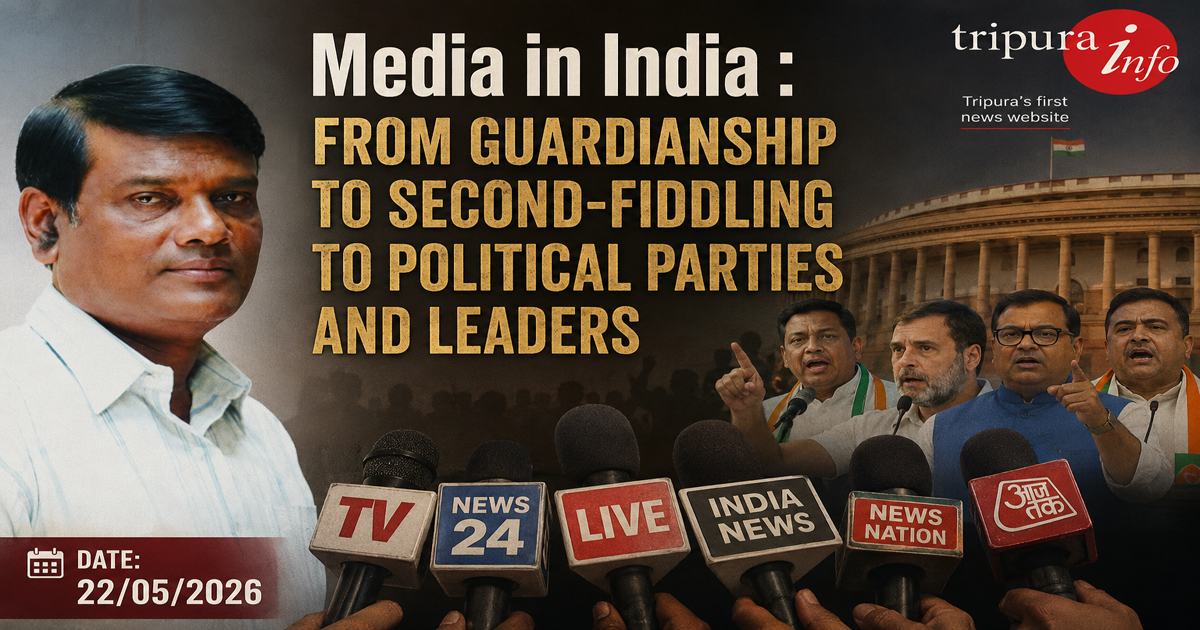
Celebrated British parliamentarian and essayist Edmund Burke (1729-1797) had described the press-the holistic term media was not in circulation in remote eighteenth century-as the proverbial 4th estate or pillar of democracy during his speech in British parliament in 1771 on reconciliation with then rebellious British colonies in the United States of America. Burke’s view of media was reinforced by Czech-born British playwright and screen writer Tom Stoppard (1937-2025) who said “.. if your aim is to change the world , journalism is a more immediate short-term weapon”. This is borne out in retrospect by the role of weekly ‘Iskra’ (flame) in moulding public opinion by the communist Bolshevik party in the run-up to the epoch-making Russian revolution of 1917 and earlier the writings of French philosophers before the French revolutions of 1789, 1830 and 1848.
But history apart , pivotal role of print media-there was no online or electronic media then-in fuelling national opinion in India in the struggle against the colonial British government now forms part of well recorded history . Late doyen of Indian journalism and editorship , Durgadas Khullar’s seminal work ‘India from Curzon to Nehru and after’ is a testimony to the role of journalism in Indian freedom movement. The market , of course, abounds with other authentic works on the crucial subject.
But in the present age of decline and fall from grace, Indian journalism or, inter alia, role of media in shaping public opinion or in diffusion of ideas, specially after the advent of electronics and online media raise serious questions on the efficacy or plain utility of journalism in mobilising public opinion. The ubiquitous dominance of social media that has given voice to the till now voiceless is one reason why the very role of conventional media is now in question while huge investments required for launching and sustaining media platforms without official favour is another potent reason for the declining standards of media across India. What worsens the situation is ideological predilections and political prejudice that hit one more nail on the credibility of the media across the country.
The point must be buttressed by practical examples that are found aplenty across the country but one has to be selective in illustrating the point for the sake of clarity and brevity. Almost the entire media world in West Bengal had been singing paeans as a matter of daily ritual to the disastrous government led by Mamata Banerjee in West Bengal for long fifteen years with a little exception of one Bengali daily that would print news based on gory reality in the lowest corner of eighth column on the last page . There was a definite context to this as the Editor of that vernacular daily had been falsely implicated by Mamata in a plethora of false cases and the newspaper’s bills worth crores had been held up over and above denial of possession of a costly plot of land won through litigation in supreme court. But come the crucial day of May 4 and all the six major Bengali and English dailies as well as TV channels effected a volte face and from the very next day the victorious BJP emerged as the new icon of worship to the print and electronic media in West Bengal.
But this is no case in isolation : actually the advent of expensive electronics and online media platforms in a big way from the onset of the first decade of this century had ushered in the process of media’s second-fiddling to the establishment. The NDTV owned and managed earlier by Pranay Roy had been inaugurated in the office of then prime minister Dr Manmohan Singh and the newly introduced channel had all along been beneficiaries of governmental bounties . So much so that top journalists of the channel had a booming private practice in the form of lobbying on behalf of ambitious politicians seeking ministerial berths or businessmen on the look out for illegal favours. Anecdotal proofs dug out of the past firmly establish the fact that NDTV journalists were taken on foreign tour of Dr Manmohan Singh in Iran in the garb of diplomatic officials.
The channel’s espousal of secularism was so great that at one stage the chief editor Pranay Roy had condescended to invite and speak live to superstar Amitabh Bachhan for the cardinal sin he had committed by meeting then Gujrat chief minister Narendra Modi and by agreeing to become the brand ambassador of Gujrat tourism in lieu of a favour in the form of exemption from amusement tax on his film ‘Paa’. Another NDTV journalist- a lady at that-had tried to seek an explanation from film star Salman Khan who had befriended Modi and flown kites with him during a promotion visit to Gujrat. Salman , of course , cared little for niceties and snubbed the charlatan lady anchor, unequivocally asserting that it was his personal matter and relationship and media had no right to encroach on his personal domain.
The same charlatan lady journalist , reputed to be an expert private practitioner, was also snubbed by British labour party leader Barry Gardiner . Intrusively queried by the journalist why the labour party had invited Narendra Modi to a programme in London, Gardiner explained that Modi was the elected chief minister of Gujrat which was an important state from British perspective as 50% of British investment in India was in Gujrat till then. But the lady persisted , raising questions of morality in the context of Gujrat riots of 2002 and then came the roaring repartee : You seem to have no respect for the highest court in your country , the supreme court which never found any fault with Modi . The programme was cut off abruptly but the charlatan lady anchor who is now neither visible nor voluble had been outdone by another hyper-secular lady colleague who used to visit Kashmir on regular basis to sympathise with paid and injured stone-pelters on Indian army personnel and had also earned the dubious distinction of being certified as fellow-traveller by UN-designated Pakistani terrorist, the infamous Hafiz Syed. But India has been rid of the contrived antics and verbal diarrhoea of the NDTV stars after the tectonic shift in political power in India in 2014 and , finally, following the acquisition of the channel by Gautam Adani two years ago.
During that period there were channels and print media outlets that would focus more on public interest in keeping with professional ethics and they had to pay a price for this as a natural corollary. Several senior editors of TV channels had been silenced in media briefings held by then prime minister Dr Manmohan Singh. A section of delusional media persons , deprived of opportunities for private practice and pretending to have ideological convictions based on twisted interpretations of so-called secularism, opened new fronts by launching channels to dish out tweaked versions of news and jaundiced views of issues to the public through websites that receive liberal foreign funding-either from China, US deep state or the infamous George Soros. The multiple channel owners have adopted a comical strategy : they keep one or two channels reserved as ruling party’s propaganda machine while giving marginal leeway to one or two for striking discordant notes on specific issues . Perhaps there is no alternative either, as dependence on governmental favour has reached such high levels that the owners of print and electronics media must always remain on toes. Perhaps embittered by his experiences with media, the incumbent prime minister Narendra Modi who had been eminently media-friendly till the year 2005 changed tack and has not held a single open press conference since then. It is only when individual media houses seek interviews that the prime minister obliges in his office on the basis of pre-submitted questionnaire which , of course, has always been the standing norm followed by high dignitaries across the world.
The scenario in Tripura in this regard reflects the reality at the national level , at least since the year 2018. Till then the media comprising newspapers , channels and a few online outlets had been relatively free in coverage of events , individuals and institutions but the scenario tangibly changed once personal ambitions and lure of prosperity stole a march over professional commitments and morality . This is perhaps in consonance with the spirit of the time but any positive change or revival of the good old days when high office holders would assess media’s views before taking crucial decisions seems unlikely in the epicurean world of relentless pursuit of power and pelf. Media now performs the role merely of an appendage and an alteration in the definition of press or media at large now seems in order .
(Tripurainfo)
more articles...