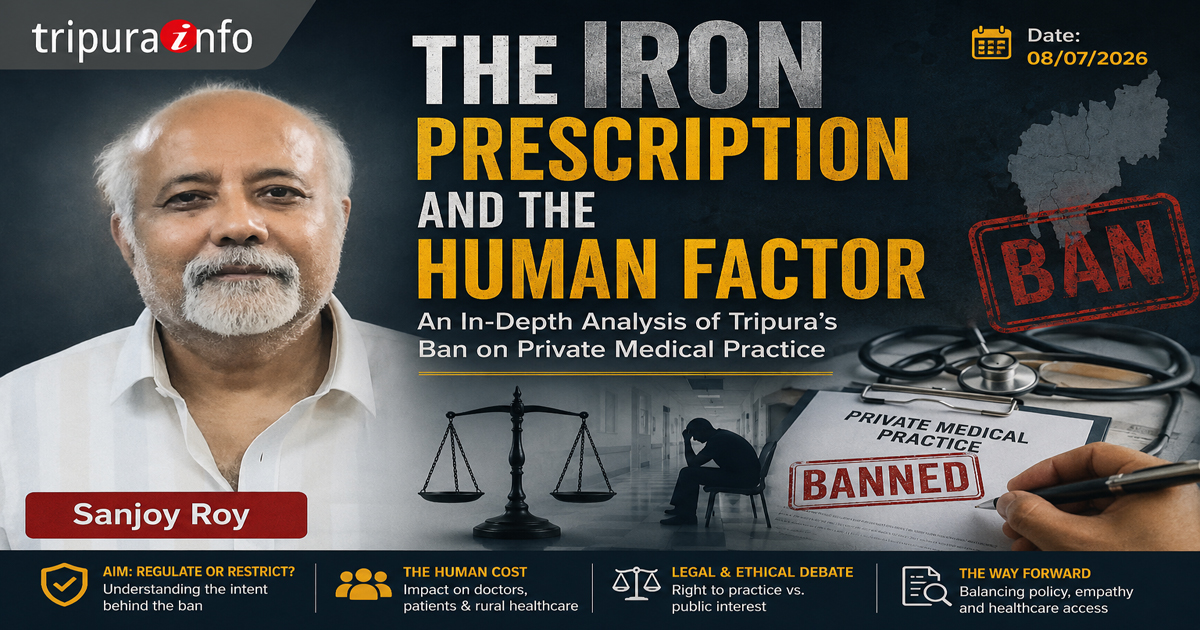
The Iron Prescription and the Human Factor: An In-Depth Analysis of Tripura’s Ban on Private Medical Practice
Sanjoy Roy
July 8, 2026
The Government of Tripura’s decision
to prohibit private medical practice for faculty members and medical officers
attached to the Agartala Government Medical College (AGMC) and the Govind
Ballabh Pant (GBP) Hospital represents a structural shift in the state's social
sector infrastructure. Accompanied by a 20 percent Non-Practicing Allowance
(NPA) calculated on basic pay, this policy aims at dismantling a long-tolerated
dual system where public doctors split their time, energy, and professional
focus between state-run facilities and private commercial chambers. In theory,
the mission of the government is noble, necessary, and patient-centric. It
asserts a fundamental moral contract: that public health infrastructure, funded
by the public exchequer, must exist exclusively for the welfare of the
citizens-particularly the underprivileged, elderly, pregnant women, and rural
patients who flock to premier referral hospitals with nothing but pain and
hope.
However, as the implementation of
this historic cabinet decision unfolded, a stark reality emerged. An
institutional reform of this magnitude cannot be executed purely through
administrative mandates or legal power. The initial rollout exposed a profound
friction between a rigid bureaucracy and the deeply sensitive human dynamics of
the medical profession. The latest development-where the Medical College
Teachers' Forum has reversed its initial stance and resolved to resume private
practice until a comprehensive, formal statutory notification is officially
published-further highlights a tactical standoff. This essay examines the
complexities of the private practice ban, the friction between mandated
bureaucracy and political statesmanship, the public fallout, and the ultimate
necessity of placing the human factor at the center of institutional change.
1. The Nobility
of the Mission and the Pitfall of Bureaucratic Leverage
The underlying intent of the Tripura
government is rooted in an undeniable public need. For decades, the public
healthcare delivery system has been weakened by an inherent structural flaw:
specialized doctors frequently diverted their peak professional attention to
private evening clinics. This divided professional attitude led to systemic
issues, including high absenteeism, prolonged patient waiting times, and a
growing public perception that public hospitals were merely feeder routes to
private consultations. To rectify this, the state government utilized
considerable policy ammunition. The cabinet drew upon recommendations from a
prestigious AIIMS New Delhi delegation which advised a complete prohibition on
private practice to elevate AGMC into a "Centre of Excellence".
Furthermore, the state aligned its financial compensation package with national
models, offering a 20 percent salary-linked allowance while permitting Dearness
Allowance calculations on both basic pay and NPA.
Yet, despite the validity of the
policy, the initial execution suffered from a severe lack of emotional
intelligence. Buoyed by the legal and administrative power at their disposal,
high-ranking officials approached the transition with a mechanical mindset.
They operated under the assumption that all government employees are uniform,
interchangeable parts of a state machine, ignoring the reality that medical
treatment is not a standard corporate job but a deeply human service.
The public rhetoric from the health
bureaucracy quickly gave way to an underlying ideological friction. When senior
administrative figures addressed the media, they displayed an administrative
desperateness that deeply unsettled the medical community. Issuing rigid,
top-down ultimatums-such as explicitly stating that doctors who disagreed with
the new service terms are "free to resign"-served to alienate the
very individuals needed to make the reform a success. This heavy-handed display
of state power lacked the restraint required when managing a highly
specialized, intellectual workforce. It reduced a complex ethical transition
into an adversarial struggle, causing immediate resentment among senior
clinicians and medical educators.
2.
Understanding the Doctor as a Human Being: Beyond Coercion
To evaluate this controversy fairly,
one must admit a fundamental truth: doctors are human beings before they are
civil servants. The medical profession demands a matchless level of sincerity,
dedication, and personal commitment. Healthcare professionals routinely
sacrifice their personal lives, working grueling hours under high-stress
conditions to preserve human life. Because of the intense nature of their work,
doctors naturally seek genuine recognition, emotional dignity, financial
security, and a respected status within society.
When an administration handles a
delicate transition with rigid authoritarianism, it strips away the
professional dignity of its healthcare workforce. The Superspeciality Doctors’
Forum flagged the government’s tone as "demeaning and disrespectful to the
profession". In their formal representations, these specialists pointed
out that many had joined government service years prior, under a clear,
good-faith understanding that private practice was permitted. Altering these
terms unilaterally, without empathetic dialogue, shattered professional trust.
Furthermore, the blanket approach
adopted by the bureaucracy failed to recognize that the problem of highly
commercialized private practice was not universal. While this specific group
stood to lose a handsome parallel income, the rhetoric of the administration
penalized the entire medical fraternity indiscriminately. Rather than
introducing a nuanced, dignified mechanism-such as a voluntary "opt-in
versus opt-out" model—the administration used a blunt instrument to
enforce compliance, forgetting that while the state may own the physical
hospital buildings, it does not own the intrinsic dedication of the doctors
working inside them.
3. The Medical
Fraternity's Fragmented Stand and Systemic Deficiencies
The lack of a collaborative approach
from the outset resulted in a fractured response within the state’s medical
community, revealing long-standing institutional grievances:
- The AGMC Teachers' Forum: Initially chose a path of
public compliance, announcing that its members would respect the cabinet's
decision and temporarily discontinued private chambers out of respect for
public health interests. However, their compliance came with a firm demand
for long-delayed structural reforms. The forum highlighted that the
Tripura Medical Education Service Rules had remained stagnant since 2010,
resulting in delayed promotions and severe career stagnation for medical teachers.
They pointed out a glaring financial anomaly: newly appointed assistant
professors at AGMC frequently received salaries lower than senior
residents in other parts of India. For these educators, private practice
had been a necessary economic buffer against an inadequate state pay
structure. They maintained that private practice was not the primary
driver of institutional absenteeism, and urged the state to implement
time-bound promotions and adjust salaries to modern standards alongside
the 20 percent NPA. However, noting that the administration had failed to
issue a formal statutory notification, the Forum eventually reversed its
stance and resumed interim practice to protect chronic patients from an
artificial crisis.
- The Superspeciality Doctors' Forum: In contrast, the
super-specialists stood in firm opposition to the blanket ban in its
present form. They argued that banning private practice in isolation would
do absolutely nothing to improve the state's healthcare standards unless
the government simultaneously resolved the systemic deficiencies plaguing
public hospitals. The super-specialists comprehensively highlighted a
detailed series of chronic issues: acute manpower shortages (a critical
deficit of specialists, residents, and nurses), infrastructure gaps in
ICUs and operating theatres, and poor equipment upkeep (such as vital
machinery in the state cancer hospital remaining non-functional for
months). They argued that without correcting these foundational flaws,
forcing doctors to stay in under-equipped hospitals for longer hours would
only increase systemic frustration without yielding better patient
outcomes.
4. Ground-Level
Fallout and the Ammunition of the Opposition
When the ban was initially pushed,
private clinics faced sudden closure, and the immediate consequences fell
squarely on the public hospital infrastructure. Lacking a phased transition, an
unprecedented wave of patients redirected from private chambers directly into
state-run facilities. The resulting scene, for example, at the GBP Hospital’s
Gynecology and Obstetrics OPD highlighted the hazards of rushed administrative
execution. Patient turnout increased multi-fold, causing massive overcrowding.
Expectant mothers, many in advanced stages of pregnancy, were forced to stand
in long queues for hours in stifling heat and extreme humidity. The physical
infrastructure-characterized by inadequate seating, poor ventilation, and a
pungent atmosphere-was overwhelmed by the sudden influx. While the closure of
private clinics was designed to protect the poor, the immediate administrative
bottleneck subjected vulnerable patients to severe discomfort.
This immediate crisis provided the
political opposition with significant leverage. Senior political figures
labeled the public hospital conditions "abnormal" and urged an
immediate re-evaluation of the ban to match the state’s ground realities.
Former administrators and opposition MLAs criticized the move as
"unrealistic," arguing that the state could not mechanically compel
specialized professionals beyond their standard routines without expecting a
severe brain drain. They suggested that instead of an outright ban, the state
should have introduced an institutional model utilized successfully elsewhere:
establishing regulated, paid evening specialist clinics within the government
hospital premises to generate revenue and keep specialists on-site.
Concurrently, leaders of the opposition warned that the strict policy would
discourage outside specialists from joining the state's medical framework.
5. Political
Recalibration: Statesmanship Replaces Confrontation
As public dissatisfaction brewed,
and the threat of a prolonged medical standoff loomed large, the Chief Minister
demonstrated essential political acumen and restraint. Recognizing that the unyielding
posture of the bureaucracy was driving the state toward an administrative
dead-end, the leadership stepped in to de-escalate the tension and steer the
narrative away from confrontation. As an experienced medical professional, the
Chief Minister understood both sides of the issue: the patient waiting in the
crowded corridor and the professional dignity of the practitioner. When
addressing the medical fraternity at a state function, the Chief Minister
noticeably toned down the aggressive rhetoric of his administrators. He did not
utilize the administrative ammunition of threats or forced resignations;
instead, he spoke with politeness, clarity, and respect.
While standing firm on the cabinet's
core decision to maintain the ban, the leadership actively sought the
cooperation and goodwill of the doctors as a community. The Chief Minister
addressed their anxieties regarding career progression by revealing that the
state had appointed a retired High Court judge to review and regularize the
promotion framework, replacing ad hoc systems with a transparent path forward.
Crucially, the leadership acknowledged that the definitive statutory
notification had not yet been issued, explicitly stating that the state wants
doctors to be satisfied with the legal conditions before locking them in. By
appealing to the medical community's sense of public service while protecting
their welfare, the Chief Minister successfully bridged the trust deficit
created by his bureaucratic subordinates.
6. The Path
Forward: Balancing Steel with Empathy
The ongoing healthcare transition in
Tripura offers a profound lesson for governance: institutional reform cannot
succeed through coercion alone. Power must always be balanced with empathy. In
response to the initial operational bottlenecks and following the leadership's
intervention, the Health Secretary conducted an extensive review of hospital
facilities. This ground-level audit resulted in the creation of additional OPD
registration counters, expanded seating areas, and better basic amenities like
fans and drinking water for expectant mothers.
To ensure the long-term success of
this reform, the state must transition from immediate crisis management to a
sustainable, four-track development plan:
Four-Track Reform Strategy for
Tripura Healthcare
|
Strategy Track
|
Focus area and Action items
|
Target outcomes
|
|
1. Facility
Expansion
|
Upgrade
AGMC and GBP Hospital capacity to 1,413+ beds.
|
Accommodate
the massive redirect of public patients.
|
|
2.
Active
Recruitment
|
Launch
mission-mode hiring of specialized doctors, residents, and technicians.
|
Eliminate
chronic clinical manpower shortages.
|
|
3. Infrastructure
Upkeep
|
Maintain
fully functional Operating Theatres, ICUs, and advanced cancer diagnostic
labs etc.
|
Ensure
doctors have tools to match their clinical hours.
|
|
4. Human
Dignity
|
Enact
fair, transparent promotions and modernized career service rules
|
Resolve
stagnation and restore professional trust.
|
The state has already made notable
progress by doubling the bed capacity at AGMC and GBP Hospital to 1,413 beds,
initiating a 100-bed tertiary eye care hospital, and establishing the Tripura
University of Health Sciences. However, these physical structures must be
supported by a motivated workforce.
Conclusion: The
Final Word
Ultimately, public healthcare is
defined by its human component. The state government possesses the legal
authority and the policy ammunition to enforce its mandates. However, as the Chief
Minister noted by quoting a historic principle, "the people are the final
word". In a public service framework, "the people" includes both
the vulnerable patients seeking care and the dedicated medical professionals
providing it.
For Tripura's private practice ban
to achieve its potential as a public health revolution, the bureaucracy must
abandon authoritative ultimatums and sustain the collaborative, respectful
approach modeled by the Chief Minister. The recent decision by the Teachers'
Forum to resume interim private practice due to the non-issuance of the
notification proves that a verbal announcement cannot substitute for systematic
administrative drafting. It highlights that when an administration bypasses
meticulous groundwork, the resulting operational gaps inadvertently compel a
retreat to the status quo. Iron implementation is necessary to maintain
institutional discipline, but it must be accompanied by a commitment to
professional dignity and administrative precision. The true success of this policy
will not be measured by the strictness of its announcement, but by the
government's ability to build a healthcare system where patient welfare and
professional respect exist in harmony.
(Tripurainfo)
more articles...