Somnath Swabhiman Parv: Thousand Years of Unbroken Faith
Prof. (Dr.) Manik Saha Chief Minister, Tripura
May 10, 2026
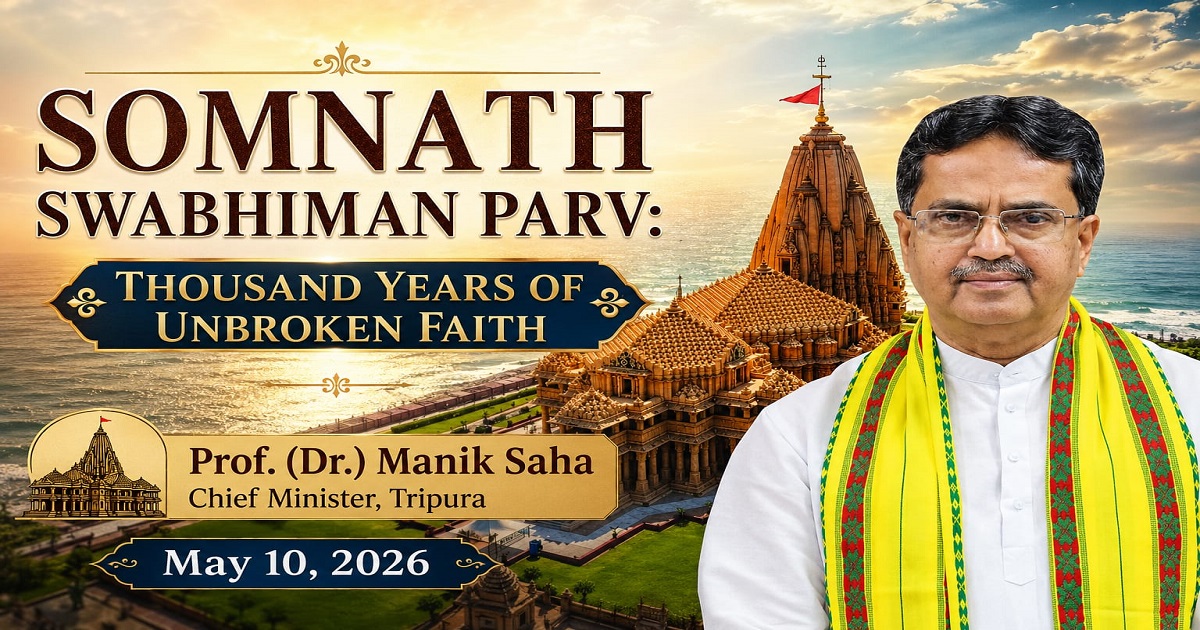
The Somnath temple, revered centre of Shiva shrine stood as an enduring symbol of cultural resilience and indomitable faith. Opening verse of the Dwadasha Jyotirlinga Stotram places Somnath at the very beginning of the twelve sacred Jyotirlingas, signifying its place in India's spiritual- heritage. It reflects the belief that Somnath is the foundation of Bharat's spiritual geography. Located at Prabhas Patan near Veraval in Gujarat, Somnath is not merely a place of worship but a living symbol of India's civilisational continuity.
Presently Somnath temple complex comprises of the Garbhagriha, Sabhamandap and Nrityamandap rising majestically alongside the Arabian Sea. The temple is crowned by a 150- foot Shikhar, with a 10-tonne Kalash at its summit. The Dhwajdand marks the temple's unwavering identity symbolising generations of devotion and craftsmanship.
The historical roots of Somnath extend deep into ancient Indian tradition. Prabhas Tirtha, where temple is located, is associated with Lord Shiva and the worship performed by Chandra, the Moon God. According to tradition, Chandra worshipped Lord Shiva here and was relieved of his curse, giving the site immense spiritual significance. Over the ages, Somnath drew the reverence and prayers of millions.
Over centuries, Somnath witnessed multiple phases of construction, each reflecting the devotion, artistry and resources of its time. Ancient accounts describe successive temples being built here, using different materials, symbolising renewal and continuity. The most turbulent phase of Somnath's history began in January 1026, when Somnath faced its first recorded attack by Mahmud of Ghazni. This marked the beginning of a long period during which the temple was repeatedly destroyed and rebuilt over the centuries. Despite this, Somnath never ceased to exist in the collective consciousness of the people. The cycle of the temple's devastation and revival is unparalleled in world history. It demonstrates that Somnath was never merely a structure of stone, but a living embodiment of belief, identity and pride. Somnath was repeatedly targeted by invaders whose objective was demolition rather than devotion. Yet Somnath's story is defined by the indomitable courage, faith and each time the temple was rebuilt through the collective resolve of devotees like Devi Ahilya Bai Holkar. This unbroken cycle of revival has made Somnath a powerful symbol of courage, faith & continuity.
On 12 November 1947, Sardar Vallabhbhai Patel visited the ruins of Somnath and expressed his determination to rebuild the temple. His vision was rooted in the belief that the restoration of Somnath was essential to restoring India's cultural confidence. The reconstruction was undertaken with public participation and national resolve. The present temple, built in the Kailash Mahameru Prasad architectural style, was consecrated on 11 May 1951 in the presence of the then Hon'ble President Dr. Rajendra Prasad. The ceremony marked not just the reopening of a temple, but the reaffirmation of self-respect of every Indian.
Marking 50 years since the rebuilt Somnath Temple was reopened in the year 1951 programme was held on 31 October 2001. The occasion highlighted the pivotal role played by Sardar Vallabhbhai Patel, K. M. Munshi and several others in the reconstruction of the temple. The programme also coincided with the 125th birth anniversary of Sardar Vallabhbhai Patel and was attended by the then Hon'ble Prime Minister Atal Bihari Vajpayeeji, the then Hon'ble Home Minister Lal Krishna Advaniji, and the then Hon'ble Chief Minister of Gujrat Narendra Modiji with other dignitaries.
The year 2026 marks the completion of 1000 years since the first attack on Somnath in 1026, as well as 75 years of the reconstruction and inauguration of the temple in independent India in May 1951.Somnath Swabhiman Parv 1000 Years of Unbroken Faith (Atoot Aastha) was organized at Somnath from 8th to 11th January 2026 in the august presence of Hon'ble Prime Minister as Chief Guest.
National Implementation Committee under the Chairmanship of Hon'ble Union Home Minister Amit Shahji on 16th January 2026 resolved that Somnath Swabhiman Parv-1000 Years of Unbroken Faith (Atoot Aastha) is to be organised as a yearlong national commemoration for the period 11th January 2026 to 11th January 2027.The commemoration is envisaged around two key pillars, namely Yatras and Events, to ensure nationwide outreach as well as participation of pilgrims and devotees from all sections of society with activities across all the Shivalayas from Block and Tehsil levels up to District and State levels through devotional, cultural and community-based programmes ensuring high public outreach.
A major component is the organisation of 12 major yatras over 12 months commencing from Jyotirlinga States and associated cluster States/UTs, so that every part of the country is meaningfully connected with the campaign. Universities and educational institutions will be coordinated for organising Somnath Samvad Dialogues and related campus outreach activities, including seminars, cultural programmes to wide-based youth engagement during celebration of Parv. National programme is being held from 8th May to 11th May, 2026 in Shri Somnath Temple Complex with key activities like Kalash Yatra, Bhajan Sandhya, chanting of Omkar Mantra, Mantra writing in the Somnath booklet, narration of Stories associated with Somnath.
State of Tripura is also going to participate in the event with its high devotional spirit, cultural potential and legacy. On 11th May, 2026 programmes will be held across the State where with all other key activities screening/ telecast of the live event from Somnath will be arranged.
Shri Somnath Trust under the chairmanship of Yashasvi Pradhanmantri Narendra Modiji set a new phase of revival of the temple. Governance reforms, infrastructure upgrades and heritage preservation efforts have strengthened the temple's role as a spiritual and cultural centre. Declared a 'Swachh Iconic Place' in 2018, Somnath has adopted innovative sustainability practices. Somnath has also emerged as a strong centre of women empowerment.
Union Government under the visionary leadership of Yashasvi Pradhanmantri Narendra Modi ji focuses on promoting history, tradition, and culture through an ideology of cultural nationalism and integral humanism, aiming to redefine India's identity by emphasizing its roots and indigenous traditions. His vision of 'Vikas Bhi, Virasat Bhi' is to promote an inclusive vision of nation-building, where rapid economic and infrastructural development is harmonized with the conservation of India's centuries-old heritage—be it monuments, traditions, languages, art, or indigenous knowledge systems. This approach ensures that as India moves forward on the path of modernization, it does not lose sight of its cultural identity, legacy, and the historical values that define its soul. This approach seeks to strengthen our roots by emphasizing Indian traditions, history, literature, and arts. The 'glorious heritage' of India remained a central theme of governance. Standing on the shores of Saurashtra, the Somnath Temple continues to inspire Indians all over the world.
(Tripurainfo)
more articles...