Nandantrisha's Jatra Weaves Mythology with Tripura's History
Prasanta Chakraborty
November 14, 2026
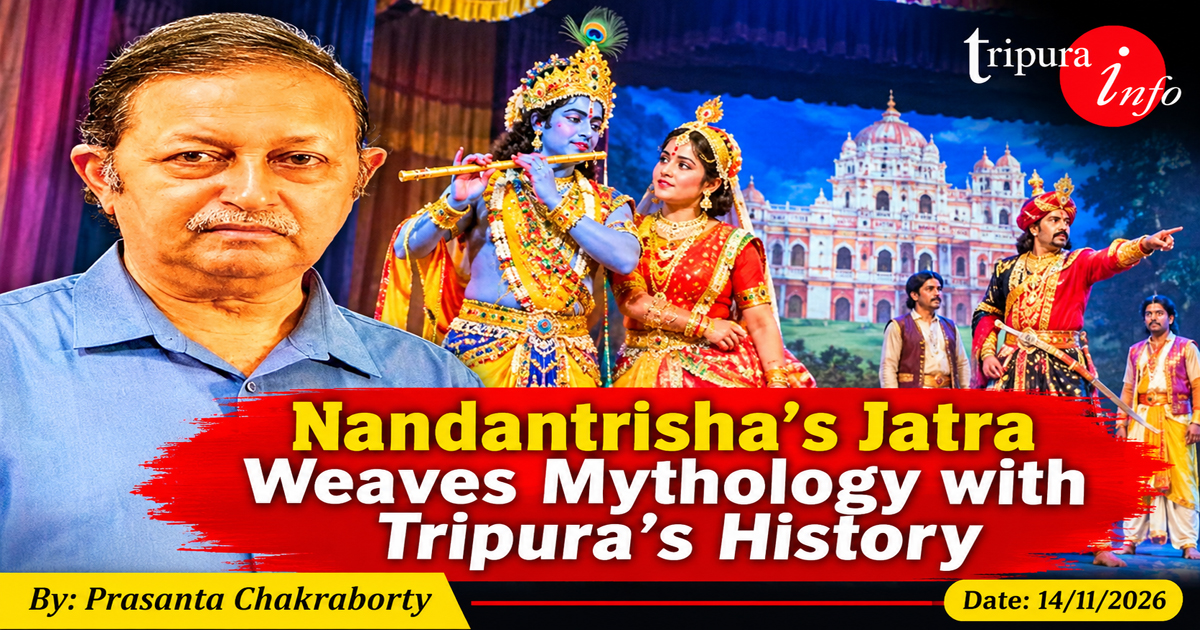
Nandantrisha staged Jatra Sati Onge Ma Tripureswari at MuktoDhara Auditorium on November 12, presenting an interesting blend of mythology, history and religious belief. The production traces the story of Goddess Sati while seeking to connect the larger Shakti tradition with the religious heritage of Tripura.
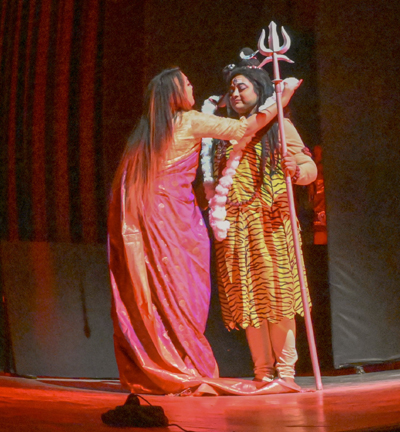
The Jatra opens with the familiar Puranic legend of Sati and Lord Shiva. King Daksha, pleased with his intense meditation, receives a boon that Mahamaya will be born into his family. She is subsequently born as Sati, who grows up and marries Shiva against her father's wishes.
Daksha's opposition stems partly from Shiva's unconventional lifestyle. An ascetic who frequents cremation grounds and lives in the company of Nandi, Bhringi and other unusual companions, Shiva hardly fits the image of a suitable son-in-law in the eyes of the proud king. Daksha's resentment is further deepened by an earlier incident in which Shiva refuses to rise in respect when the king enters an assembly. Unable to accept what he considers an insult to his royal status, Daksha becomes increasingly hostile towards his daughter and son-in-law.
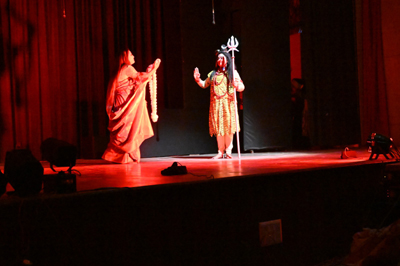 The conflict reaches its climax when Daksha organises a grand yajna without inviting Sati and Shiva. On learning about the ceremony from Narada, Sati decides to visit her father's palace despite having received no invitation. But the humiliation and disrespect directed at her husband prove unbearable. She plunges into the sacrificial fire and dies.
Sati's death leaves Shiva devastated and furious. Carrying her lifeless body on his shoulders, he begins a destructive journey that threatens the very existence of the universe. Alarmed by the situation, the gods seek Vishnu's intervention. Vishnu uses his Sudarshan Chakra to dismember Sati's body, and the places where the different parts fall become sacred centres of worship, traditionally recognised as the fifty-one Shakti Peethas.
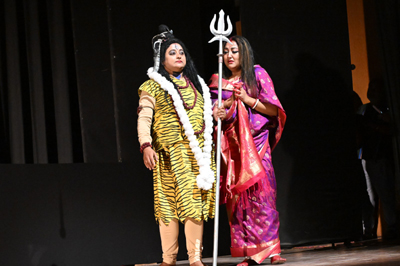 From this mythological account, the production moves to a significant chapter in Tripura's history—the establishment of the Tripureswari temple under the patronage of Maharaja Dhanya Manikya. This transition gives the Jatra a distinctly regional dimension, linking the pan-Indian Shakti tradition with Tripura's religious heritage.
The narrative takes another interesting turn when Goddess Kali appears before her devotees in the guise of a poor beggar. Her seemingly irrelevant conversations with the disciples initially leave them puzzled. Eventually, however, she reveals her divine identity, making them realise that Tarini and Mata Tripureswari are manifestations of the same supreme power.
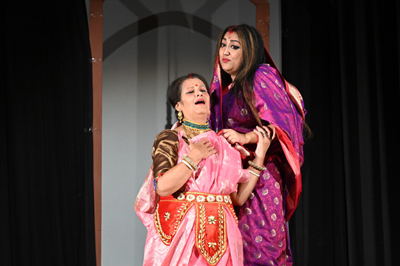 The production thus attempts to bring mythology, local history and spiritual belief into a common narrative, placing the Tripureswari temple at the centre of Tripura's enduring religious tradition.
The character of King Daksha has a striking contemporary relevance. His arrogance and authoritarian attitude bring to mind the rulers of our times, who approach citizens with folded hands seeking their votes but, once in power, often behave like autocrats, showing little concern for public welfare or even the well-being of Mother Earth. The Jatra also conveys a larger moral message: God resides in human beings, and serving humanity is, in essence, serving the Almighty. The opposition of Daksha in the marriage of his daughter with a vagabond is symptomatic of the modern-day generation that opposes any marital relationship between socially and financially high and low families.
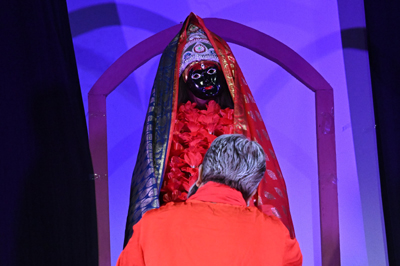 The musical arrangements are among the positive features of the production. The background music is well suited to the situations, while the songs complement the narrative and add to its emotional appeal. The lighting, however, is somewhat uneven. Although coloured lights effectively enhance certain dramatic moments, particularly during the encounters between Devi and her father or husband, the occasional circular movement of the lights appears distracting and lacks proper focus. Greater precision in their use could have strengthened the visual impact.
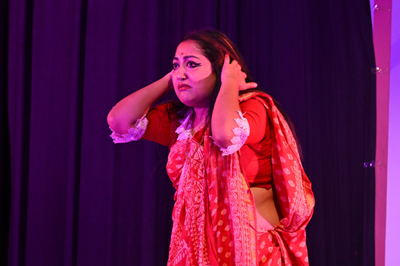
The performances are, by and large, impressive. Dr Olivia Sarkar in her role as Tarini , Solanki Banerjee as Ma Tripureswari and Samir Dutta as Dakhsharaj and a disciple are particularly noteworthy. Jaishankar Bhattacharjee, playing Nandi and Kala Khan, deserves special mention for his performance. Jay Dutta as Thakur, Sameer Debnath as Bhola, Shyamal Kanti Dey as Brahma and Sambhu, and Abhijit Gope as Dharma and Yadab also handle their respective roles with confidence.
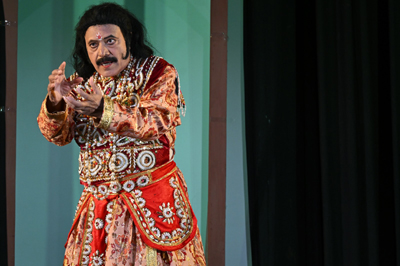 Pradip Debnath, in the dual roles of Narada and Disciple, Subhasis Gupta as Daitya Narayan and Birbhadra, Monoranjan Das as Bhringi and Purohit, and Somyodeep Choudhury as Narayan and Maharaja Dhanya Manikya make their presence felt. Other performers include Saikat Sasha as Raikojak and Villagers, Mrinal Pal as Bhrigu and Keshaba, Bipradeep Paul as Child Dhanya, Soma Nandy as Shiva, Susmita Dhar as Radha, and Poushali Bhattacharjee as Kamala and Disciple. They all contribute to the overall presentation.
 The production also benefits from the efforts of its technical team. Mrinal Chatterjee handled the lighting, while the Nandy trio—Soumendra, Soumyajit and Subhrajit—provided the background music. Udaysankar Bhattacharjee deserves appreciation for his effective anchoring. The costumes, designed by Nataraj Poshakalaya, and the make-up by Dakshina Ranjan Dev add authenticity to the characters. Sisir Kar was responsible for sound, while Rajesh Kanti Saha designed the stage appropriately. Dr Swapna Datta provided assistance in the production.
 Nevertheless, the Jatra has considerable scope for improvement. Its duration is rather long and may test the patience of today's audience. The introduction of a chorus or a Vivek could make the presentation more engaging. Instead of depending heavily on visual sequences to convey information, the production could use dialogues and songs through the chorus or Vivek to explain developments and establish connections between different episodes. Some words and expressions used in particular dialogues also deserve reconsideration. At times, the dialogues were not clearly audible, indicating the need for better sound projection and amplification.
More importantly, the production could have explored contemporary social problems through its religious narrative. Rather than remaining largely confined to mythology and religious beliefs, it could use religion as a backdrop to highlight issues confronting society today. Such an approach would make the Jatra more relevant and appealing to a wider audience.
Overall, Jatra Sati Onge Ma Tripureswari is an earnest attempt to combine mythology with Tripura's historical and religious heritage. Despite some shortcomings in presentation and duration, the production has its moments of dramatic appeal. A little trimming, sharper dialogues, more disciplined lighting and greater engagement with contemporary realities could make it a considerably more compelling theatrical experience.
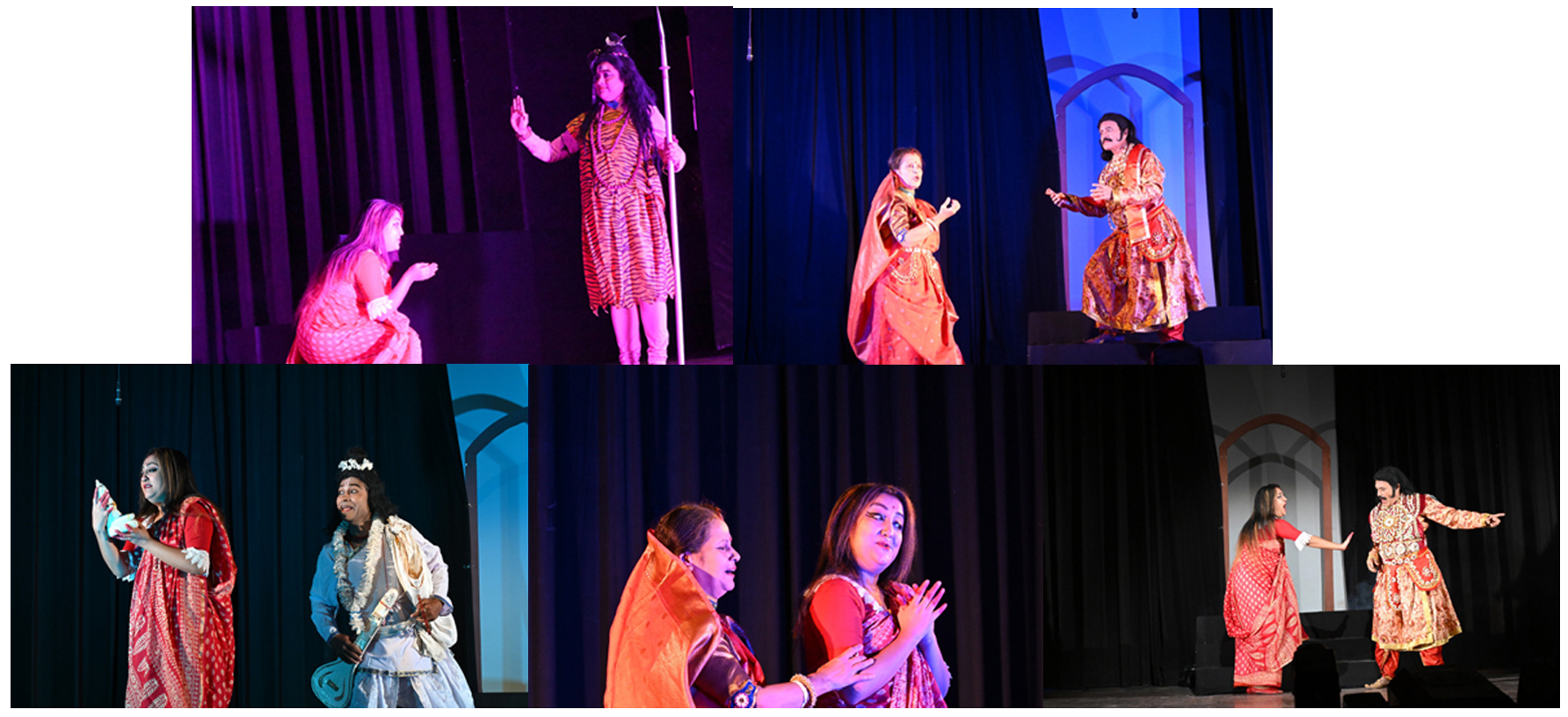
(Tripurainfo)
more articles...