A Folk Tradition’s Fight for Survival A review of the performance of Elok-Shelok
Prasanta Chakraborty
September 1, 2026
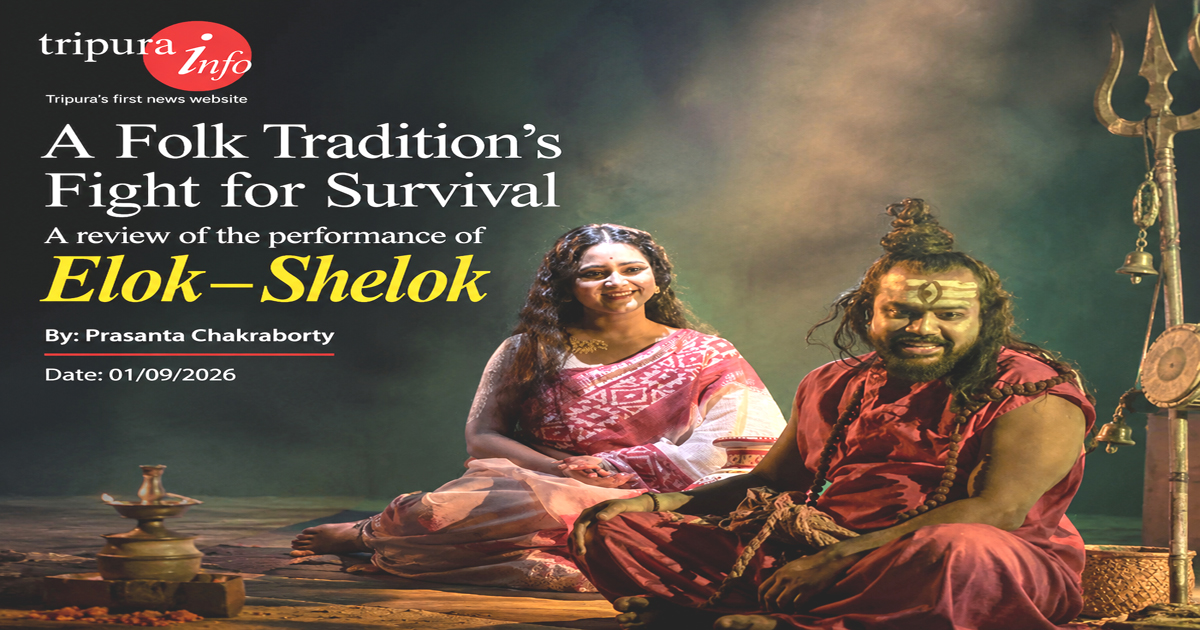
A packed Muktodhara auditorium recently witnessed Elok–Shelok, a production of Rangamati Natyabhumi, on August 30, 2026. It was the group’s second staging of the play, following its first presentation at Rajarshi in Udaipur, Gomati district.
At the heart of Elok–Shelok-the mundane world and the ethereal world-is the conflict between tradition and modernity. Through the story of a Gajan pala troupe, the play brings alive the predicament of a rural folk-art form struggling to survive in a rapidly changing society. Gajan pala, once an integral part of rural cultural life, is now on the verge of extinction, and its performers are fighting a desperate battle to preserve the tradition. Traditionally, Gajan pala was performed in rural Bengal during the transition from the end of Chaitra to the beginning of Baisakh.
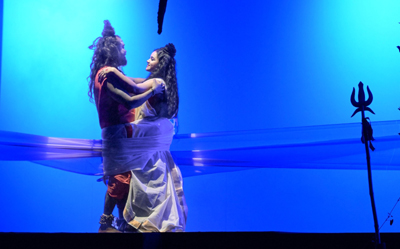 For the performers, however, the struggle is not merely about livelihood. Their attachment to the art form goes much deeper; it is part of their identity and existence. Sadananda, the central character, represents this unwavering commitment. A devoted performer and believer, he cannot imagine giving up Gajan pala and taking up another profession merely to earn a living.
Sadananda is a common man living on the bank of the Gomati River. At the time of his birth, his mother found a small tuft of matted hair on his head and called him Mahadev. As he grew up, Sadananda-one who is always happy-began to believe that he himself was a part of Mahadev.
His troupe had long been financed by Mona Saha, the village head and a businessman. Sadananda lost his parents during childhood and grew up under Mona Saha’s care. Detached from worldly affairs, he remained deeply attached to his troupe. As the world and its culture changed rapidly, he became increasingly worried about the declining condition of Gajan. Meanwhile, Mona Saha forced him to marry Porabasi.
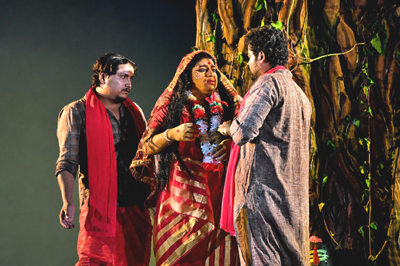 Porabasi sees their situation differently. She feels neglected and deprived amid financial hardship and dissatisfaction in her married life. The lack of financial security and emotional fulfilment pushes her into an extramarital relationship with Mona Saha. The relationship is shaped not only by her emotional and physical needs but also by economic insecurity. The affair is known among the villagers, and even Sadananda is aware of it. Yet, because of his indifference to family life, hardly anyone seems bothered by the relationship.
The crisis surrounding Gajan pala is also reflected within the troupe. The young man playing Parvati no longer wishes to continue in the female role. He is frequently ridiculed by villagers, while the shrinking opportunities to earn a livelihood through the pala make him uncertain about his future. A carpenter by profession, he eventually wants to return to his hereditary occupation in search of economic security.
Sadananda, however, discovers a Parvati in Bhanulal, the carpenter, and tries to convince him that he is the incarnation of Mother Parvati. A materialist, Bhanulal refuses to accept this belief. Sadananda realises that the troupe cannot survive without Bhanu, as he is the only person capable of playing Parvati. Thus, the play portrays an unsuccessful relationship between the mundane and the ethereal worlds.
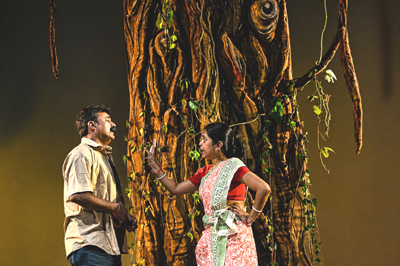 The play proceeds through a series of contradictions, beginning with its very title. The conflict between the material and ethereal worlds adversely affects Sadananda. There is also a conflict within the troupe over whether to continue with the traditional Gajan pala. Bhanulal’s vehement opposition to playing Parvati further sharpens this conflict.
Another contradiction emerges between Porabasi, who seeks financial and physical pleasure, and Sadananda, who remains absorbed in his ethereal world. The contrast between Sadananda and Mona Saha is equally striking. While Sadananda remains detached from worldly affairs, Mona Saha enjoys financial power and has an extramarital relationship with Sadananda’s wife.
There is a certain polish in rural culture, yet the frequent use of abusive language by the characters creates another contradiction.
Among the characters, Lenga attracts considerable attention. A prototype of the Shakespearean fool, he creates laughter through his apparently foolish statements, which are nevertheless deeply introspective. Porabasi, as a quarrelsome wife expecting material pleasure from her husband but eventually turning to an extramarital relationship, is successful in her role. Mona Saha and Bhanulal also demand attention, while the supporting characters perform their roles well.
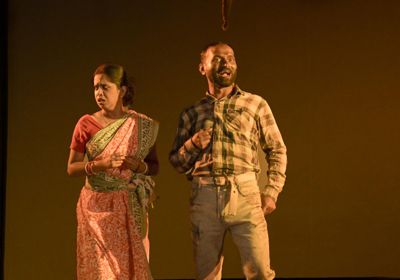 The lady from the ethereal world, with whom Sadananda wants to connect, also leaves an impression. Her slow movement and beautiful modulation of voice create an atmosphere of ethereality.
The loud music associated with the modern generation, however, was one aspect that struck me adversely, as it apparently did many spectators. Perhaps the director intended it to highlight the contradiction between the two worlds, but other techniques could have conveyed the idea without disturbing the atmosphere. The calmness that prevailed through much of the play receives a sudden jolt.
At the beginning, Mahadev, Parvati and their followers enter through the auditorium amid the beating of drums and blowing of conch shells. This interaction with the audience is repeated later when the young generation presents a musical show on stage.
The random use of slang, too, could have been minimised or dropped.
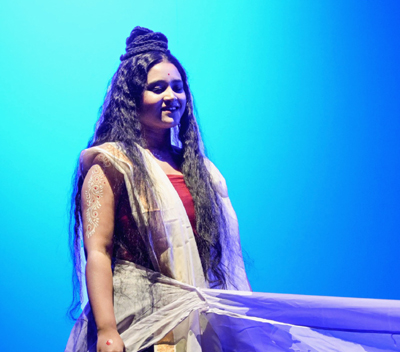 The stage design effectively contributes to the ethereal dimension of the play. The white screen illuminated by blue light creates an otherworldly feeling, while the slow movement and soft voice of the lady enhance the atmosphere. The tree at the centre of the stage, with the image of Shiva at its base, further reinforces the impression of ethereality.
There are some repetitions which could have been avoided to make the production more organised and compact. This could also have helped limit the duration to one hour and twenty minutes.
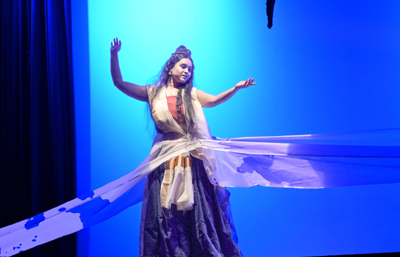 Despite these shortcomings, Elok–Shelok succeeds in bringing to the stage the crisis of a disappearing folk tradition and the difficult choices faced by those committed to preserving it. Its strongest appeal lies in the contrast between material necessity and spiritual devotion, and between a changing society and an art form struggling to survive. The sense of humour that prevails throughout the play is another key feature of its success.
The story is written by Ashok Dev, while the script was written and directed by Uttam Das. The production was by Rangamati Natya Kshetra. Sanjay Das handled the lighting, Pritam Das directed the background music, Sujan and Pankaj Bhowmik arranged the stage, and Rupa Nandy was in charge of costumes.
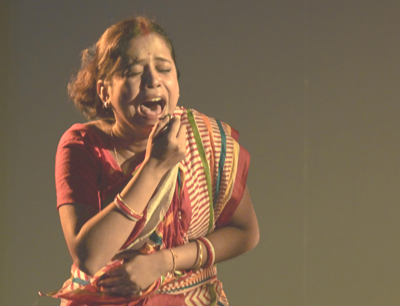 Uttam Das played Sadananda, Budhhadev Saha played Bhanulal Sutradhar, Sani Sarkar played Lenga, Pankaj Debnath played Gouranga, Bijay Goswami played Haricharan, and Subhasis Gupta played Mona Saha. Rimi Dev played Porabasi, Sayanika Sutradhar and Jyotika Singh played villagers, and Tusti Roy Choudhury played Suradhwani. Aniket Barman, Deep Malakar, Tushar Bhattacharjee and Debraj performed as members of Dohar. Uday Debnath was the anchor. Pritam Das and Bijay Goswami were the band singers, while Sarijit played the guitar and Sourajit Gope played the Octopad.
(Tripurainfo)
more articles...