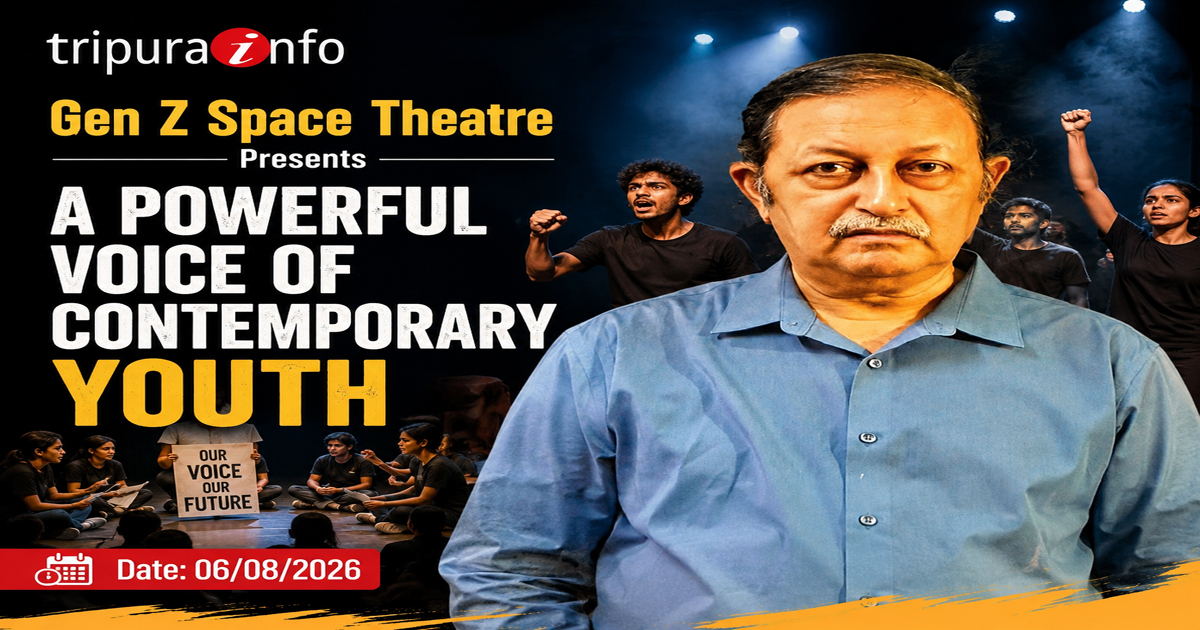
Gen Z Space Theatre Presents a Powerful Voice of Contemporary Yout
Prasanta Chakraborty
August 6, 2026
A few days ago, I was reading Simon
Reynolds' concept of Retromania,
developed in Retromania: Pop
Culture's Addiction to Its Own Past (2011). I found certain
parallels between his observations and the present Gen Z movement. In earlier
times, when we failed to secure a job, gain admission to an educational
institution, or achieve any cherished goal, or when we found ourselves overpowered
on the home front, we accepted it as our fate or our own inadequacy. We seldom
dared to question authority or challenge the established order. The recent
movements in neighbouring countries may ultimately create chaos, but they have
also demonstrated the power to shake the entrenched dominance of corrupt
leaders whose priority has often been the accumulation of public wealth for
personal gain.
 Similarly, the youth of India have
spontaneously come together under the banner of the Cockroach Janata Party.
The term "Cockroach Janata Party" was reportedly first used by the
Honourable Chief Justice of India to denigrate the unemployed youth of the
country, although he later denied the allegation, stating that he had been
misquoted. Gen Z has since adopted the name and the symbol of the cockroach as
a satirical emblem to raise its voice against the long-standing corruption in
public life.
Similarly, the youth of India have
spontaneously come together under the banner of the Cockroach Janata Party.
The term "Cockroach Janata Party" was reportedly first used by the
Honourable Chief Justice of India to denigrate the unemployed youth of the
country, although he later denied the allegation, stating that he had been
misquoted. Gen Z has since adopted the name and the symbol of the cockroach as
a satirical emblem to raise its voice against the long-standing corruption in
public life.
The evening of 2nd August 2026
witnessed the movement being dramatised at the auditorium of Students' Health
Home, Agartala. It was probably the first attempt in Tripura, and perhaps even
in the country, to bring the movement onto the proscenium stage. Although it
was a 20-minute production and its maiden performance, with no props and no
special lighting effects, the play successfully enabled the actors to
communicate its message to the audience. The audience, in turn, felt a close
connection with the message of the performers on stage.
 The actors and actresses were all
representatives of India's Gen Z generation. As the play highlighted, this
generation has chosen social media as a major medium of protest. Many among the
older generation, particularly those who supported the government, believed
that the movement would remain confined to social media. However, neither the
government nor its supporters anticipated that this otherwise non-political
movement would gather such momentum. The protesters have now raised their
voices against corruption, soaring prices, widespread unemployment, and several
other issues that have profoundly affected public life.
The actors and actresses were all
representatives of India's Gen Z generation. As the play highlighted, this
generation has chosen social media as a major medium of protest. Many among the
older generation, particularly those who supported the government, believed
that the movement would remain confined to social media. However, neither the
government nor its supporters anticipated that this otherwise non-political
movement would gather such momentum. The protesters have now raised their
voices against corruption, soaring prices, widespread unemployment, and several
other issues that have profoundly affected public life.
 The performers on stage echoed the
aspirations and concerns of Gen Z. They articulated several major demands. The
first was that a retired Chief Justice of India should neither be re-employed
nor appointed to any lucrative post-retirement position, nor be allowed to join
politics. Their second demand called for reserving 50 per cent of seats for
women in every sphere of public life, without linking such reservation to an
increase in the number of seats in Parliament. Their third demand sought the
cancellation of licences of media houses controlled by business tycoons that,
according to them, blindly endorse every action of the government. Another
demand was that if an Election Commissioner is found guilty of deliberately
deleting the names of genuine citizens from the electoral roll, such an act
should invite prosecution under the UAPA, since depriving a genuine citizen of
voting rights, they argued, is no less serious than an act of terrorism.
The performers on stage echoed the
aspirations and concerns of Gen Z. They articulated several major demands. The
first was that a retired Chief Justice of India should neither be re-employed
nor appointed to any lucrative post-retirement position, nor be allowed to join
politics. Their second demand called for reserving 50 per cent of seats for
women in every sphere of public life, without linking such reservation to an
increase in the number of seats in Parliament. Their third demand sought the
cancellation of licences of media houses controlled by business tycoons that,
according to them, blindly endorse every action of the government. Another
demand was that if an Election Commissioner is found guilty of deliberately
deleting the names of genuine citizens from the electoral roll, such an act
should invite prosecution under the UAPA, since depriving a genuine citizen of
voting rights, they argued, is no less serious than an act of terrorism.
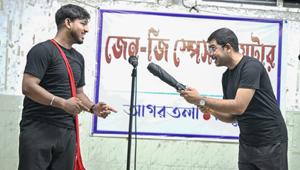 The scriptwriter and director
incorporated the revolutionary songs of Rabindranath Tagore, Kazi Nazrul Islam,
and Sukanta Bhattacharya, which were sung along with dances by the actresses to
express the outrage and determination of the Gen Z movement. While one group of
actors represented Gen Z, two others portrayed members of the older generation
who initially dismissed the movement and ridiculed its prospects. However, as
the movement gathered strength, swelling like waves during a high tide, they
began advocating that it be crushed through severe measures, including
imprisoning some of its leaders or finding faults with the movement and its
participants. Nevertheless, Gen Z did not retreat. Instead, more people
continued to join, and with every passing moment, the movement grew stronger
and larger.
The scriptwriter and director
incorporated the revolutionary songs of Rabindranath Tagore, Kazi Nazrul Islam,
and Sukanta Bhattacharya, which were sung along with dances by the actresses to
express the outrage and determination of the Gen Z movement. While one group of
actors represented Gen Z, two others portrayed members of the older generation
who initially dismissed the movement and ridiculed its prospects. However, as
the movement gathered strength, swelling like waves during a high tide, they
began advocating that it be crushed through severe measures, including
imprisoning some of its leaders or finding faults with the movement and its
participants. Nevertheless, Gen Z did not retreat. Instead, more people
continued to join, and with every passing moment, the movement grew stronger
and larger.
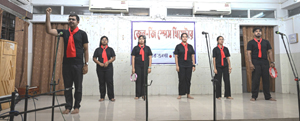 The
actors portraying Gen Z wore black costumes with red pieces of cloth draped
around their necks. The black costumes worn by the actors symbolised more than
a theatrical choice. They embodied protest, collective solidarity, and moral
outrage against corruption and social injustice. Stripped of ornamentation, the
costumes reflected the simplicity and determination of a generation united in
its demand for accountability and change. The use of red in the production
served as a striking visual metaphor for revolution, sacrifice, and the
passionate resolve of a generation unwilling to remain silent. It underscored
the intensity of the movement's emotions while evoking the enduring tradition
of protest and social awakening celebrated in Bengali literature and song. In
the performance, two members of the group, who were without the red cloth
around their necks, assumed the roles of elderly critics who questioned and
challenged every demand raised by Gen Z. The performances were remarkably
natural, particularly considering that it was the troupe's first staging of the
play. Such was the sincerity of their acting that the audience hardly felt they
were watching a theatrical performance.
The
actors portraying Gen Z wore black costumes with red pieces of cloth draped
around their necks. The black costumes worn by the actors symbolised more than
a theatrical choice. They embodied protest, collective solidarity, and moral
outrage against corruption and social injustice. Stripped of ornamentation, the
costumes reflected the simplicity and determination of a generation united in
its demand for accountability and change. The use of red in the production
served as a striking visual metaphor for revolution, sacrifice, and the
passionate resolve of a generation unwilling to remain silent. It underscored
the intensity of the movement's emotions while evoking the enduring tradition
of protest and social awakening celebrated in Bengali literature and song. In
the performance, two members of the group, who were without the red cloth
around their necks, assumed the roles of elderly critics who questioned and
challenged every demand raised by Gen Z. The performances were remarkably
natural, particularly considering that it was the troupe's first staging of the
play. Such was the sincerity of their acting that the audience hardly felt they
were watching a theatrical performance.
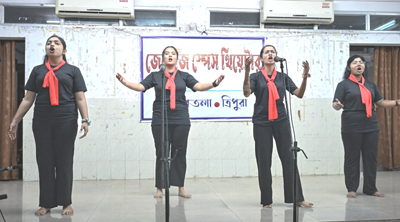 Gen Z Space Theatre produced the play GenZ. The play was written
by Bibhu Bhattacharjee and directed by Sagarima Dey, while the background music
was composed by Prabal Majumder and Prabhat Rudra Pal. The cast comprised Maukh
Chakraborty, Sagarika Chakraborty, Souramita Sen, Rahul Ray, Somayanika Banik,
and Sagarima Dey, all of whom delivered compelling stage performances.
Gen Z Space Theatre produced the play GenZ. The play was written
by Bibhu Bhattacharjee and directed by Sagarima Dey, while the background music
was composed by Prabal Majumder and Prabhat Rudra Pal. The cast comprised Maukh
Chakraborty, Sagarika Chakraborty, Souramita Sen, Rahul Ray, Somayanika Banik,
and Sagarima Dey, all of whom delivered compelling stage performances.
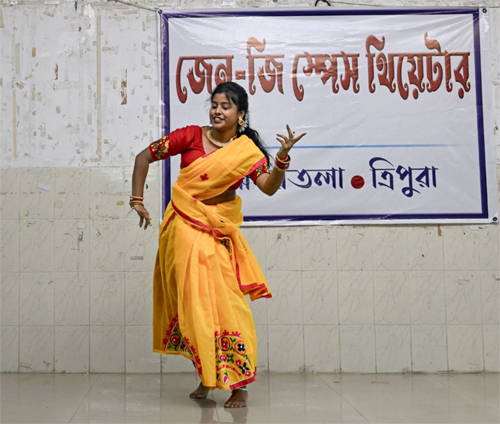
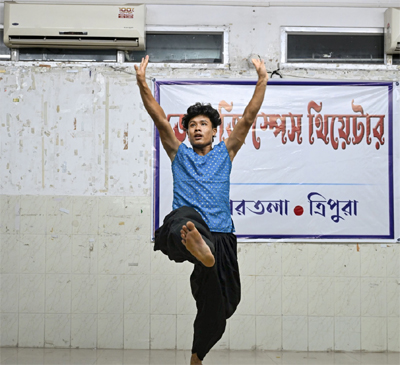
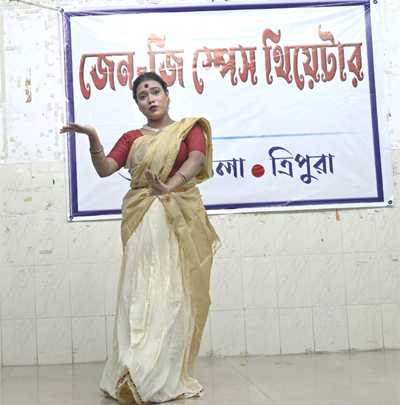
Even
before the curtain rose, the audience was psychologically prepared through a
selection of revolutionary songs by Salil Choudhury, Rabindranath Tagore, and
Kazi Nazrul Islam. This was followed by performances by three dancers, which
were warmly appreciated by the spectators. At the beginning of the programme,
the anchor, Udaysankar Bhattacharjee, introduced the audience to the concept
and objectives of the Gen Z movement, thereby providing an appropriate context for
the play that followed.
(Tripurainfo)
more articles...