Zero Tolerance on Drugs: Rhetoric vs Ground Reality in Tripura Raises Serious Questions
Jayanta Debnath
January 11, 2026
Union Home Minister Amit Shah, while sitting in Delhi, has repeatedly projected a message of zero tolerance against drugs, calling for complete eradication of narcotics from Tripura and other northeastern states. Echoing this stance, Tripura Chief Minister Dr Manik Saha has also issued strict directives to the state police, asking them to act with zero tolerance against drug trafficking.
However, the situation on the ground in Tripura presents a sharply different picture, raising serious questions about the actual preparedness and intent behind the anti-drug campaign.
In reality, the agencies that are supposed to play a decisive role in curbing drug trafficking appear to be virtually ineffective. Not only is the condition of the Tripura Police’s Anti-Narcotics wing far from satisfactory, but the two key central government agencies like Customs and the Directorate of Revenue Intelligence (DRI), which are entrusted with preventing drug and gold smuggling and tracking illegal money flows are also functioning in a severely weakened state in Tripura.
Shockingly, these two crucial central agencies are operating in the state with barely five to seven ground level officers and staff each. This glaring shortage of manpower in ground level exposes the stark contrast between the Centre’s declared intent to eliminate drugs and the actual resources deployed in a highly drug-vulnerable border state like Tripura.
Occasionally, officials from these central agencies arrive from Delhi, Shillong, or Guwahati and detain a few alleged drug traffickers or gold smugglers from Tripura. But after a short period, many of the arrested individuals are reportedly released. The people of Tripura are rarely informed about the final outcome of such cases. There is little to no public clarity on what punishments, if any, are awarded in cases related to drug seizures, raids on jewellery shops, or arrests linked to human trafficking.
This lack of transparency has further deepened public scepticism about the seriousness of the so-called zero-tolerance policy.
As a result, a fundamental question is now being raised: how can drug trafficking be effectively curbed in a state that is increasingly vulnerable to narcotics when only around ten to twelve ground level officers from two central agencies are deployed? The contradiction between strong political messaging and weak institutional capacity has become too glaring to ignore.
Ironically, even as these questions persist, the Directorate of Revenue Intelligence recently showcased its operational capability in a high-profile case. According to a Press Information Bureau release dated 7 January 2026, the DRI busted a major trans-border gold smuggling syndicate operating from Dubai and Bangladesh. The operation, conducted in Delhi and Agartala, led to the seizure of 29.2 kg of foreign-origin gold worth over Rs. 40 crore and cash amounting to Rs.2.9 crore. Four members of the syndicate were arrested, and investigations revealed that Tripura was being used as a transit route via the Indo–Bangladesh border.
While such successes highlight the potential of central agencies, they also underline an uncomfortable truth: without adequate manpower, consistent follow-up, and transparency in prosecutions, isolated crackdowns cannot substitute for a sustained and credible anti-drug strategy.
Adding to the mystery, a key accused linked to multiple smuggling and trafficking networks reportedly died mysteriously in July 2025, an incident that sparked further investigations into his extensive nexus across borders. However, the progress and outcome of those investigations have never been made public.
Despite these concerns, the state government continues to project success. Chief Minister Dr Manik Saha has reiterated Tripura’s zero-tolerance policy, claiming that drug seizures increased by over 100 percent in 2025. The government has also intensified Operation Drug-Free Tripura in collaboration with the Border Security Force (BSF), particularly along vulnerable border stretches.
The opposition, however, paints a very different picture. CPI(M) leader Jitendra Chaudhury and other opposition figures have openly alleged that powerful drug syndicates continue to operate under political patronage. According to them, while official statistics highlight seizures and arrests, the drug trade remains rampant beneath the surface.
Corruption concerns further complicate the narrative. Multiple reports suggest that while small-time peddlers are routinely arrested, major kingpins often evade conviction. Inadequate scientific infrastructure, weak forensic support, and alleged corruption at sensitive checkpoints, notably the Churaibari gate are cited as key reasons for this failure.
Trafficking Routes and Substances
Tripura’s geography makes it particularly vulnerable. The Agartala–Silchar railway line and the state’s 856 kilometre porous border with Bangladesh have emerged as primary conduits for drug trafficking.
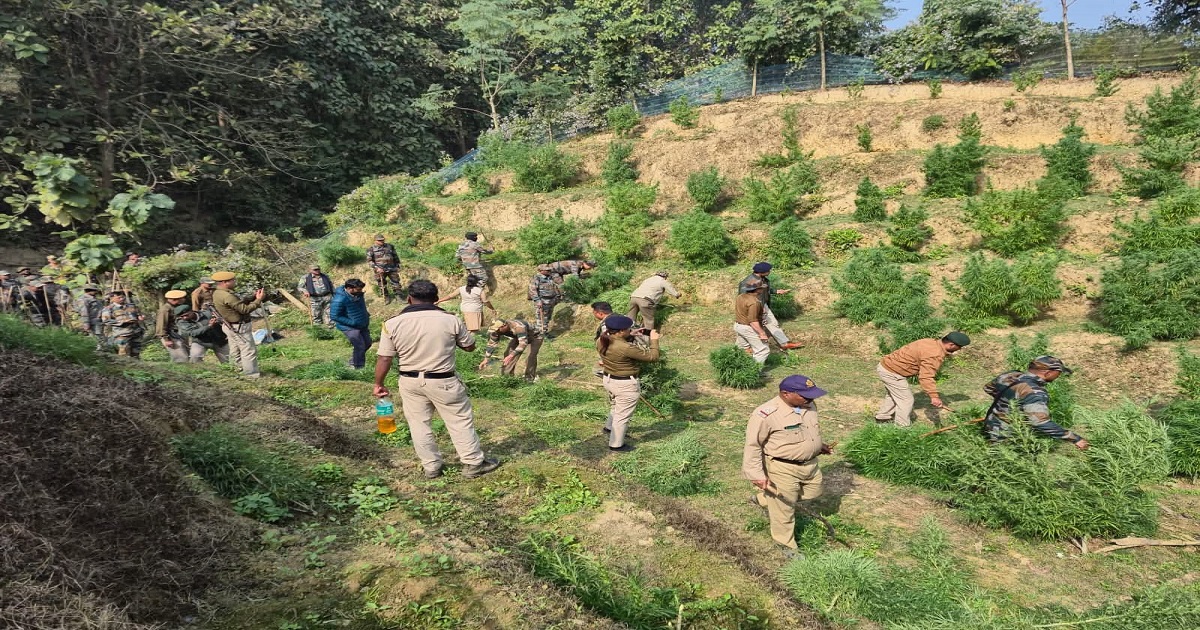
The substances most frequently seized include Yaba tablets, a dangerous mix of methamphetamine and caffeine, along with heroin and brown sugar smuggled from neighbouring states. Cannabis cultivation is another major challenge; in recent operations, police authorities claim to have destroyed more than 24 lakh cannabis plants. Phensedyl, a banned cough syrup in high demand in Bangladesh, also remains a major item in cross-border smuggling.
The Core Question With barely a dozen officers manning two critical central agencies, the central question remains unavoidable: how can drug and gold trafficking be effectively curbed in an increasingly drug-prone border state like Tripura?
Until manpower shortages, transparency gaps, political accountability, and institutional weaknesses are addressed, Tripura’s much-publicised zero-tolerance policy risks being remembered not as a mission, but as a slogan, powerful in speeches from Delhi, yet fragile on the ground where the battle truly matters.
Often, during drug-trafficking operations, the names of such political leaders or office-holders come up that it becomes difficult for the police to arrest or even question them. In the Jirania case, where a huge quantity of cough syrup was brought by train a few months ago, the person whose name surfaced is reportedly the father-in-law of a influential figures from Tripura.
Reports indicate that while small-scale peddlers are frequently arrested, major kingpins often evade conviction due to inadequate scientific infrastructure and corruption at certain checkpoints like the Churaibari gate.
In 2025 and early 2026, Tripura has seen intensified law enforcement actions against drug trafficking networks, which officials state use the state’s international border with Bangladesh as a major smuggling corridor. In January 2025, the Enforcement Directorate (ED) conducted its largest-ever raids in Tripura, targeting the properties of eight alleged drug mafias across West Tripura, Gomati, and Sepahijala districts. Key figures under investigation included former NLFT extremist Kamini Debbarma and retired police officers Dhruva Majumder and Amal Baidya, who are suspected of links to narcotics smuggling and Hawala transactions.
In December 2025, police seized over 44,000 Yaba tablets worth Rs. 2.5 crore from a passenger train at Dharmanagar. Arrested individuals included Mafia Begum, Ankuri Bibi, and Hafia Begum, highlighting an increasing trend of women being used as couriers.
In April 2025, a notorious figure named Ripon Mia was arrested in Boxanagar following a community-supported raid. Another prominent individual, Nirmal Saha (known as a Phensedyl mafia), died mysteriously in July 2025, which sparked further investigations into his extensive networks.
Despite Tripura recording its lowest overall crime rate in nearly two decades, the police leadership has clearly identified narcotics as a strategic priority area. As highlighted by DGP Anurag Dhankar, IPS, enforcement under the NDPS Act increased by about 11% in 2025, reflecting intensified detection, investigation, and follow-up action rather than a relaxed posture due to the fall in general crime.
A key indicator of this strategy is the sharp rise in the value of seized and destroyed contraband, which nearly doubled from Rs. 849 crore in 2024 to Rs.1,636 crore in 2025. This points to a deliberate focus on high-value consignments, organised supply chains, and bulk recoveries, instead of only small, street-level seizures. Equal emphasis on destruction of seized drugs underlines the intent to prevent recirculation and to strengthen legal outcomes.
Overall, the drugs strategy in Tripura combines aggressive enforcement, disruption of organised networks, and decisive disposal of contraband, signalling that while general law and order has improved, the state is pursuing a zero-tolerance, high-impact approach against narcotics trafficking and abuse.
In this backdrop, Tripura’s people are left wondering whether the promise of zero tolerance against drugs is a genuine mission or merely a slogan one that sounds powerful in Delhi, but loses substance on the ground in one of India’s most sensitive border states.
(Writer Jayanta Debnath is a senior journalist and Editor Tripurainfo.com)
(Tripurainfo)
more articles...