Indian Coast Guard (ICG): A Strategic Pillar of India’s Act East Vision
Dr. Sumon Ali
February 1, 2026
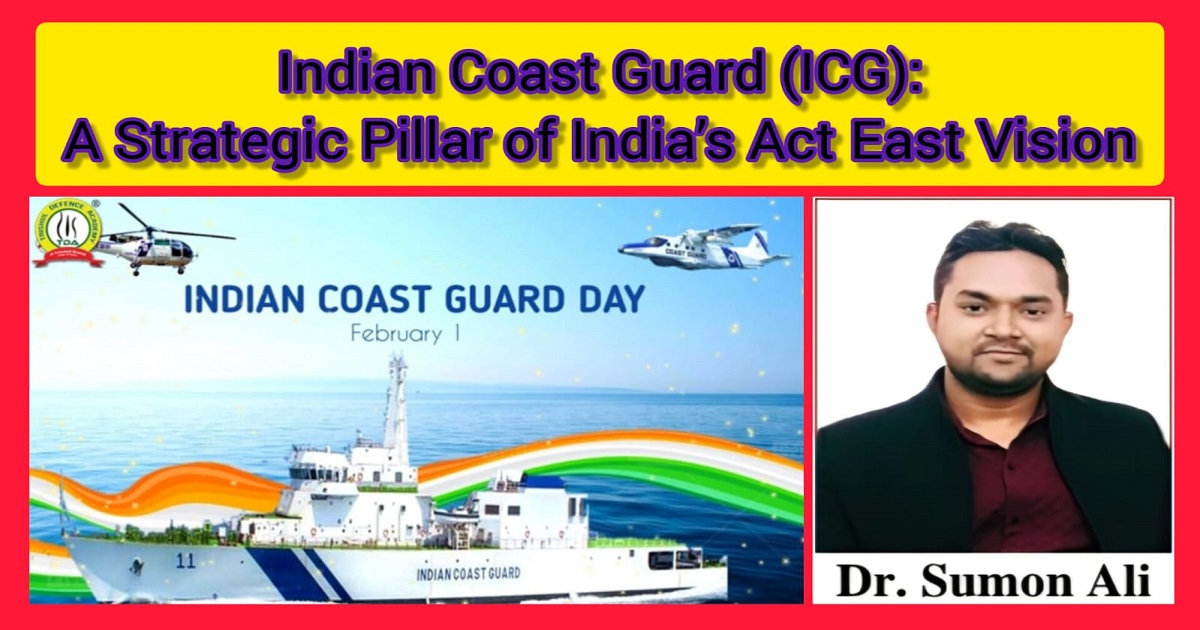
The Indian Coast Guard is no longer merely a coastal security force; it has emerged as a vital instrument of India’s foreign policy and geo-strategic vision. Within the Act East framework—where policy is crafted at the diplomatic level—the Coast Guard turns strategy into maritime reality through coastal vigilance, regional cooperation, humanitarian action, and constant watch over emerging challenges at sea. Hence, 1 February, observed as Indian Coast Guard Day, is not just ceremonial; it reminds us that India’s future strength rests increasingly on its maritime capability, steadfastly guarded by the Indian Coast Guard.
In the twenty-first century, the epicentre of international politics and diplomacy is gradually shifting from the landmass to the maritime domain. Nearly 90 percent of global trade is conducted through sea routes, and the importance of maritime boundaries in determining the balance of power no longer needs renewed emphasis. In this evolving global reality, for India, maritime security is not merely a matter of military concern; rather, it constitutes a fundamental pillar of economic development, strategic influence, and diplomatic capability.
It is within this context that India’s Act East Policy, introduced in 2014, must be understood not simply as a diplomatic initiative to strengthen relations with the countries of East and Southeast Asia, but as a far-reaching maritime-centric geo-strategic framework. Among the institutions that are quietly yet decisively translating this strategic vision into operational reality at sea, the Indian Coast Guard has emerged as a crucial pillar.
From Look East to Act East: A Maritime Strategy in Motion
India’s eastward engagement began in 1991 when the government of P. V. Narasimha Rao launched the Look East Policy, primarily anchored in economic and commercial cooperation with the countries of East and Southeast Asia. The emphasis at that time was on trade, connectivity, and regional economic integration. However, after 2014, under Prime Minister Narendra Modi, this approach underwent a significant transformation and was rearticulated as the Act East Policy—a shift that symbolised not merely observing the region, but actively engaging with it in strategic, political, and security dimensions.
The principal objectives of this renewed policy framework are multi-layered and clearly strategic:
• Strengthening strategic relations with ASEAN countries
• Expanding India’s presence across the Indo-Pacific region
• Ensuring the security of maritime routes and sea lanes
• Positioning India as a key player in the regional balance of power
It thus becomes evident that the Act East Policy is far more than a diplomatic outreach; at its core, it represents a maritime-centric geo-strategic doctrine designed to align India’s foreign policy with the realities of emerging sea-based power politics.
Indian Coast Guard: Institution, Mandate, and Strategic Significance
Founded on 1 February 1977, the Indian Coast Guard was entrusted with the responsibility of protecting India’s extensive 7,500 km coastline and its 2.3 million square kilometre Exclusive Economic Zone (EEZ). Operating under the Ministry of Defence as a paramilitary maritime force, its core duties include:
• Ensuring coastal security
• Preventing illegal infiltration
• Combating smuggling and narcotics trafficking
• Suppressing piracy and human trafficking
• Conducting search, rescue, and relief operations during maritime emergencies
While these responsibilities may appear administrative at first glance, in practice they are deeply connected to India’s national security framework and closely linked to the country’s wider foreign policy and strategic interests in the maritime domain.
Strategic Roles of the Indian Coast Guard in Advancing the Act East Policy
1) Maritime Security and Regional Stability: Securing the Sea Lanes
A central pillar of the Act East Policy is the assurance of Safe Sea Lanes of Communication (SLOCs). A significant share of commercial shipping bound for India from Southeast Asia transits the Strait of Malacca, one of the world’s busiest maritime corridors. This region faces persistent challenges such as piracy, illegal fishing, and smuggling.To address these threats, the Indian Coast Guard conducts regular coordinated patrols and exercises with the coast guards of Indonesia, Thailand, Myanmar, and Malaysia. These engagements not only strengthen maritime security but also build mutual confidence, interoperability, and practical cooperation with regional partners.
2) Maritime Diplomacy and Soft Power: Coast Guard as a Diplomatic Instrument
Contemporary diplomacy is no longer confined to ambassadors and formal dialogues; it increasingly operates through naval and coast guard engagements. The Indian Coast Guard participates in training programmes, officer exchange initiatives, and joint search-and-rescue missions with several ASEAN countries.Through these sustained interactions, India projects itself as a “Net Security Provider”—a country capable of contributing to the security of its neighbourhood, not merely safeguarding its own waters. This role significantly enhances India’s soft power and credibility across the Indo-Pacific.
3) Balancing China’s Expanding Maritime Footprint
An implicit yet critical dimension of the Act East Policy is responding to China’s growing maritime presence in the Indo-Pacific. Through the “String of Pearls” approach, China has developed strategic access points at Gwadar (Pakistan), Hambantota (Sri Lanka), and Kyaukphyu (Myanmar), developments that carry clear security implications for India.In this context, the Indian Coast Guard strengthens coastal surveillance through radar networks and Maritime Domain Awareness (MDA) systems, ensuring constant monitoring of India’s maritime boundaries. This vigilance allows the Indian Navy to focus on broader strategic roles while the Coast Guard maintains robust near-shore security.
4) Humanitarian Assistance and Disaster Relief (HADR): Building Regional Trust
Another vital dimension of the Act East framework is Humanitarian Assistance and Disaster Relief (HADR). During tsunamis, cyclones, and maritime accidents, the Indian Coast Guard has undertaken rescue and relief operations not only in India but also in Sri Lanka, Maldives, Indonesia, and Myanmar.These humanitarian missions shape India’s image as a responsible and responsive regional power—an approach that is widely perceived as more reassuring and acceptable than overt strategic assertiveness.
Northeast India and the Act East Vision: Connectivity, Corridors, and Coastal Security
A crucial internal dimension of the Act East Policy is the integration of India’s Northeast with Southeast Asia. States such as Tripura, Mizoram, and Manipur are no longer peripheral borderlands; they are steadily becoming part of emerging international trade corridors. In this evolving landscape, ensuring the security of sea-linked and riverine trade assumes growing importance—an area where the Indian Coast Guard is poised to play an increasingly significant role.
1) International Connectivity and Trade Corridors
Under the Act East framework, the Government of India has undertaken several major connectivity projects that are set to transform the role of the Northeast:
• Kaladan Multimodal Transit Transport Project (KMTTP) — This project establishes sea and river connectivity from Kolkata to Sittwe Port in Myanmar, and thereafter links Mizoram through road and inland waterways. Once fully operational, it will connect the Northeast directly to international sea routes without relying solely on overland corridors such as the Siliguri route or routes via Dhaka.
• India–Myanmar–Thailand Trilateral Highway (IMT Highway) — Approximately 1,360 km long, this route will connect India’s Northeast to the main trade networks of Southeast Asia. Although internal instability in Myanmar has delayed progress in certain stretches, once completed it will allow Indian goods to reach Thailand, Malaysia, and Vietnam with far greater ease.
• Agartala–Akhaura Rail Link — This rail link connects the Northeast to international markets through Bangladesh transit routes, significantly reducing both time and transportation costs. However, recent political instability in Bangladesh has posed challenges to the smooth operationalisation of some border-based connectivity initiatives.
Successful implementation of these projects will help position the Northeast as a gateway for international trade and export-oriented economic growth.
2) Internal Connectivity and Infrastructure Development
Alongside external corridors, the Act East framework has catalysed a series of internal initiatives across the Northeast that are steadily overcoming the region’s long-standing geographical isolation and laying a strong developmental foundation:
• Rail Connectivity: In Mizoram, passenger train services have begun for the first time in independent India’s history. The Bairabi–Sairang rail project involves the construction of nearly 48 tunnels and 142 bridges, demonstrating how complex terrain is being successfully integrated into the national rail grid.
• Inland Waterways Revival: On the Brahmaputra, Ro-Ro ferry services have been revitalised, reducing transportation costs and making river-based cargo movement more efficient and viable.
• Digital Connectivity: Through the effective implementation of BharatNet and 4G expansion, internet and digital services have reached remote areas, strengthening education, healthcare, and local entrepreneurship.
Government reports and media analyses indicate that these initiatives are not merely about economic infrastructure; they are creating the conditions for the Northeast to emerge as a functional gateway for business and communication with Southeast Asia.
3) The Coast Guard’s Potential Role in This Emerging Landscape
As connectivity and trade expand through these corridors, the strategic relevance of the Indian Coast Guard will grow proportionally:
• With the rise in international trade, the demand for secure sea and river transport will increase, where the Coast Guard will lead in navigation safety, inspection, and rescue operations.
• Transport through riverine and border-adjacent regions—particularly along routes near the Myanmar frontier—will pose complex security challenges. The Coast Guard’s surveillance across coastal and riverine zones will be crucial to ensuring safe passage.
• As customs authorities, port authorities, and multimodal transport planners make future decisions, Coast Guard inputs derived from Maritime Domain Awareness (MDA) will play a key role in shaping data-driven security policies.
Together, these developments underline how infrastructure, connectivity, and maritime security are becoming deeply interlinked within the Act East vision.
4) Challenges and Security Considerations
While the projects under the Act East Policy are immensely promising, they are not without obstacles:
• Political instability in Myanmar has created implementation hurdles for certain connectivity routes, notably delays along segments such as the Paletwa–Zorinpui corridor.
• Widespread security risks in border-adjacent regions—such as human trafficking and cross-border smuggling—necessitate intensified surveillance across sea and river routes, where the Indian Coast Guard will play an indispensable role.
These challenges underline that connectivity without security cannot deliver its intended strategic benefits.
5) Social and Economic Benefits
Enhanced connectivity under Act East will not only boost trade but also strengthen the social and economic fabric of the Northeast:
• Greater employment opportunities for youth, expanded export avenues for local agricultural and industrial products, and the growth of export-oriented Micro, Small, and Medium Enterprises (MSMEs).
• Improved access to education, healthcare, and commercial communication, helping to place the rural economy of the Northeast on a more stable and sustainable foundation.
Taken together, these outcomes show that the Act East vision is as much about people and prosperity as it is about strategy and security.
In sum, the Indian Coast Guard is no longer merely a coastal security force; it has become an indispensable instrument of India’s foreign policy and geo-strategic vision. Where policymakers and diplomats articulate the intent of the Act East approach, the Coast Guard converts that intent into daily operational reality across India’s maritime frontiers—securing sea lanes, building regional trust, supporting humanitarian missions, and sustaining a rules-based maritime order in the Indo-Pacific.
Thus, 1 February—observed as Indian Coast Guard Day—should be seen as more than a ceremonial marker. It is a strategic reminder that India’s future power, prosperity, and influence are increasingly tied to its maritime capability. From safeguarding the Exclusive Economic Zone to enabling maritime diplomacy, from coastal vigilance to regional cooperation, the Coast Guard stands as the quiet but firm sentinel of India’s sea power.
Put simply, as India looks east and acts east, it is the Indian Coast Guard that ensures the nation can secure east. In that sense, the Coast Guard has truly emerged as a central pillar of India’s Act East Policy and a defining force in shaping India’s maritime century. (Dr. Sumon Ali, Guest Faculty, Department of Political Science, Tripura University)
(Tripurainfo)
more articles...