Acting Locally for Global Impact: Reimagining PBRS by Integrating Ecosystem Services.
Dr. Atul Kumar Gupta
May 22, 2026
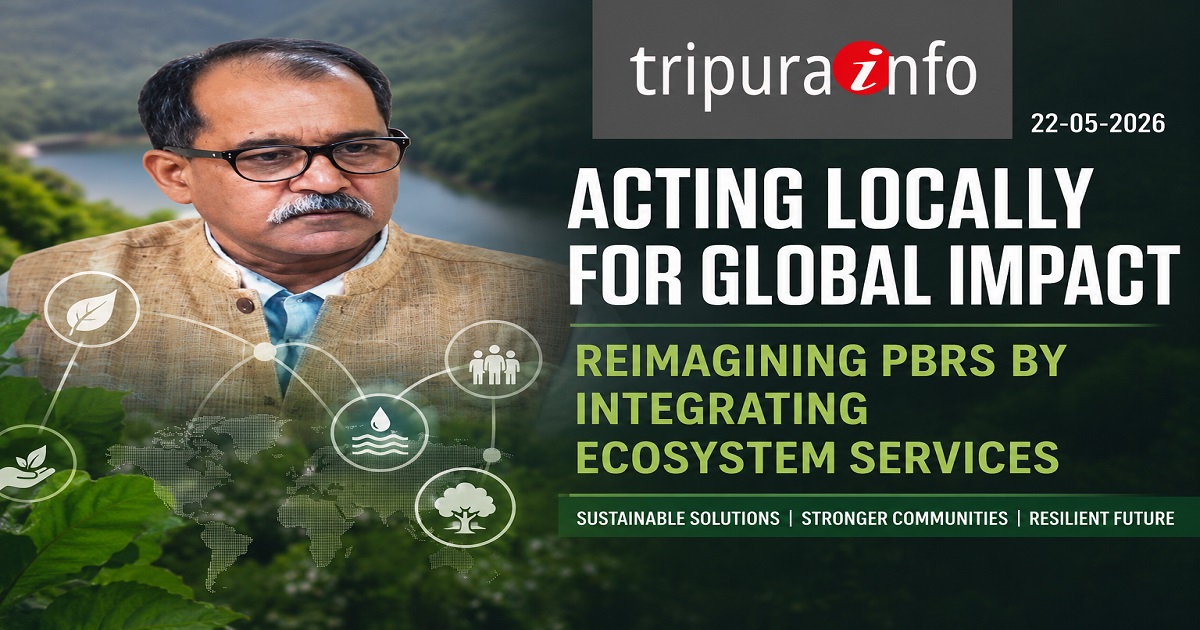
The theme of the International Day for Biological Diversity 2026-"Acting locally for global impact"-is a powerful reminder that global ecological security relies fundamentally on local ecosystems. Forests, wetlands, rivers, grasslands, pollinators, sacred groves, and agro- biodiversity conserved at village and landscape levels collectively sustain planetary ecological balance. India championed this decentralized approach through the Biological Diversity Act of 2002, establishing Biodiversity Management Committees (BMCs) and People's Biodiversity Registers (PBRs). Across the country, thousands of PBRs have documented local biodiversity, traditional knowledge, and ecological heritage. However, the growing ecological and climate challenges before us require that these registers evolve further from (current) static documentation tools into (future) dynamic ecological planning and biodiversity governance instruments.
Having rich experience of working in this field, including close engagement with Biodiversity Management Committees (BMCs), preparation of People's Biodiversity Registers (PBRs), and local biodiversity governance processes, I have often felt that there exists some disconnect at the grassroots and thus the true ecological and economic significance of local ecosystems has been only partially captured in our present documentation frameworks.
While at one level, Gram Panchayats mostly possessed rich biodiversity, forests, wetlands, water resources, pollinators, traditional knowledge systems, and immense ecosystem services; at another level, institutions and programmes such as BMCs, Gram Panchayat Development Plans (GPDPs), livelihood schemes, restoration activities, and Access and Benefit Sharing (ABS) mechanisms were all functioning in parallel. Yet, despite all these positive initiatives, they often have worked in silos - disconnected from one another.
Consequently, biodiversity-rich communities often face limited livelihood opportunities. PBRs document biodiversity but rarely inform local development planning. GPDPs address development priorities without integrating ecological assets. Furthermore, ABS mechanisms focus heavily on the direct extraction of biological resources, largely overlooking the broader, continuous ecological services generated by these landscapes.
Through years of field interactions and institutional experience, I strongly feel that Ecosystem services could be that missing link having potential to connect conservation, decentralized local planning, local livelihoods, and future benefit sharing framework. Ecosystems continuously provide invaluable services-forests recharge groundwater, wetlands moderate floods, and pollinators sustain agriculture. Yet, these services remain invisible in local governance.
There is a strong need for reversing the current trend where external beneficiaries (urban centres, industries, and downstream users) derive immense value for free, while those who maintain these functions receive little support Acting Locally for Global Impact: Reimagining PBRS by Integrating Ecosystem Services.
Therefore, to me, the future of biodiversity governance lies not merely in documenting nature in its static format (PBRS), but in recognizing, valuing, and reconnecting the ecological relationships through which biodiversity (through ecosystem services) quietly sustains economies, livelihoods, cultures, and human well-being every single day. This integration will transform static PBRs into Natural Capital Accounting Tools and may act as a New frontier for Conservation Finance (even for sustaining BMCs, most of which are currently without sustainable financing support).
In fact, this is going to be a transition from a narrow ABS model (focused mainly on biological material access) to a landscape-level ecosystem service valuation and benefit-sharing framework linked with local governance institutions like Biodiversity Management Committees (BMCs), Gram Panchayats, Block Panchayats, and Urban Local Bodies. This expanded ABS mechanism will ensure that the ecosystem-service users contribute financially to local biodiversity custodians.
This shift represents a fundamental change in perspective: viewing biodiversity not merely as a resource to be accessed, but as living ecological infrastructure to support: Decentralized Financing: creating incentives for biodiversity stewardship; Policy Convergence: Aligning GPDPs with climate adaptation and Wetland restoration; Empowered BMCs: Transforming them into technical hubs for ecological governance. This also identifies with global developments around: ecosystem service valuation; natural capital accounting; payment for ecosystem services (PES); biodiversity finance; etc.
As we align with the Kunming-Montreal Global Biodiversity Framework, we must recognize that conservation becomes truly sustainable only when stewardship and local well-being are inextricably linked. By empowering village-level institutions to value the ecosystems they inhabit, we turn "acting locally" into a measurable, global impact. By adopting to this we actually would be reaffirming principle deeply rooted in Indian ecological traditions - that local stewardship of nature has global significance.
As the world observes International Day for Biological Diversity 2026, there is perhaps a timely opportunity to reimagine biodiversity governance not only as conservation of species, but also as conservation of ecological functions and ecosystem services that sustain society itself. Acting locally (at BMC levels) for global impact may therefore begin with something as grounded and practical as empowering village-level biodiversity institutions to understand, document, and value the ecosystems and services that they provide.
Of course, this would require careful institutional design and supportive rules or guidelines. The ideas presented here are intended only as a humble attempt being made to explore practical models through which biodiversity conservation, ecosystem services, local planning, livelihoods, and benefit sharing may be more meaningfully connected that may help carry this conversation forward into future policy and practice.(Dr. Atul Kumar Gupta, IFS (Retd.), Professor, TDU, Bengaluru)
(Tripurainfo)
more articles...