Nazrul's 127th Birth Anniversary: Kazi Nazrul in the Heart of Tripura
DR. SUMON ALI
May 26, 2026
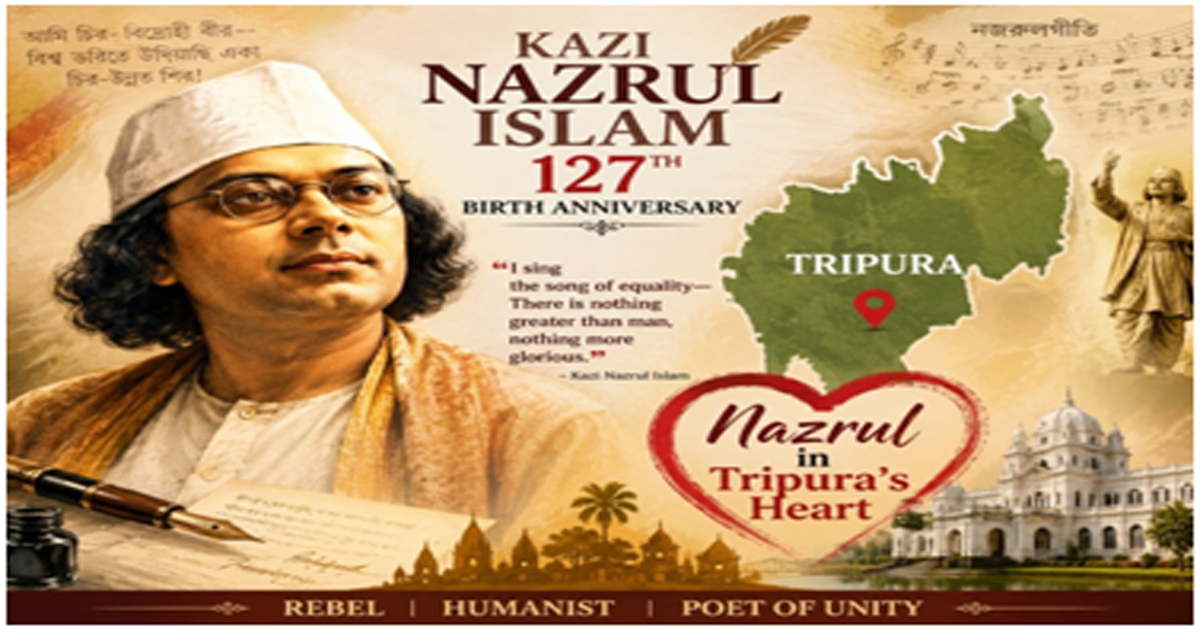
In the history of Bengali literature and culture, Kazi Nazrul Islam
stands as an extraordinary personality who simultaneously symbolizes rebellion,
humanity, love, equality, secularism, and cultural liberation. His literary
works were not merely protests of an era; they were the language of humanity’s
struggle for freedom and dignity. He was a poet, lyricist, composer,
journalist, dramatist, and above all, the voice of humanity.
While discussing Nazrul, one must especially remember Tripura, an
important center of the cultural heritage of North-East India. Tripura is
renowned not only for its political history but also for its patronage of
Bengali literature and culture. Nazrul shared a deep and emotional connection
with the royal family of Tripura, its literary environment, cultural
traditions, and the warmth of its people.
A historic connection developed between Nazrul’s literary thought,
personal life, love, musical pursuits, and humanistic worldview and Tripura. In
particular, his life partner Promila Devi, the cultural enthusiasm of the royal
family of Tripura, and the literary atmosphere of Agartala strengthened this
relationship even further. Therefore, the cultural heritage shared by Kazi Nazrul
and Tripura is not merely a literary subject; it is a glorious chapter in the
history of Bengali culture. “In the
heart of Tripura, Nazrul lives on as a shining symbol of rebellion, humanity,
harmony, and cultural unity.”
Tripura has long been recognized as a cultural meeting ground of Bengal
and North-East India. During the reign of the Manikya Dynasty, the state
achieved remarkable progress in literature, music, art, and education. The
kings of Tripura were not merely rulers; they were patrons of culture.
Gradually, Agartala emerged as a major cultural center. Literary
gatherings, musical performances, theatrical activities, and intellectual
discussions were regularly organized in the royal court. The Bengali language
and literature enjoyed special prestige under royal patronage. Ujjayanta Palace
was not merely an administrative palace; it was the vibrant center of culture
and fine arts. Many writers, musicians, and intellectuals received the
hospitality of the royal court of Tripura.
Another important characteristic of Tripura’s cultural heritage was its
pluralism. A unique social environment developed here through the coexistence
of Bengali and indigenous tribal cultures. This diverse cultural reality deeply
attracted Nazrul’s humanistic and egalitarian consciousness.
As Nazrul Islam’s literary fame spread across different regions of
Bengal, the literary society of Tripura also became deeply fascinated by his
works. His poem Bidrohi (“The
Rebel”) not only stirred the literary world but also awakened a new
consciousness of freedom and self-respect among the youth. In Bidrohi, he declared: “I am the eternal rebel hero —
I have risen beyond this world, alone, with my head forever held high!” This
proclamation became a symbol of Bengali self-identity against colonial rule.
The educated society and royal family of Tripura were also deeply impressed by
Nazrul’s genius.
Nazrul’s relationship with Tripura gradually evolved from literary
acquaintance into a personal and cultural bond. He developed close emotional
ties with the people of Comilla and the Tripura region, which later had a
significant influence on his personal life as well.
Tripura and his wife Promila Devi formed an extremely important chapter
in Nazrul’s life. Promila Devi’s original name was Ashalata Sengupta; within
the family she was known as “Dolon,” and her nickname was “Duli.” She was the
only daughter of Basanta Kumar Sengupta, a Nayeb of the then princely state of
Tripura, and his second wife Giribala Devi. After marriage, Kazi Nazrul Islam
renamed Ashalata as “Promila,” inspired by the heroic female character in Meghnad Badh Kavya by Michael
Madhusudan Dutt. After Basanta Kumar Sengupta’s death, Giribala Devi left Teota
village of Manikganj with Promila and settled in Kandirpar, Comilla, under the
care of Indrakumar Sengupta. The present-day Comilla region of Bangladesh was
historically connected to the cultural sphere of Tripura.
Nazrul and Promila’s marriage was interfaith, which at that time was
considered highly controversial and widely discussed in society. Yet Nazrul was
the poet of humanity; he viewed religion not as a force of division, but as a
source of unity and human solidarity. His famous lines declare: “I sing the song of equality-There is
nothing greater than man, nothing more glorious.” This proclamation from Samyabadi (“The Egalitarian”) was
reflected in his personal life as well.
Nazrul’s love for Promila was deep and profoundly humane. Their
relationship transcended religious narrowness and became a symbol of human
unity. The cultural environment of Tripura and Comilla played an important role
in the development of this relationship.
The royal family of Tripura had long been known as patrons of Bengali
literature and culture. In particular, Bir Bikram Kishore Manikya was a ruler
devoted to education and culture. Poets, writers, and musicians were accorded
great respect in the royal court. The royal family of Tripura also held Nazrul
Islam’s genius in high esteem. During times of financial hardship in Nazrul’s
life, the royal family, like many cultural circles, stood beside him. His songs
and poems were performed in the royal court, making his literature an
inseparable part of Tripura’s cultural life.
Today, Ujjayanta Palace remains one of the foremost symbols of Tripura’s
historical and cultural identity. The palace of the Manikya kings was not
merely a seat of governance; it was a center of literature and the arts.
Nazrul’s literature and music were admired there, and his memory still remains
intertwined with the cultural history of the palace. In Agartala’s cultural
sphere, Nazrul studies and performances have become a long-standing tradition.
Tripura’s multicultural society and natural diversity deeply influenced
Nazrul. Hills, lush greenery, coexistence among communities, and the warmth of
the people resonated with his humanistic worldview. Tripura was a land of
harmony, and Nazrul himself was the poet of communal harmony. Therefore, the
social reality of Tripura further enriched his literary consciousness.
Throughout his literature, the call for human liberation, equality, and love
bears a deep relationship with the cultural environment of Tripura.
As a symbol of communal harmony, Nazrul’s literature presents a unique
example of religious coexistence. He wrote Islamic songs, but also composed
Shyama Sangeet and devotional hymns. He famously wrote: “We are two flowers on the same stem-Hindu and Muslim.” This spirit
remains profoundly relevant in South Asian society even today. In Tripura’s
multi-community social fabric, Nazrul’s message of harmony carries special
significance. At a time when division and intolerance are increasing, Nazrul’s
philosophy of humanity and coexistence teaches society to think anew.
Although Nazrul is called the “Rebel
Poet,” his rebellion was for human liberation. He wielded his pen against
injustice, exploitation, communalism, and inequality. His rebellion was not for
destruction, but for the establishment of justice and humanity. Therefore,
there is fire in his poetry, but also love. “There is nothing greater than man.” This faith transformed him
into the poet of humanity. The culturally conscious society of Tripura deeply
embraced this humane spirit of Nazrul.
From the princely era onward, the multidimensional literature of Kazi
Nazrul Islam-his secularism, humanity, equality, love, and spirit of
protest-has profoundly influenced the people of Tripura. His writings became
the language of protest against oppression, discrimination, and exploitation
for deprived and marginalized people and inspired movements for rightful
justice and dignity.
After independence, Nazrul studies expanded further in Tripura’s
educational institutions, cultural organizations, and social spheres. His works
were included in academic curricula, institutions and establishments were named
after him, and Nazrul Kalakshetra was established through government
initiatives. Across Agartala, Udaipur, Kailashahar, and many other parts of the
state, numerous cultural organizations continue to spread his ideals through
Nazrul Geeti, recitation, literary discussions, and research activities. The
participation of artists and scholars from West Bengal, Assam, and Bangladesh
has further enriched Nazrul studies in Tripura. Colleges, universities, and
other institutions continue research and discussions on Nazrul’s literature,
introducing new generations to his literary vision and philosophy of life.
Kazi Nazrul
Islam Academy and Research Foundation continues to play an important
role as a major cultural institution promoting Nazrul studies in Agartala. On
the occasion of the 127th birth anniversary of the poet of truth, beauty, and
human consciousness, the institution has organized a four-day “Nazrul Milan Mela and Cultural Festival”
from 25 to 28 May 2026. The formal inauguration of the event will be conducted
by the Chief Minister of the state. The participation of distinguished Nazrul
singers, reciters, and literary figures from Kolkata, Tripura, and Bangladesh
will further enrich the cultural significance of Nazrul studies. Through
seminars, musical performances, essay competitions, cultural programs, and
research-oriented activities, the institution continues to play a significant
role in presenting Nazrul’s literature, music, and humanistic philosophy to the
younger generation. Through Nazrul Jayanti celebrations and memorial events,
the institution is making a special contribution in bringing Nazrul closer to
new generations.
Nazrul’s relationship with the literature and culture of Tripura is so
deep that he is often felt here as “our
own poet.” Above all, his humanistic and secular consciousness continues to
inspire unity, harmony, and progressiveness in Tripura’s cultural life.
For today’s youth, Nazrul remains an extraordinary source of
inspiration. He taught people to protest against injustice, spoke of equality,
and imparted the value of self-respect. The message of courage, struggle, and
humanity in his poetry inspires young minds to think differently. His famous
call: “Speak, hero-say, my head is
forever held high!” still gives strength to the youth to stand against
injustice. At a time when religious division, intolerance, social inequality,
and humanitarian crises are increasing in society, Nazrul’s literature has
become newly relevant. He taught people to see humans simply as humans. His
literature remains a powerful voice for equality, humanity, and harmony. Even
amid the cultural crises of globalization, Nazrul reminds us of our roots, our
humanity, and the power of resistance.
Above all, the relationship between Kazi Nazrul Islam and Tripura forms
a significant chapter in the history of Bengali culture. The royal family of
Tripura, its literary atmosphere, cultural heritage, and the warmth of its
people deeply touched Nazrul’s life and literature. In return, Nazrul secured a
permanent place in Tripura’s cultural consciousness through his literature,
music, and humanistic philosophy. Even today, Nazrul lives in the heart of
Tripura as a radiant symbol of rebellion, humanity, harmony, and cultural
unity.
[The author is associated with the Department
of Political Science at Tripura University.]
(Tripurainfo)
more articles...