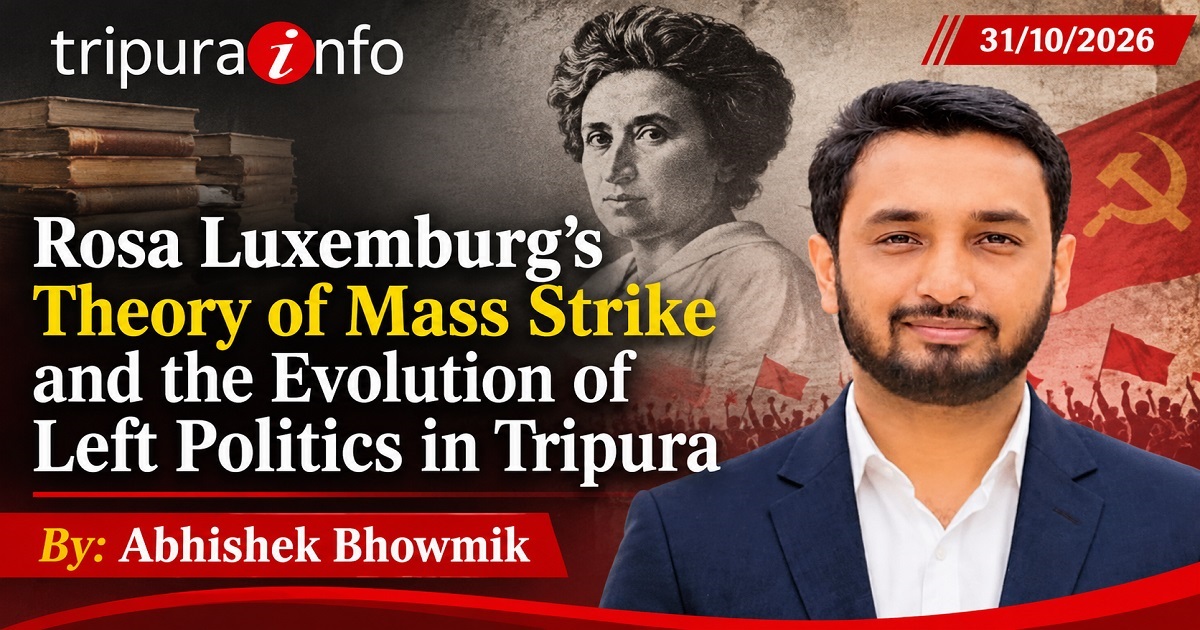
Rosa Luxemburg's Theory of Mass Strike and the Evolution of Left Politics in Tripura
By: Abhishek Bhowmik
October 31, 2026
1. Introduction
M.A. in Political Science, Sociology, and Public Administration
Political movements play an important role in shaping democratic institutions, social relations, and public policy. In a democratic society, political change does not depend only on elections or government institutions. It is also influenced by collective action, public participation, political consciousness, and the organisation of people around common social and economic interests.
In this context, the political philosophy of Rosa Luxemburg, one of the most influential Marxist thinkers of the early twentieth century, offers an important theoretical framework for understanding mass movements. Her work The Mass Strike, the Political Party and the Trade Unions, published in 1906, explores the relationship between popular participation, class consciousness, political organisation, and collective action.
The historical development of Left politics in Tripura provides an interesting regional context for examining these ideas. The state has a distinctive political history shaped by agrarian society, tribal communities, organised political movements, democratic institutions, and the participation of workers, peasants, and other social groups.
The Communist Party of India (Marxist), commonly known as CPI(M), has played a significant role in this history, particularly through its participation in the Left Front government and its engagement with organised political and social movements.
This article examines Rosa Luxemburg's theory of mass strike and collective action in relation to the evolution of Left politics in Tripura. Its central objective is to understand how political ideology, mass mobilisation, social organisation, and democratic participation contribute to the development of regional political movements.
2. Rosa Luxemburg: A Major Thinker in Marxist Political Theory
Rosa Luxemburg (1871-1919) was a prominent Marxist theorist, political economist, and revolutionary socialist. Her writings examined capitalism, class relations, political participation, revolutionary movements, and the role of organised working people in historical change.
Luxemburg developed her political ideas within the wider intellectual tradition of Marxism. Karl Marx had emphasised the importance of class relations, material conditions, and historical processes in understanding society. Luxemburg extended these discussions by examining how collective political action develops through the interaction between social conditions and popular experience.
One of her major contributions was her understanding of mass movements as dynamic historical processes. According to her approach, collective action cannot always be explained as the result of a decision taken by political leaders or organisations alone. Mass movements develop through the interaction of economic conditions, political events, public experience, and growing collective consciousness.
Her theory therefore provides a useful starting point for studying political mobilisation beyond formal institutions.
Luxemburg also recognised the importance of political organisation. Political parties, trade unions, and other collective organisations can help people understand their shared interests, articulate demands, and coordinate political action.
Her approach connects three important dimensions of political science:
1. Political consciousness: The development of people's understanding of their social and economic circumstances.
2. Collective action: The ability of individuals to participate in organised efforts around shared objectives.
3. Political organisation: The institutions and organisations through which collective interests are expressed.
These concepts provide an analytical foundation for examining the historical development of Left politics in Tripura.
3. Understanding the Theory of Mass Strike
The theory of mass strike is one of Luxemburg's most important contributions to Marxist political thought. In her 1906 work, she examined the mass strikes associated with the Russian Revolution of 1905 and explored their relationship with political and economic struggles.
For Luxemburg, a mass strike was not simply a temporary withdrawal of labour. It represented a broader process through which economic demands, political aspirations, public participation, and collective consciousness could interact.
She argued that political movements emerge through historically specific circumstances. Economic grievances may encourage collective action, while participation in collective action can deepen political understanding and strengthen social solidarity.
The theory can be understood through four interconnected concepts.
First, collective participation. Individuals become participants in a wider movement when they recognise common interests and engage in collective activities.
Second, class consciousness. People develop an understanding of how their economic position relates to wider social and political structures.
Third, political learning. Participation in movements can provide practical experience of organisation, leadership. negotiation, and democratic engagement.
Fourth, organisational coordination. Political parties, trade unions, and other associations can help articulate demands and connect local concerns with wider political objectives.
These concepts are relevant to the study of regional political movements because they direct attention towards the relationship between people's everyday experiences and their participation in organised politics.
However, Luxemburg's mass-strike theory was developed in a particular European historical context. Its application to Tripura should therefore be analytical rather than literal. Electoral politics, regional social structures, constitutional institutions, and mass movements operate under different conditions in different societies.
4. Tripura's Historical and Social Context
Tripura occupies a distinctive position in the political history of Northeast India. Its social composition, geographical location, agrarian structure, and cultural diversity have influenced the development of political organisations and public institutions.
According to the 2011 Census, Tripura had a total population of 3,671,032. The Scheduled Tribe population was 1,166,813, representing approximately 31.8 per cent of the state's population. These figures demonstrate the importance of tribal society in understanding Tripura's social structure and political development.
The state is home to multiple tribal communities, each with distinctive cultural identities, languages, traditions, and historical experiences. Bengali-speaking communities also form an important part of Tripura's social and political landscape.
Consequently, the state's political development cannot be understood through a single social category. Class, ethnicity, land relations, cultural identity, regional development, and access to public institutions all contribute to the formation of political interests.
From a Marxist perspective, the relationship between material conditions and political consciousness is particularly relevant. Questions concerning land, employment, agricultural livelihoods, education, social welfare, and access to public resources can influence how communities participate in political life.
At the same time, regional political analysis must recognise that class relations interact with tribal identity, language, culture, and constitutional arrangements.
This makes Tripura an important case for studying the relationship between Marxist political theory and the realities of a diverse Indian state.
5. The Historical Development of Left Politics in Tripura
The growth of Left politics in Tripura was part of a broader process of political mobilisation and democratic development. Over time, organised Left movements established connections with different sections of society. including workers, peasants, rural communities, and sections of the tribal population.
The CPI(M)-led Left Front became a major force in Tripura's electoral politics. Its first major electoral victory in the state assembly election of 1977 marked an important stage in the institutional development of Left governance.
The Tripura Human Development Report records the formation of a Left Front government following the 1977 election. It also documents the subsequent electoral history of the state and the development of institutions of local self-government.
The Left Front's political presence continued through several subsequent electoral cycles. CPI(M) and its allies participated in state governance, legislative politics, and organised political activity over an extended period.
This history is significant because it illustrates how a political movement can become established within a constitutional democratic system. Ideological mobilisation, party organisation, public participation, electoral competition, and government institutions form interconnected parts of this process.
The experience of Left politics in Tripura therefore provides a useful regional setting for examining the relationship between mass participation and political organisation.
6. CPI(M), Mass Organisation, and Political Participation
Political parties are important institutions in representative democracy. They organise political ideas, select candidates, communicate policy objectives, mobilise voters, and provide channels through which citizens can participate in public affairs.
In the context of Left politics, mass organisations have historically provided additional platforms for collective participation. Workers' associations, farmers' organisations, student groups, youth organisations, and women's organisations can connect specific social concerns with wider political debates.
The importance of these organisations can be understood through the concept of political socialisation. Political socialisation refers to the process through which individuals acquire political knowledge, values, attitudes, and patterns of participation.
Participation in meetings, public discussions, campaigns, community activities, and collective organisations may help individuals understand public policy and develop organisational skills.
From this perspective, the historical role of CPI(M) in Tripura can be studied through its organisational networks and its engagement with different sections of society.
Such an approach does not require the assumption that every participant shares identical motivations. People may participate in political organisations because of economic interests, ideological commitments, community concerns, leadership relationships, or expectations regarding public services.
The analytical importance lies in understanding how these different motivations become connected through political organisation.
Luxemburg's theoretical framework encourages attention to the relationship between popular participation and organised political action. In the Tripura context, this provides a way to examine how social demands can enter political institutions and become part of wider public debates.
7. Electoral Democracy and the Institutionalisation of Left Politics
One of the most important features of Tripura's political history is the relationship between ideological politics and electoral democracy.
Political movements may originate in social mobilisation, but their participation in democratic governance requires engagement with elections, legislative institutions, public administration, and constitutional procedures.
The development of Left politics in Tripura demonstrates the significance of these institutional dimensions.
The Election Commission of India maintains historical statistical reports covering Tripura's assembly elections, providing an official basis for examining the state's electoral development.
The 2013 Tripura Legislative Assembly election provides a clear example of the electoral strength achieved by the Left Front. CPI(M) won 49 of the 60 assembly seats, while its alliance partners also secured representation. The Left Front consequently returned to government for another term.
This result illustrates the importance of electoral mobilisation and party organisation in a parliamentary democracy.
It also highlights a central distinction in political science: mass movements and electoral politics are connected, but they are not identical.
A mass movement involves collective participation around shared demands or objectives. An election, by contrast, is a formal mechanism through which citizens choose representatives under constitutional rules.
Political organisations can connect these two processes by translating social concerns into policy proposals, electoral programmes, and legislative priorities.
Luxemburg's emphasis on collective political activity offers a theoretical perspective for understanding the relationship between participation and organisation. In Tripura, this relationship can be examined through the historical interaction between political campaigns, community mobilisation, electoral institutions, and government.
8. Land, Agrarian Society, and the Political Economy of Tripura Land relations are an important subject in the political economy of rural societies.
Political economy examines the relationship between economic structures, political institutions, power, and the distribution of resources. In an agrarian society, land ownership, tenancy, agricultural employment, access to productive resources, and rural development can influence both social relations and political participation.
These questions are particularly relevant to Tripura because rural livelihoods and agricultural concerns have historically formed part of the state's political landscape.
Left political movements in India have often emphasised agrarian reform, the protection of agricultural workers, and the economic interests of small and marginal farmers. The historical experience of Left governance in Tripura can be studied within this wider framework.
However, a data-based analysis should distinguish between policy objectives, the legal provisions introduced, their actual implementation, and measurable social outcomes.
For example, research on land reform should examine relevant legislation, land distribution records, tenancy arrangements, agricultural statistics, and official development reports. Such evidence allows researchers to understand how institutional changes affect rural communities.
Luxemburg's theory contributes to this discussion by highlighting the relationship between material conditions and collective political consciousness.
When people experience common economic concerns, these concerns may become the basis of collective demands. Political organisations can provide channels through which such demands are articulated and discussed within the democratic system.
Thus, the study of agrarian politics in Tripura connects Marxist concepts of class relations with regional questions of livelihood, social justice, and rural development.
9. Tribal Society, Political Representation, and Democratic Participation The relationship between tribal identity and political organisation is essential to understanding Tripura.
The state's Scheduled Tribe population represented approximately 31.8 per cent of the total population in the 2011 Census. This demographic reality makes tribal representation, cultural recognition, regional development, and political participation important areas of research.
The Tripura Tribal Areas Autonomous District Council, or TTAADC, is an important constitutional institution in this context. It provides a framework for autonomous administration in designated tribal areas.
The Tripura Human Development Report discusses the role of the TTAADC alongside the state's local self-government institutions. It identifies the council's role in providing a degree of self-government to tribal communities.
From a political science perspective, the council can be examined through the concepts of decentralisation, political representation, autonomy, and participatory governance.
Decentralisation involves the distribution of authority across different levels of government.
Political representation concerns the mechanisms through which social groups participate in decision-making. Participatory governance emphasises citizens' involvement in public affairs beyond voting alone.
A Marxist analysis can complement these approaches by examining the relationship between economic interests, social inequalities, and political participation.
Nevertheless, tribal identity should not be reduced to class alone. Cultural rights, language, customary practices, territorial concerns, and historical experiences have independent importance in shaping political life.
A comprehensive study of Tripura's Left politics must therefore examine how class-based political ideas interact with the state's diverse social identities and constitutional institutions.
10. Political Consciousness and Collective Action: A Luxemburgian Interpretation
Luxemburg's theory offers three particularly useful concepts for interpreting political movements in Tripura.
The first is political consciousness. People develop political understanding through education, social interaction, economic experience, public discussion, and participation in collective activities.
The second is collective agency. Collective agency refers to the capacity of people to act together in pursuit of shared objectives. Political parties and social organisations may facilitate this process by providing structures for coordination and communication.
The third is the relationship between leadership and participation. Political leadership can articulate objectives, develop organisational strategies, and connect local concerns with wider political programmes. At the same time, public participation provides political organisations with information about social needs and community priorities.
These concepts help explain why political movements should be studied as social processes rather than solely through election results.
In Tripura, a Luxemburgian interpretation could investigate the relationship between grassroots mobilisation, organised political activity, electoral participation, and the development of political institutions.
Such research could examine historical party documents, public speeches, election manifestos, newspaper archives, oral histories, and interviews with political activists and community members.
A balanced analysis would include evidence from different social groups and political perspectives. This would help distinguish between the stated objectives of political organisations, the experiences of participants, and the measurable outcomes of political activity.
The purpose of applying Luxemburg's theory is not to assume that Tripura's experience reproduces the historical circumstances of early twentieth-century Europe. Rather, it is to use her concepts to ask meaningful questions about collective action, political consciousness, and democratic participation in a different historical setting.
11. A Data-Based Approach to Studying Left Politics in Tripura
A systematic study of the relationship between mass movements and Left politics requires reliable historical and statistical evidence.
Four categories of data are particularly useful.
Electoral data: Election results, party-wise seat totals, vote shares, voter turnout, and constituency-level changes can help explain the development of electoral support. The Election Commission of India provides historical statistical reports for Tripura's assembly elections.
Demographic data: Census information can help researchers understand population composition, literacy, rural and urban distribution, and the demographic context of political participation. The 2011 Census recorded 1,166,813 Scheduled Tribe residents in Tripura.
Institutional data: Government reports, legislation, local-government records, and administrative publications can help researchers examine decentralisation, land policy, development programmes, and public administration.
Historical and qualitative evidence: Party documents, newspapers, interviews, speeches, memoirs, and academic studies can provide information about political ideas, organisational development, and the experiences of participants.
Combining these sources allows researchers to connect theoretical arguments with empirical evidence.
For instance, election results can establish the scale of electoral support, but they cannot independently explain why voters supported a party. Interviews and historical research can help investigate the social and political processes behind those results.
Similarly, the existence of a government programme does not automatically establish its social impact. Researchers must examine implementation records and relevant outcome indicators.
This methodological distinction is central to evidence-based political science.
12. Contemporary Relevance and Future Research Rosa Luxemburg's theory remains relevant as a framework for investigating the relationship between organised politics and popular participation.
For the study of Tripura, it raises several important research questions:
1. How have workers, peasants, students, and community organisations contributed to the historical development of Left politics?
2. What role have local political organisations played in connecting community concerns with state-level politics?
3. How have class relations interacted with tribal identity and regional political institutions?
4. What relationship exists between grassroots participation and electoral mobilisation?
5. How have political organisations contributed to political education and civic engagement?
These questions can be investigated through historical comparison and contemporary empirical research.
A longitudinal study covering several election cycles could examine changes in electoral support alongside demographic, economic, and institutional developments.
Interviews with political activists and community members could complement the statistical analysis.
Researchers could also compare the experiences of different districts to understand how local economic conditions, social composition, and organisational networks influence political participation.
Such research would contribute to the wider study of Indian federalism, regional political movements, democratic decentralisation, and Marxist political thought.
It would also provide an opportunity to examine how international political theories can be interpreted within the specific social and historical conditions of Northeast India.
13. Conclusion
Rosa Luxemburg's theory of mass strike provides an important perspective for understanding the relationship between collective action, political consciousness, and organised movements.
Her work emphasises that political participation develops through the interaction of social conditions, collective experience, and organisational activity. These ideas offer a valuable conceptual framework for examining the historical development of Left politics in Tripura.
The state's political history includes the growth of organised Left movements, the electoral achievements of the CPI(M)-led Left Front, the development of local self-government, and the continuing significance of tribal representation and regional institutions.
The historical record, including the Left Front's victory in the 1977 assembly election and CPI(M)'s 49-seat performance in the 2013 election, demonstrates the importance of organised political participation in Tripura's democratic development. Official demographic data also underline the importance of tribal society in understanding the state's political structure.
At the same time, a comprehensive interpretation must recognise that Tripura's political experience is shaped by its own historical, cultural, economic, and constitutional conditions.
Luxemburg's ideas should therefore be used as analytical tools rather than as a ready-made explanation of every regional political development.
Ultimately, the study of mass movements in Tripura highlights the relationship between citizens, political organisations, social interests, and democratic institutions. It demonstrates why political science must examine not only electoral outcomes but also the wider social processes through which people develop political awareness and participate in collective life.
By connecting Marxist political theory with historical evidence and regional experience, researchers can develop a deeper understanding of Tripura's political evolution and the continuing significance of mass participation in democratic society.
Selected References
2. Luxemburg, Rosa. The Mass Strike, the Political Party and the Trade Unions (1906).
3. Election Commission of India. Election Results and Statistical Reports: Tripura Legislative Assembly Elections.
4. Government of Tripura. Tripura Human Development Report.
5. Government of Tripura. Economic Review of Tripura 2019-20.
6. Office of the Registrar General and Census Commissioner, India. Census of India 2011: Scheduled Tribe Population Data.
Online Source Links
1. https://www.marxists.org/archive/luxemburg/1906/mass-strike/index.htm
2. https://www.eci.gov.in/statistical-reports
3. https://trpenvis.nic.in/test/doc_files/state_development_report.pdf
4. https://tripura.gov.in/sites/default/files/ECONOMIC-REVIEW-2019-20.pdf
Note: This PDF presents the extracted text with OCR spacing and obvious formatting issues cleaned up. The factual claims, arguments, and reference details have not yet undergone academic verification. The original reference list begins with reference number 2.
(Tripurainfo)
more articles...