Tapas Dey : The Flame That Has Passed into Memory!!!
Biswanath Bhattacharya
September 12, 2026
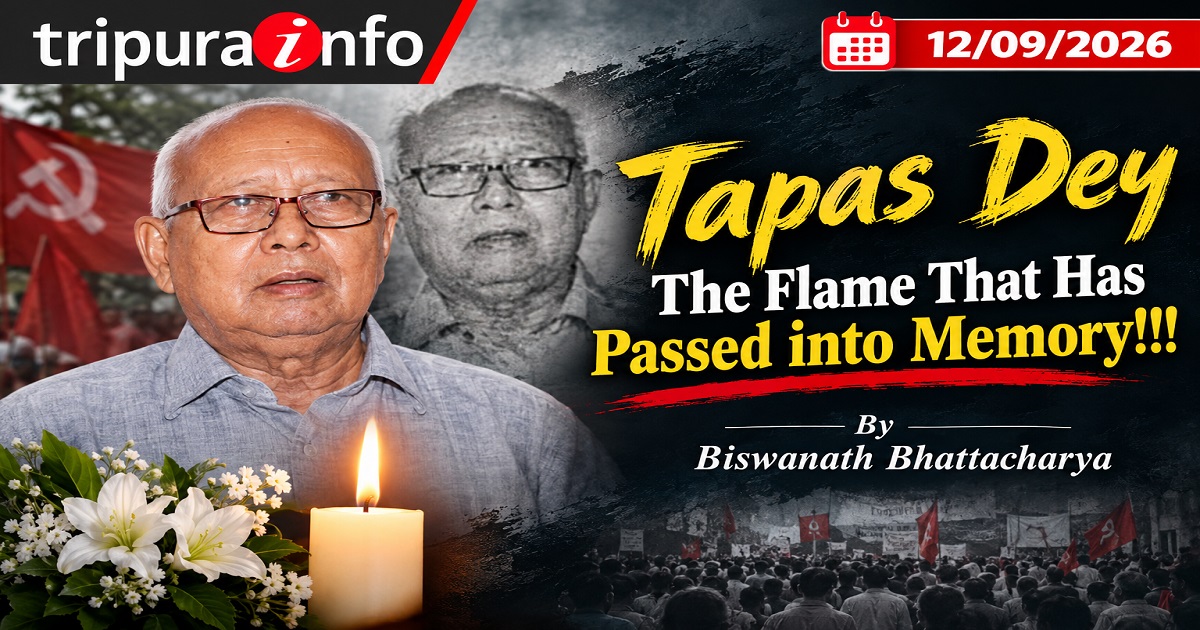
With his death, an era has ended—not merely an era in Tripura’s politics, but an era in which honesty could still walk into a political room without disguise. At 1:45 this morning, Tapas Dey—former MLA, veteran of Tripura’s public life, and, to me, always my beloved Tapas da—passed away at the age of eighty-four. The world was still asleep when the news entered my life like a blade. Since then, I have been trying to accept a sentence my heart refuses to read: Tapas da is no more. Honest politicians have always been painfully few; today, that emptiness feels immeasurable. In my eyes, Tapas da was perhaps the last lamp of honesty—a small but steadfast light that neither ambition, adversity nor changing political allegiance could extinguish. With that lamp gone, the corridors of public life seem darker, colder and more desolate. Yet this morning it is not the politician I first remember. I remember the familiar voice, the sudden telephone call, the trust in his eyes, and the affectionate insistence with which he would ask whether I had eaten.
Tapas da came to Tripura in 1965 as a refugee from then-East Pakistan, carrying six annas and an unconquered will. In a strange land, with neither privilege nor protection, he fashioned a life from grit. At the State Tripura Polytechnic and later at Ram Thakur College, where he was elected General Secretary, leadership found him early. In 1972, he won the Shalgara seat and became Tripura’s youngest MLA. All India Radio announced his victory; history announced the arrival of a man who would remain inseparable from the state’s political memory.
He was quintessentially a political figure—instinctive, seasoned and tirelessly engaged. For decades he was a loyal soldier of the Indian National Congress, devoted especially to Priyadas Chakraborty and schooled in an age when loyalty was treated as a moral vow. Later, disappointed by the paths before him, he changed his political course: first through the Tripura Democratic Front and then into the fold of Tipra Motha, where he became a steadfast loyalist and a trusted elder to Maharaja Pradyot Kishore Manikya Bahadur. Some called it changing colours. I saw, beneath the change, the same restless search for relevance, purpose and a cause worthy of his remaining strength.
But the public man is only one part of the Tapas da I mourn. The Tapas da I knew came to me with words still unformed and trusted me to give them shape. He hardly ever wrote a line himself. His confidential letters, private communications, political appeals—every delicate message, every secret thought that had to travel beyond the room—passed through my pen. Sometimes he would speak; sometimes a glance was enough. He knew I would understand what he wished to say, and he knew I would guard what must never be said. I never broke that trust. Today, when he can no longer dictate another letter, I realise that those pages were not merely political drafts; they were the diary of a friendship written in confidence. I shall carry his secrets honourably to my own grave.
He expressed affection in the old, generous way—through food, fuss and a refusal to let a guest leave unsatisfied. He would feed me the choicest fish and the finest sweets, watching my plate with almost brotherly vigilance. I can still hear him urging me to take one more piece. What seemed ordinary then has become sacred now. I would give anything to sit at that table once more, to hear his familiar insistence, to complain half-heartedly that I had eaten enough, and to know that he was sitting across from me. Grief enters through the smallest doors: the remembered taste of a sweet, an empty chair, a plate no loving hand will fill again.
My wife, Mamata, too, regarded him as her own brother, and he embraced her with the same unforced affection. A short while ago I told her the saddest news of my life. For a moment she stared at me as though the words could not possibly be true; then she began to cry, helplessly and profusely. I had no words with which to console her, because I was broken by the same loss. We sat with one name between us—Tapas da—and suddenly our home felt lonelier than it had ever felt before. There are moments when language becomes a poor vessel for sorrow. Today is such a moment. The man who trusted my pen with everything has left that pen numb.
Tapas da was not without contradictions; no life lived so intensely could be. He could be fiery and silent, stubborn and tender, political to the marrow yet deeply personal in his loyalties. He did not seek merely to occupy a chair; he wished to shape events, to stand near the hinge of history and push. Even when electoral fortune deserted him, he refused to become a footnote. In 2023, at an age when many withdraw into recollection, he returned to the arena as a Tipra Motha candidate. Defeat could halt his campaign, but never extinguish his zeal.
His passing closes more than a life. It closes a window into an older Tripura—the Tripura of refugee struggle, student politics, crowded party offices, handwritten messages, fierce loyalties, bruising arguments and friendships that survived them all. That generation had its faults, but it still understood that public life demanded sacrifice, that loyalty carried a price, and that a man’s word ought to weigh more than his convenience. Tapas da carried something of that vanishing ethic within him. In an age when politics so often rewards calculation over conscience, he remained, in my eyes, the last lamp of honesty. The lamp had grown old; the winds around it were often cruel; yet it refused to go out. Today, that light has finally disappeared from our sight, and the darkness it leaves behind is not his alone—it belongs to the whole political life of Tripura. The roads he walked remain; the rooms in which he planned and persuaded remain; but the air inside them will never be quite the same. Somewhere, it will always seem that Tapas da is about to enter, carrying urgent news, an unfinished argument, and one more letter for me to draft.
I have written this tribute with moist, tearful eyes. I was scheduled to visit my orthodontist today, but I cancelled the appointment; how could I attend to the ordinary business of the day when a part of my own life had just been extinguished? The lamps of honesty in public life are being put out one by one, and with every flame that dies, the darkness grows a little deeper. Today, with Tapas da’s passing, I feel that one of the last and brightest of those lamps has burnt down. The appointment can wait; grief cannot. Before doing anything else, I had to sit before this page and write for the man whose thoughts had so often travelled through my pen.
Farewell, Tapas da. I do not know how to write this last letter because, for the first time, you are not here to tell me what it should say. You trusted my pen with your secrets; today that same pen trembles before the finality of your silence. Who will now call with an urgent thought? Who will ask me to turn an unfinished sentence into a letter? Who will watch my plate and insist upon one more piece of fish, one more sweet? You treated Mamata as a sister and filled our home with an affection we had come to take for granted. Death has taught us, too late, that such love is never ordinary. We loved you through the days of struggle, through changing banners, through victories, reverses and the quiet twilight of your life. We love you still—and we shall miss you in ways that words will discover only slowly.
May the Almighty receive your soul in peace. May the soil of Tripura, which you served and loved, remember your footsteps. And may the flame that was Tapas Dey—restless, loyal, defiant—burn on in the hearts of those who knew him.
“Honesty is the lamp a true public servant leaves behind; even when the hand that carried it is gone, its light continues to accuse the darkness.”
(Tripurainfo)
more articles...