KV Satyanarayan: The Lamp That Refused the Darkness!!!
Biswanath Bhattacharya
May 28, 2026
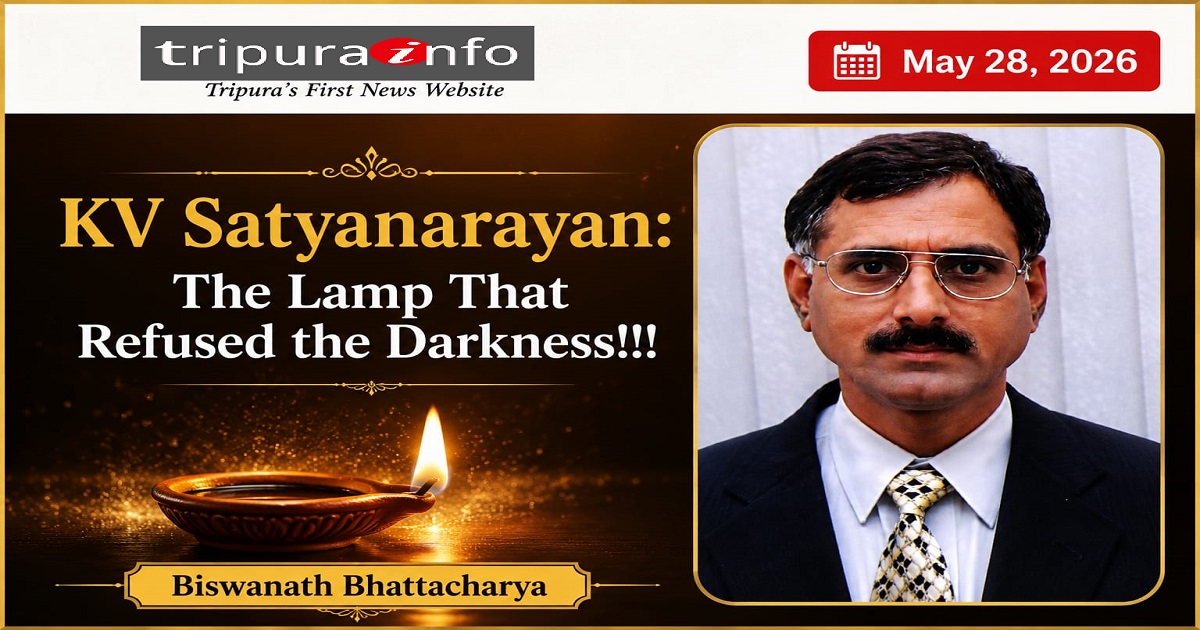
I cannot now recall the exact year, perhaps 1985–86, perhaps a little later—but memory, when it is touched by destiny, preserves not the calendar but the light. It was in the TPSC that I first met a very young gentleman: slightly short in stature, quiet in bearing, yet marked by a pair of piercing eyes that seemed to speak before his lips did. I had approached him with some anxious queries concerning an examination matter. He listened with rare patience, not interrupting, not dismissing, not displaying the vanity that often accompanies newly won success. When he replied, he did so with lucidity, precision, and astonishing intelligence. His answers were not merely correct; they were illuminating. When I asked his name, he said with unaffected simplicity that he was KV Satyanarayan from Andhra Pradesh, now Telangana and that he had only recently been selected to the Indian Administrative Service. Even in that fleeting encounter, one could sense that this was no ordinary young officer. There was discipline without hardness, intelligence without arrogance, and gravity softened by gentleness. Some men introduce themselves by rank; he introduced himself by character.
Thereafter, life carried us apart, and I had almost forgotten that brief but striking encounter. Yet Providence, which sometimes arranges meetings with the gravity of a hidden script, brought him before me again in 1987–88, when he was serving as District Magistrate and Collector, South Tripura, Udaipur. I cannot honestly say that my first experience under him was wholly pleasant. At that time he appeared to be moving, at least in part, under the baleful influence of a one-eyed Tripura Civil Service officer whose reputation had long been a byword for moral corruption. That man seemed to embody all that is poisonous in public life: intrigue without scruple, ambition without ethics, and influence without honour. His career itself had long invited whispered disbelief, for many held that political favour, rather than merit, had carried him into office. Around his name clung stories of notoriety and shameless conduct, and he came to symbolize how deeply partisan power can stain institutions meant to remain upright. To think that a satvik and cultured Brahmin like Satyanarayan could, for a while, fall within the radius of such a destructive presence was a matter of sorrow to me. Evil seldom announces itself with drums; it enters quietly, flatters authority, and seeks to bend bright minds toward shadow. But the true test of a man is not whether darkness approaches him; it is whether darkness can finally claim him.
In those days I was entrusted with a very insignificant charge—the Citizenship Section. It was hardly a five-minute job. Yet what seemed at first like neglect proved to be a blessing in disguise. The meagreness of official work gave me the freedom to cultivate my mind. The district library was poor, almost barren, and so I had to procure books from Agartala. By two or three days I would finish one and begin another. I also subscribed to two newspapers so that I might deepen my awareness of current affairs and refine my command of English. Among newspapers, The Statesman was to me a stern and elegant tutor; from it one could learn not only news, but cadence, restraint, and the subtle discipline of correct usage. Thus, in a small room and under an unimportant assignment, I continued my private apprenticeship to language and thought. Looking back, I feel that those silent days of reading prepared me to recognize greatness when I stood near it.
For Satyanarayan was, in truth, one of the brightest officers I have known. His mind was not merely efficient; it was innovative, exploratory, and restlessly alive. He possessed that rare administrative imagination which sees beyond files, beyond routine, beyond the dead habit of precedent. He was able to detect possibility where others saw only procedure. Leadership in him was never theatrical. It revealed itself in the clarity of his grasp, the swiftness of his comprehension, the seriousness with which he treated public responsibility, and the energy with which he sought development for the district. Beside him stood Shri RK Singh, IAS, his second in command, and together they applied their brilliance to the advancement of South Tripura. Their work bore the stamp of officers who wished not merely to govern but to build. Administration, in such hands, ceased to be a machinery of signatures and became instead an instrument of transformation.
“Some men hold office; a rarer few give office a conscience.”
Then, suddenly, he was transferred. In his farewell speech, his frustration was plainly visible. The pain was understandable. Every serious officer desires that the projects he has initiated should move toward meaningful completion; for creative labour seeks fulfillment, not abrupt severance. Yet governments are often indifferent to this human and administrative truth. They transfer the architect before the structure has risen, and in doing so they interrupt not merely tenure but vision. In his disappointment there was no pettiness. What one felt was the anguish of a man who had ideas still unfolding, plans still breathing, and service still to render. His regret was itself a testimony to the sincerity of his commitment.
After his transfer I did not work under his direct control for many years. Later, in 1998–99, I was transferred to the Revenue Department and remained there until 2003–04. There I came across three legendary officers, among them Sudhir Sharma, whose standards were formidable, and before whom many Joint Secretaries and Deputy Secretaries struggled to satisfy expectations. By good fortune and persistent labour, I somehow did. Then came R. P. Meena, who was more like a brother than a superior. And there once again I encountered Satyanarayan Sir, along with Shri Debashish Sircar, IAS. It was then that a fuller revelation occurred. The officer who may once have held an unfavourable impression of me came to discover me in my full glow; and I, in turn, discovered the astonishing versatility and brilliance of his mind. His English was superb—graceful, exact, and commanding. More than that, I discovered in him a rare broadmindedness. He was not cramped by ego, prejudice, or vanity. He was well read, intellectually alert, and generous in appreciation. He praised, in eloquent language, those who deserved praise. That quality is rarer than brilliance itself. Many are clever; few are magnanimous. Satyanarayan Sir was both.
After retirement, when I began posting jokes on Facebook, I again came within the range of his attention. I still remember the wise advice of my Facebook friend Ajay Chaturvedi, who urged me to publish those pieces in book form, perhaps around 2014–15. To be truthful, financial hardship stood in the way, and I now look back with regret. But Satyanarayan Saheb, true to his habit of encouraging merit wherever he found it, praised those writings with warmth and refinement. Encouragement, when it comes from an ordinary person, is pleasant; when it comes from a mind of depth and discrimination, it becomes unforgettable. His praise was never hollow compliment. It arose from discernment, from literary sensitivity, and from the largeness of a man who delights in the gifts of others.
Now he is among my closest friends on WhatsApp. Whenever he finds an article of mine to be of value, he praises it with an openness of mind that reveals both humility and culture. Over time I have continued to notice the incisiveness of his intellect. His prediction regarding the West Bengal election, made seven or eight months in advance—proved correct, though at the time I had vehemently disagreed with him. That difference only exposed my immaturity and his mature judgment. He sees farther because he thinks deeper. His mind is analytical without being dry, sharp without being cruel, and experienced without becoming cynical. In conversation one feels the discipline of reading, the polish of reflection, and the steadiness of a man who has learned to weigh events without noise.
Even in the small things, character reveals itself. In his WhatsApp display picture, he appears alongside his wife. That simple choice speaks eloquently of affection, respect, and companionship. To him, wife is not an ornament to life but its honoured presence, almost a goddess in the sacred domestic sense of the word. In an age when public accomplishment often coexists with private barrenness, this quiet reverence becomes deeply meaningful. It shows a man capable not only of governing institutions but of cherishing relationships; not only of command, but of devotion.
KV Satyanarayan remains, to my mind, a man of piercing intelligence, administrative imagination, literary grace, broad sympathies, and noble-hearted generosity. I first saw in him a promising young officer; later I saw a district leader of vision; and later still I came to know a cultivated, broadminded, and deeply humane personality whose words of appreciation dignify those who receive them. If, for a passing season, the shadows of lesser men seemed to fall across his path, they could neither diminish nor define him. The essential man remained untouched: luminous in mind, large in spirit, and steadfast in character. That is how I remember him, and that is how I honour him, not as one who merely held high office, but as one who carried within himself a rarer sovereignty: the authority of intellect, the grace of culture, and the quiet radiance of a generous soul. Long after offices change hands and power passes into other names, such a man continues to live in memory like a lamp that neither wind nor darkness can put out.
(Tripurainfo)
more articles...