A Thunderous Promise- The Statehood of Tripura !!!
Biswanath Bhattacharya
January 20, 2026
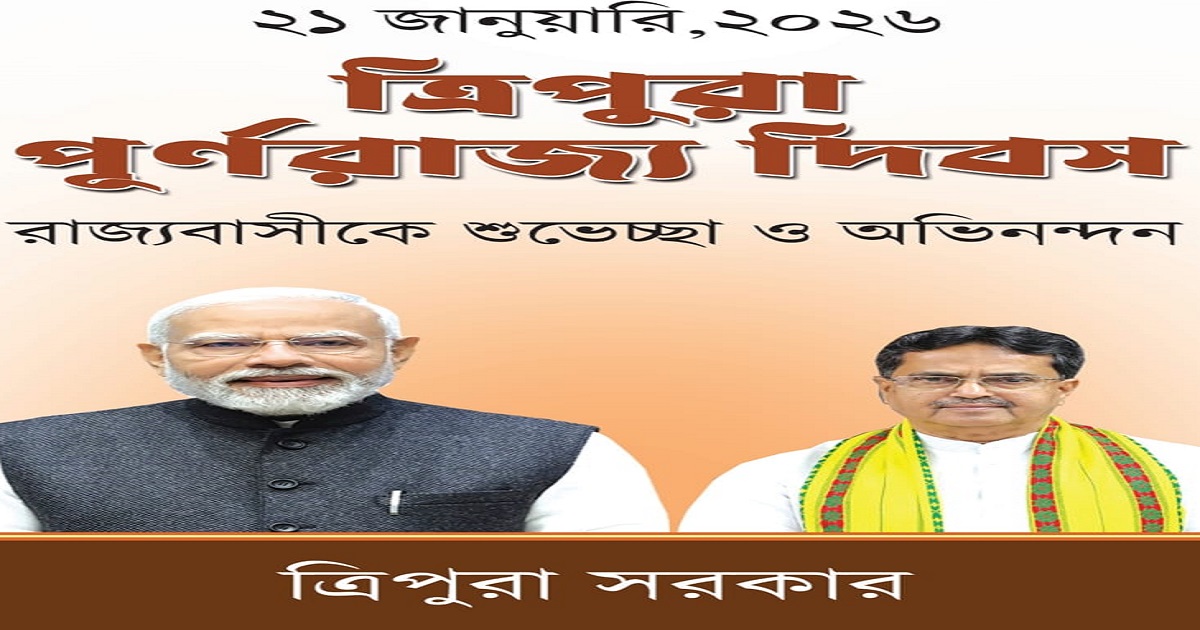
I remember that day as if the sky itself leaned closer to listen. It was the 21st of January 1972, and the Assam Rifles ground in Agartala had become a single living thing—heaving, bright, and unbearably hopeful. People pressed in from every lane and hillside; there was not room for a pin. Faces glowed with the reflected light of banners and the winter sun, and every throat seemed to hold the same word: at last. When Indira Gandhi stepped into that space, she carried with her the weight of recent storms and the quiet authority of someone who had learned to turn crisis into decision. Her voice cut through the air and, in a single sentence, turned longing into law. The applause that followed was not merely sound; it was a release, a chorus of relief and triumph that rolled across the ground like thunder.
The year before, the world around us had been remade. The struggle that birthed a new nation had left its mark on every border town and every household that had opened its doors to the displaced. The liberation that unfolded nearby was not an abstract headline; it was a living, urgent thing—families arriving with nothing but stories, fields pressed into service for shelter, nights spent listening for news. Under the pressure of those events, leadership had to be decisive, and decisions had consequences that reached into our daily lives. For many of us in Tripura, the emergence of a neighboring country sharpened the need for recognition and governance that understood our particular realities—our tribal cultures, our border anxieties, our hopes for development. When the declaration came, it felt as if the map had finally learned to name us properly.
Yet the spectacle of that day—magnificent and unforgettable—was only the visible crest of a long, patient tide. Behind the scenes, across villages and party offices, in classrooms and union halls, a thousand small labors had been knitting the possibility of statehood into being. The demand for recognition was not the monopoly of any single banner. Congress leaders argued the case in corridors of power; CPI(M) cadres kept the pressure alive in the streets and the panchayats; CPI thinkers framed the demand in terms of social justice and equitable governance; RSP activists carried the message into workplaces and tea gardens. Each group brought its own language and its own tactics: petitions and protests, midnight strategy sessions and dawn vigils, legislative motions and grassroots education. Where one voice faltered, another rose; where one tactic stalled, another found purchase. It was a choreography of persistence—sometimes discordant, often tense, but always bound by a shared conviction that Tripura’s future deserved a fuller, clearer place in the nation.
There is a particular kind of eloquence in such persistence. It is not the flash of rhetoric but the steady accumulation of insistence: the petition that returns again and again until it can no longer be ignored; the committee that refuses to disband until its questions are answered; the local leader who walks from hamlet to hamlet until the demand becomes a communal heartbeat. Political parties, though divided on many fronts, discovered in this cause a rare common ground. They translated local grievances into national conversations, and in doing so they taught a lesson about the power of sustained civic will. The work behind the curtain—negotiations, compromises, the slow alchemy of policy—was as vital as the public moment when the declaration was spoken.
Statehood changed the grammar of our lives. It was more than an administrative label; it was a reconfiguration of possibility. With statehood came a nearer seat at the table where decisions are made, a clearer channel for resources, and the authority to shape policies that reflected Tripura’s distinct cultural and geographic needs. It meant institutions that could address tribal rights with sensitivity, that could plan infrastructure with local knowledge, that could respond to border realities with both firmness and humanity. For farmers it promised better access to support and markets; for students it opened the prospect of institutions that would nurture local talent; for families it offered the hope of hospitals and schools that were not distant abstractions but reachable realities. Above all, statehood conferred dignity—the recognition that our history, our languages, and our aspirations mattered in the larger story of the nation.
The path to that dignity was not without cost. There were nights of anxious waiting when negotiations seemed to stall, mornings when promises felt fragile, and moments when old grievances threatened to unravel the fragile consensus. Courage showed itself in many forms: in the leaders who risked political capital to press the case, in the activists who marched despite fatigue and weather, in the communities who kept faith when hope might have been easier to abandon. Compromise was often necessary; it was the price paid for a durable settlement that could carry the weight of governance and the promise of progress.
When the declaration was made, the crowd’s reaction was immediate and whole. People wept openly; strangers embraced as if they had always known one another; children, who had been born into uncertainty, suddenly found themselves standing in a future that felt less precarious. The applause rolled and rolled, a thunder that seemed to say: we have been seen. In that sound were the echoes of every petition, every march, every sleepless night of negotiation. It was a moment when leadership and longing met, when the decisive act of a national figure intersected with the patient insistence of a people.
Looking back, the day of 21st January 1972 , remains a portrait of collective achievement. It reminds us that history is rarely the work of a single hand; it is the product of many hands, some visible and some hidden, all pulling toward a common horizon. The declaration on that packed ground was a milestone, yes, but it was also a beginning—a call to build institutions, to heal divisions, and to translate the exhilaration of a single day into the steady labor of governance. The promise of that moment has been tested and remade in the years since, but its core endures: when communities persist and leaders answer, when courage meets patience, the map of possibility expands.
(Tripurainfo)
more articles...