Madhav Gadgil's Legacy: Transforming Science and Conservation
Anupam Guha
January 29, 2026

Among the several distinguished personalities whose names will be inscribed in golden letters in the history of India's environmental movement and modern environmental science, Madhav Dhananjay Gadgil stands out. He was not only a profoundly knowledgeable scientist but also an inspiring philosopher, policymaker, and an extraordinary fighter who deeply resonated with the hearts of marginalized and ordinary people. His life philosophy and worldview emphasized that the importance of nature conservation was not limited to theory alone; rather, he linked it intricately with human life, rights, and social justice. He believed that a strong bond exists between nature and humanity, where environmental protection is not just a matter of science and research but a moral and social duty. His life and ideals continue to inspire us, demonstrating that even in the face of challenges, one can remain steadfast in bridging the gap between nature and humanity. His struggle and philosophy teach us that true environmental awareness combined with human values can help build a beautiful and sustainable world.
Madhav Gadgil was born on May 24, 1942, in Pune, Maharashtra. From a young age, he harbored a deep passion and curiosity for nature, biodiversity, and the animal kingdom. This unfulfilled love for nature propelled him forward on his life's journey. After completing his studies in biology and zoology in India, he pursued higher education at one of the world's most esteemed institutions, Harvard University. There, he earned a Ph.D. in mathematical ecology, which provided him with a profound perspective on understanding the complexities of the environment. Alongside his theoretical knowledge, he was particularly committed to finding practical solutions to real-world environmental issues. His relentless perseverance and visionary outlook continue to serve as an inspiring beacon for us today.
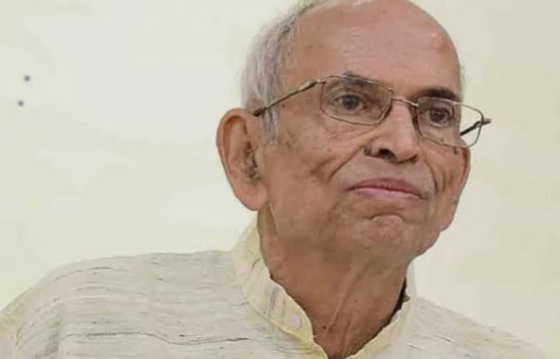 Dhananjay Ramchandra Gadgil, the renowned economist, was the youngest son of Madhav, born with an innate habit of independent thinking and a noble lesson of rising above divisions among people to see everyone with equal eyes. Outside the classroom curriculum, his regular reading of books and newspapers from the vast library of his ancestral home in Pune greatly enriched his knowledge and helped shape his unique worldview. His relatives, family members, neighbors, and even the renowned anthropologist Irawati Karve would take him into field surveys from his school days. His extraordinary ability to immerse himself among ordinary people and observe their lifestyles later led to remarkable success in ecology, low-cost conservation, and field studies. Through this process, he became deeply rooted in the heartfelt thoughts of marginalized and tribal communities, where his profound connection with their way of life, culture, and nature was vividly expressed. His unique perspective continues to serve as an incredible source of inspiration for us today.
From childhood, exploring forests and mountains with his father and observing birds ignited an unbreakable love for nature within his mind. Under the encouragement of his father's friend, the renowned ornithologist Selim Ali, his deep curiosity for nature transformed into an almost addictive passion. Although he achieved excellent results and had the opportunity to pursue medicine, he chose to dedicate himself to zoology during his undergraduate and postgraduate studies. However, the rigid and outdated syllabus of biology, where professors exhibited an aversion to independent thinking and inquisitiveness, along with their authoritarian approach, made him develop a distaste for conventional biological education in this country. Fortunately, during a postgraduate project at the University of Bombay, he conducted in-depth field research on the life cycle of a species of fish, which led him to establish contact with a renowned Harvard ichthyologist. This connection sparked his dream of pursuing a Ph.D. at Harvard. During this period, a new chapter began in his life—he married Sulochana, a college friend, who by then had secured an opportunity to pursue a Ph.D. in mathematics at Harvard. This union of love, dreams, and perseverance formed his life's journey, which continues to serve as a profound source of inspiration for us today.
Scientist Madhav Gadgil began his studies at Pune University, where he earned his undergraduate degree in Biology in 1963. Following this, in 1965, he completed his postgraduate studies in Zoology from the University of Mumbai, laying the foundation for his research career. During his time at Harvard University, the institution’s emphasis on free thought, the friendly relationship between students and teachers, and an open and egalitarian environment for people from all walks of life deeply influenced him. This impact created a new direction in his mind, where he recognized the value of education, knowledge, and the importance of free thinking.
Upon returning to India, he tirelessly worked to establish an environment of open and liberal education in his workplace and surroundings, where students could freely express their ideas and foster new thoughts and creativity. His experiences at Harvard made him one of the most prominent students of the renowned evolutionary biologist Edward Wilson. He was especially motivated to delve into the realm of computer science, where under the supervision of William Bossert, he began researching theoretical ecological problems and constructing mathematical models. In 1969, he completed his research as an IBM Fellow, earning his Ph.D. and becoming the first person in history to undertake research in computer science focused on biology. His pioneering work opened new horizons in theoretical ecology, earning recognition through textbooks and research papers worldwide. After completing his Ph.D., he joined Harvard’s Department of Biology as a full-time faculty member. However, within a year, driven by an unwavering respect and deep emotional attachment to his homeland, India, he decided to return. His patriotism and profound love for Indian biodiversity and the environment inspired him greatly. He was motivated to dedicate himself once again to enriching and conscientizing his country, working tirelessly for the conservation of India’s natural heritage, the expansion of education, and the preservation of its rich biodiversity.
Madhav Gadgil's name is particularly prominent in connection with the Western Ghats Conservation Movement. In 2010, based on his extensive experience and research in the Western Ghats, he was appointed as the chairman of the Western Ghats Ecology Expert Panel, which later became known as the Gadgil Commission. The Western Ghats is one of India's most biodiverse regions and a complex landscape of delicate environmental sensitivity, where nature and human life are intricately intertwined. The Gadgil Commission’s report made stringent yet essential recommendations for safeguarding the region’s environment and conserving its rich biodiversity, guiding the path toward sustainable development. The core idea of the report emphasized balancing sustainable development, environmental conservation, and the interests of local communities. Perhaps most importantly, Gadgil’s approach was human-centered ecology, where he believed that true conservation was impossible without the active participation and awareness of local people. Respecting the rights of indigenous communities, rural populations, and forest dwellers and working alongside them was central to his philosophy. This perspective inspired him to take historic and groundbreaking steps in creating forest rights laws, ensuring that the rights of forest dwellers and indigenous peoples are protected—thereby forging a remarkable connection between the nation’s natural heritage and the lives of its people.
In recognition of Madhav Gadgil’s extraordinary work, he has received numerous prestigious awards both nationally and internationally. The Government of India honored him with the Padma Shri and Padma Bhushan awards, acknowledging his significant contributions to the country. His contributions on the global stage have been even more widely recognized. Notably, in 2024, he was awarded the Lifetime Achievement Award as a "Champion of the Earth" by the United Nations Environment Programme, one of the most esteemed honors in the field of environmental conservation. This accolade is considered one of the greatest achievements of his life, highlighting his enduring impact on environmental protection and sustainable development worldwide.
On January 7, 2026, at the age of 83, the great environmentalist Madhav Gadgil passed away in Pune, a loss that deeply grieved environmental scientists and activists across India and around the world. He has left an invaluable legacy of scientific knowledge and principled activism, which will serve as an unparalleled guiding light for future generations of researchers, policymakers, and environmental movements. Gadgil’s life teaches us that conserving nature is not just about forests, rivers, or mountains, but also about ensuring human life, culture, the future, and the overall well-being of humanity. His ideas, principles, and contributions will remain forever relevant and inspiring, and he will continue to stand as an unwavering guide for us all.
(Tripurainfo)
more articles...