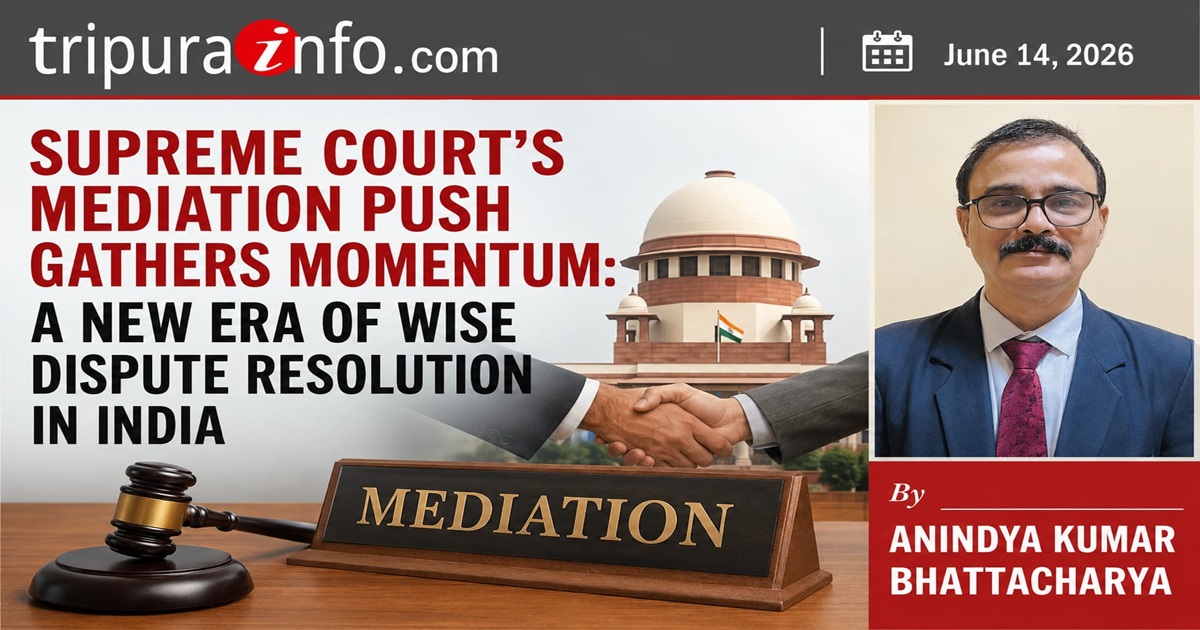
SUPREME COURT’S MEDIATION PUSH GATHERS MOMENTUM: A NEW ERA OF WISE DISPUTE RESOLUTION IN INDIA
ANINDYA KUMAR BHATTACHARYA
June 14, 2026
From Courtroom Battles to Dialogue Tables
India's judicial system is witnessing a significant shift in the way disputes are being resolved. The Supreme Court of India has increasingly embraced mediation as a preferred mechanism for resolving complex, emotionally charged, and long-pending disputes. Rather than allowing parties to remain trapped in years of adversarial litigation, the Court is encouraging dialogue, reconciliation, and mutually acceptable settlements through mediation.
This emerging judicial approach reflects the spirit of the Mediation Act, 2023 and signals a broader transformation in India's dispute resolution culture.
Kapur Family Trust Dispute: Mediation for a ₹30,000-Crore Estate
One of the most significant examples came in 2026 when the Supreme Court referred the highly publicized Kapur family trust dispute to mediation. The dispute involved Rani Kapur, mother of late industrialist Sunjay Kapur, and Priya Kapur, the widow of the deceased businessman, over control and administration of the RK Family Trust and related assets reportedly worth around ₹30,000 crore. Recognizing the sensitive nature of the family dispute, a Bench comprising Justices J.B. Pardiwala and Ujjal Bhuyan appointed former Chief Justice of India D. Y. Chandrachud as mediator. The Court emphasized that family relationships should not be permanently damaged through prolonged legal battles and that mediation offered a dignified path toward resolution.
Protecting Family Relationships Beyond Litigation
The mediation process in the Kapur matter also encompasses issues relating to the interests of Sunjay Kapur's children from his earlier marriage with actress Karisma Kapoor. The Supreme Court's intervention demonstrated that even disputes involving enormous financial stakes can benefit from consensual resolution mechanisms. The case has become a powerful example of the Court's faith in mediation for handling trust, succession, inheritance, and family governance disputes.
Mediation in the IAS Officers' Defamation Case
The Supreme Court recently adopted a similar approach in the long-running dispute between senior IAS officers D. Roopa Moudgil and Rohini Sindhuri. Observing that the continuing civil and criminal defamation proceedings were causing professional and personal harm to both officers, the Court referred the matter to mediation. Former Supreme Court Judge Kurian Joseph was appointed as mediator, while all ongoing proceedings were stayed. The Court's message was clear: where litigation threatens to destroy relationships and careers, mediation can provide a constructive alternative.
The Rise of "Swadeshi Mediation"
Another landmark development emerged from a civil dispute that had remained unresolved for nearly four decades. A Bench comprising Justices P. S. Narasimha and Atul S. Chandurkar commended Senior Advocate Gaurav Agrawal for successfully mediating the matter.
The Court described the approach as "Swadeshi Mediation"—an Indian model rooted in empathy, personal engagement, goodwill, and reconciliation. The judges observed that dispute resolution is not merely a legal exercise but also a human endeavour aimed at restoring harmony.
The concept has attracted considerable attention as an indigenous approach that blends professional mediation skills with traditional Indian values of dialogue and consensus-building.
Why Mediation Is Gaining Ground
The Supreme Court's growing reliance on mediation reflects practical realities. Court litigation is often expensive, time-consuming, and emotionally exhausting. Mediation, by contrast, offers confidentiality, flexibility, speed, and the possibility of preserving relationships. It is particularly effective in:
• Family property disputes
• Trust and succession matters
• Matrimonial conflicts
Defamation disputes
• Commercial and shareholder disagreements
Long-pending civil litigation
Unlike conventional litigation, mediation allows parties to craft solutions tailored to their specific needs rather than accepting an imposed judicial outcome.
A Cultural Shift in Dispute Resolution
The Supreme Court's recent interventions indicate that mediation is no longer viewed as a secondary option but as a mainstream method of dispute resolution. The Court's willingness to appoint eminent mediators, including former Chief Justices and retired Supreme Court judges, underscores the importance attached to the process. As mediation continues to gain acceptance, it may help reduce judicial backlog while simultaneously promoting more durable and harmonious settlements.
The Road Ahead
The success of recent mediation initiatives suggests that India is gradually moving toward a culture where dialogue prevails over confrontation and consensus triumphs over conflict. The Supreme Court's message is increasingly consistent: not every dispute requires a courtroom verdict; many can be resolved more wisely through conversation, understanding, and mutual respect. In an era of rising litigation, mediation is emerging not merely as an alternative dispute resolution mechanism but as a preferred pathway to justice itself.
(Tripurainfo)
more articles...