Sudip K Roy, IAS (Retd)
ANGKOR WAT: THE TIMELESS WONDER OF CAMBODIA
April 29, 2026
Architectural
features of Angkor Wat attracted me particularly after watching the movie Tomb
Raider. Since then, the Temple Complex in northwestern part of Cambodia was on
my bucket list of places to visit. This monument is also the biggest Temple
Complex in the world and a UNESCO World Heritage Site as well. During reign of
Khmer royal dynasty of King Suryavarmans, Angkor Wat and hundreds of other Temples
were constructed. I had an over whelming desire to see this monument. It is
better to see something once than hearing about it a thousand times.
Finally,
I reached Siem Reap, the second largest city of Cambodia, which hosts Angkor
Wat. Had to travel from Kolkata to Bangkok and then take another flight, since
the place did not have any direct air connectivity from India. Airport is small
but hosts several international flights mainly from Europe, particularly
France, perhaps because of old colonial ties. Cambodia was a French colony from
1863 to 1953 as part of French Indo-China.
After
gaining independence in 1953, Cambodia opted for a Constitutional Monarchy. The
most well-known post-independence Monarch had been Prince Norodom Sihanouk, who
led his country through the turbulent days of war with the USA & its
Allies. In between, this small country with a population of less than two (2)
crores withstood a horrible phase of communist rule between 1975-1979 and was
renamed Democratic Kampuchea under a dictator Pol Pot. Major cities of
Cambodia, apart from the Capital, Phnom Penh, are Siem Reap in North East and
Sihanoukville on the coast of Gulf of Thailand.
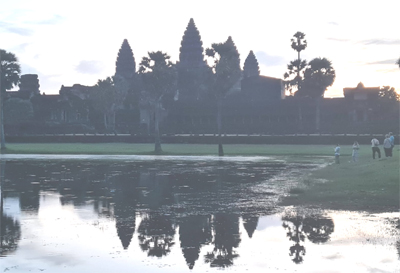 At
pre-dawn hours of next day enjoyed a TukTuk ride to the Temple Complex, about
06 km from away, to catch a glimpse of reflection of the magnificent Temple on
the waters of Lotus Pool at Sun rise. A huge crowd, mostly western tourists,
had already gathered around the Pond with Cameras ready on Tripods. I was
perhaps the only traveller from India there to witness a spectacular
phenomenon. First sliver of Sun doesn’t rise, it spills. It gradually dilutes
the pre-dawn mist and then the whole Temple glows up from inside. Watching the
rising Sun spraying its golden rays on the contours of the Temple Towers
creating a reflection on the Lotus Pond, was a spectacle that can never be
forgotten. The Pond water turned into liquid gold. Even the air seemed turn
golden for few seconds. Simply a unique moment. Everything one can imagine was
real. The spectacle lasted for couple of seconds and the crowd was euphoric.
Then it started to melt away. I also moved towards the main Temple.
At
pre-dawn hours of next day enjoyed a TukTuk ride to the Temple Complex, about
06 km from away, to catch a glimpse of reflection of the magnificent Temple on
the waters of Lotus Pool at Sun rise. A huge crowd, mostly western tourists,
had already gathered around the Pond with Cameras ready on Tripods. I was
perhaps the only traveller from India there to witness a spectacular
phenomenon. First sliver of Sun doesn’t rise, it spills. It gradually dilutes
the pre-dawn mist and then the whole Temple glows up from inside. Watching the
rising Sun spraying its golden rays on the contours of the Temple Towers
creating a reflection on the Lotus Pond, was a spectacle that can never be
forgotten. The Pond water turned into liquid gold. Even the air seemed turn
golden for few seconds. Simply a unique moment. Everything one can imagine was
real. The spectacle lasted for couple of seconds and the crowd was euphoric.
Then it started to melt away. I also moved towards the main Temple.
Angkor
Wat Temple is the ultimate expression of Khmer pride and is one of the most
visited monuments in the world. It is the heart of Khmer civilisation and
source of fierce national pride of Cambodia. It had been in continuous use ever
since it was built. Main Temple is spread over about 203 acres. But the Angkor
Archaeological Park consists of 72 major Temples. Including ruins & minor
sites, total number goes above 1000 structures. Construction was spread over a
period of 30 to 40 years during the rule of King Suryavarman II (1113–1150 CE)
of Khmer Empire. UNESCO and Archaeological Survey of India (ASI) in
collaboration with Government of Cambodia are engaged in maintenance and
restoration of few main Temples, but most of the other structures are in
different stages of natural decay. May be in the next half a century, the
assets will be gone forever in the absence of proper upkeep.
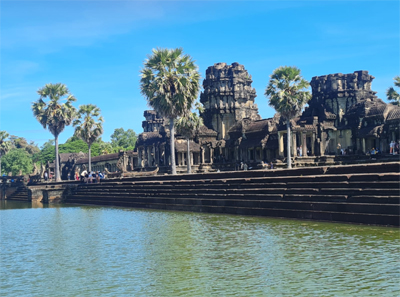 Angkor
Wat was built as a Royal Temple dedicated to Lord Vishnu. Soaring skyward, as
if trying to reach the abode of Gods, the Temple is surrounded by a
1.5-kilometer Lake (Moat) in consonance with Hindu cosmology. A stunning blend
of spirituality and engineering skill, it is an everlasting example of
mankind’s devotion to God. The magnificent structure of Angkor Wat was designed
on the architectural principles of Hindu concept of universe. Central Tower
represents Mount Meru, the mythological abode of Gods and all five Towers
symbolize the Peaks of Mount Meru and the Perimeter Wall symbolizes the
mountain ranges representing the edge of the world. With the spread of Buddhism
in South East Asia, religious character of Angkor Wat gradually transformed
into a melting pot of the two great religions, Hinduism and Buddhism.
Angkor
Wat was built as a Royal Temple dedicated to Lord Vishnu. Soaring skyward, as
if trying to reach the abode of Gods, the Temple is surrounded by a
1.5-kilometer Lake (Moat) in consonance with Hindu cosmology. A stunning blend
of spirituality and engineering skill, it is an everlasting example of
mankind’s devotion to God. The magnificent structure of Angkor Wat was designed
on the architectural principles of Hindu concept of universe. Central Tower
represents Mount Meru, the mythological abode of Gods and all five Towers
symbolize the Peaks of Mount Meru and the Perimeter Wall symbolizes the
mountain ranges representing the edge of the world. With the spread of Buddhism
in South East Asia, religious character of Angkor Wat gradually transformed
into a melting pot of the two great religions, Hinduism and Buddhism.
The
most significant feature of Angkor Wat is its orientation toward the West
unlike most Khmer Temples that face the East. Symbolically West is the
direction of Death. The unusual orientation has led scholars to interpret the
temple as primarily a Royal tomb akin to the Valley of Kings in Egypt. This
interpretation is strengthened by the fact that magnificent bas-reliefs are
designed to be viewed in anti-clockwise direction that matches ancient Hindu
funeral rites. Moreover, Lord Vishnu is frequently associated with the
direction of West. Scholars suggest that most likely Angkor Wat served both as
Temple and a Mausoleum for Royal Dynasty.
Entering
the main temple makes one feel like walking into a dreamworld. Walls are
covered with intricate carvings on themes drawn from Hindu mythology. The most famous one is the Churning of the
Ocean of Milk (Sagar Manthan by Devas and Ashuras) engraved in a vertical stretch
depicting the story in minute details. Watching Hindu mythology carved out on
stone in a faraway country is amazing. This is just a glimpse of what the
temple presents to a visitor. It is beyond my means to perfectly describe the
complexity of whole gamut of sculptures that were created by thousands of
artists over decades. Even seeing was
not believing. Those creations engraved in stone will forever remain etched in
memory.
 Later
in the day explored Ta Prohm Temple that is part of Angkor Archaeological Park
and is also a tourist attraction. It is a 12th-century marvel that showcases
the Khmer architecture. The Temple is famous for its mesmerising stone carvings
though mostly in ruins now. Roots and branches of huge trees (Strangler Figs
and Celiba aka Kapok) have got deeply intertwined with temple structures giving
the whole place a mysterious and ghostly look. Trees are so huge that in places
they obstruct sunrays. The surroundings present a haunted feel, perfect
location for any horror movie. It was a matter of pride to see a Displaying
Board “Archaeological Survey of India is partnering with its French counterpart
for restoration of the treasure”.
Later
in the day explored Ta Prohm Temple that is part of Angkor Archaeological Park
and is also a tourist attraction. It is a 12th-century marvel that showcases
the Khmer architecture. The Temple is famous for its mesmerising stone carvings
though mostly in ruins now. Roots and branches of huge trees (Strangler Figs
and Celiba aka Kapok) have got deeply intertwined with temple structures giving
the whole place a mysterious and ghostly look. Trees are so huge that in places
they obstruct sunrays. The surroundings present a haunted feel, perfect
location for any horror movie. It was a matter of pride to see a Displaying
Board “Archaeological Survey of India is partnering with its French counterpart
for restoration of the treasure”.
In
recent years this Temple emerged as a hot tourist destination after the famous
Hollywood movie Lara Croft: Tomb Raider starring Angelina Jolie was mostly
picturized in its premises. Unique blend of nature and architecture made it an
ideal setting for the film's action filled background. My Guide explained the
locations and scenes that were shot there. Quite interesting.
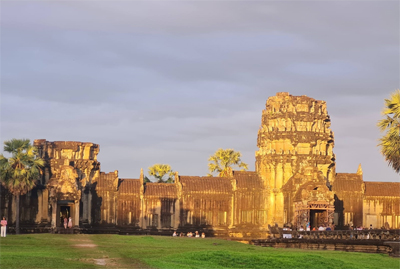
 Sunset
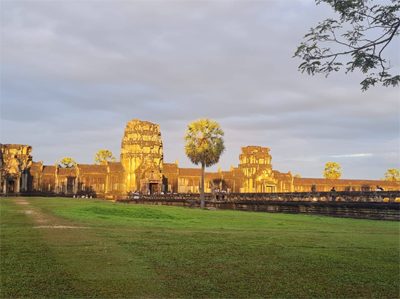
at Angkor Wat is also a never-to-be-missed experience. So, as the sun was on
its way to set, I returned to Angkor Wat. The Temple glowed softly in the
fading mild golden rays. It is a breathtaking spectacle, where the sky
transforms into a canvas of gold, pink, and fiery orange. As the sun slowly
sinks behind the ancient stone towers, reflection shimmers on the still waters
of the surrounding moat, creating a surreal frame. Time seemed to have paused.
Sunset
at Angkor Wat is also a never-to-be-missed experience. So, as the sun was on
its way to set, I returned to Angkor Wat. The Temple glowed softly in the
fading mild golden rays. It is a breathtaking spectacle, where the sky
transforms into a canvas of gold, pink, and fiery orange. As the sun slowly
sinks behind the ancient stone towers, reflection shimmers on the still waters
of the surrounding moat, creating a surreal frame. Time seemed to have paused.
The
expression ‘Travelling changes a man’ (can’t recall the author) crossed my mind
during return journey to Siem Reap. It is so profound a statement. Travel is
not simply a movement from one location to another. It undoubtedly is a journey
of discovery: new places, new people, their language, culture, custom,
religious beliefs, food habits, the economy and the list could be endless. A
whole gamut of hitherto unknown aspects of life open up. It enriches the
traveller in a way that staying in one place can never provide. Such an
exposure is priceless.
Back
in Siem Reap, I couldn’t stop pondering about what I had seen. Angkor Wat
wasn’t just a monument; it was a living memory of devotion, beauty, and
resilience. It reminded me how small we are, and yet how powerful human
imagination could be.
“TRAVEL
IS GLAMOROUS ONLY IN RETROSPECT”
Acknowledgement
o Mr. Davuth, Guide
o Cambodia Tourism Board
o Angkor Wat Temple Management
o Mr. Sok, Driver
(Tripurainfo)
more articles...