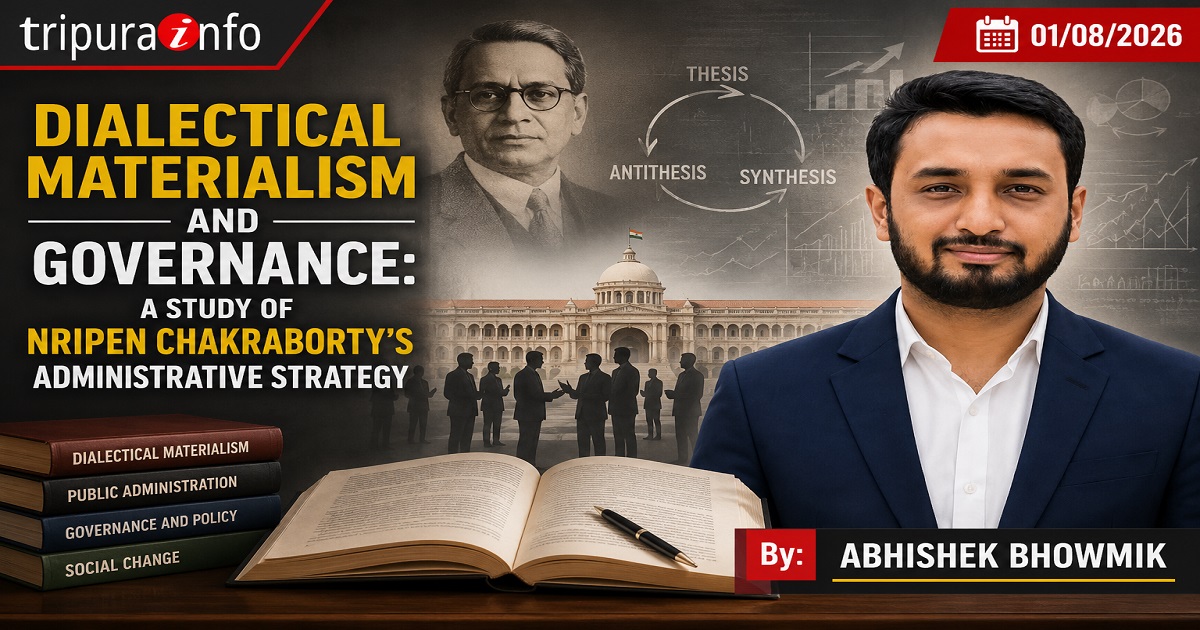
DIALECTICAL MATERIALISM AND GOVERNANCE: A STUDY OF NRIPEN CHAKRABORTY'S ADMINISTRATIVE STRATEGY
ABHISHEK BHOWMIK
August 1, 2026
Abstract
Dialectical Materialism is the philosophical foundation of Marxism developed by Karl Marx and Friedrich Engels. It explains social change as a result of contradictions within the material conditions of society rather than the evolution of ideas alone. In democratic societies, Marxist governance has often been adapted to constitutional institutions, electoral politics, and public administration. Among the Indian communist leaders who successfully integrated Marxist ideology with democratic governance, Nripen Chakraborty occupies a unique position. As the first Left Front Chief Minister of Tripura from 1978 to 1988, he transformed one of India's most underdeveloped states through ethical leadership, land reforms, decentralization, tribal welfare,
educational expansion, healthcare, and administrative accountability. His governance demonstrated that dialectical materialism could serve not merely as a revolutionary doctrine but also as a practical framework for democratic administration. This article examines the relationship between dialectical materialism and governance by analysing the administrative strategy of Nripen Chakraborty. It argues that his policies reflected the practical application of Marxist philosophy while remaining compatible with the Indian Constitution and democratic institutions.
Introduction
Political administration is never ideologically neutral. Every system of governance reflects certain philosophical assumptions regarding society, power, justice, and development. Liberal political systems generally emphasize individual liberty and market mechanisms, whereas socialist systems focus on equality, collective welfare, and social justice. Dialectical Materialism, formulated by Karl Marx and Friedrich Engels, remains one of the most influential philosophical frameworks guiding socialist political thought. It views society as a dynamic structure where historical development occurs through contradictions emerging from material conditions and class relations. Governance inspired by this philosophy seeks to eliminate social inequality, empower the working class, and establish institutions that serve collective interests instead of private accumulation.
India presents an exceptional case because communist governments have functioned within a democratic constitutional framework rather than through revolutionary transformation. The Left Front governments in West Bengal, Kerala, and Tripura attempted to reconcile Marxist principles with electoral democracy.
Among these experiences, Tripura under Nripen Chakraborty stands out because of the remarkable transformation achieved despite severe economic backwardness, ethnic diversity, geographical isolation, and administrative limitations. His administration became an example of how ideological commitment could coexist with democratic accountability and practical governance. Instead of pursuing rigid revolutionary policies, he concentrated on improving the everyday lives of ordinary people through institutional reforms and participatory administration.
Dialectical Materialism rejects the idealist assumption that ideas alone determine history. Marx argued that material conditions shape political institutions, legal systems, cultural values, and human consciousness. Economic relations constitute the foundation upon which the political and ideological superstructure develops.
According to this perspective, contradictions within the mode of production generate conflicts between different social classes, eventually leading to historical transformation. Therefore, governance cannot remain detached from economic realities. Administrative institutions must actively reduce exploitation and promote equality if they are to contribute to genuine social progress.
This theoretical understanding profoundly influenced Nripen Chakraborty's political outlook. Throughout his political career, he maintained that government should function as an instrument for social transformation rather than merely preserving existing inequalities. His policies consistently reflected concern for peasants, workers, tribal communities, and economically disadvantaged groups. However, unlike revolutionary communist regimes elsewhere, he accepted democratic elections, constitutional procedures, judicial institutions, and federal governance as the practical framework within which socialist objectives could be pursued.
When Nripen Chakraborty assumed office as Chief Minister in 1978, Tripura faced numerous developmental challenges. The state suffered from widespread poverty, unemployment, inadequate educational facilities, weak healthcare infrastructure, poor transportation, ethnic tensions, and insurgency. Administrative capacity remained limited while financial dependence upon the central government constrained developmental initiatives. Rather than viewing these conditions as permanent obstacles, his administration considered them historical contradictions requiring systematic intervention through public policy.
One of the defining characteristics of his governance was his unwavering commitment to administrative honesty. His personal lifestyle reflected remarkable simplicity and integrity. Unlike many political leaders, he rejected luxury and demonstrated that public office was a responsibility rather than a privilege. This personal example significantly strengthened public trust in government institutions. Administrative ethics became an essential component of governance because corruption was regarded not only as a legal offence but also as a violation of social justice. Public resources were viewed as collective property that must be utilized for the welfare of society rather than personal enrichment.
Land reform became one of the most significant instruments through which his government attempted to reduce economic inequality. Inspired by Marxist principles concerning agrarian relations, surplus land was redistributed among landless peasants while tenancy rights received greater legal protection. These reforms weakened remnants of feudal structures and expanded economic security among rural households. Although implemented within constitutional limitations, they reflected the broader objective of transforming unequal property relations without resorting to revolutionary violence. Increased agricultural productivity and improved rural livelihoods demonstrated the practical importance of these reforms.
Equally important was his emphasis on decentralization and grassroots democracy. Nripen Chakraborty believed that democratic governance should extend beyond periodic elections and become an everyday process involving active citizen participation. Panchayati Raj institutions received greater administrative authority, allowing village communities to participate directly in planning and implementing developmental programmes. Local participation enhanced transparency, accountability, and responsiveness while reducing bureaucratic distance between government and citizens. This decentralized model represented a practical expression of dialectical materialism because political power increasingly emerged from organized participation among ordinary people.
Tripura's tribal population occupied a central place within his developmental vision. Historical neglect had produced significant disparities between tribal and non-tribal communities, contributing to social tensions and political instability. Rather than treating tribal welfare as a symbolic political issue, his administration invested in education, healthcare, infrastructure, agricultural development, and local self-governance in tribal regions. Institutional support for the Tripura Tribal Areas Autonomous District Council strengthened democratic participation while preserving cultural identity. These initiatives reduced alienation and demonstrated that socialist governance could accommodate ethnic diversity without abandoning its commitment to equality.
Education was viewed as one of the most powerful instruments of social transformation. The expansion of schools, recruitment of teachers, and promotion of literacy campaigns reflected the government's belief that education creates informed citizens capable of participating effectively in democratic governance. Rural and tribal communities received special attention because educational inequality was understood as a structural barrier to social justice. The remarkable improvement in literacy rates witnessed in subsequent decades owes much to the institutional foundations established during Nripen Chakraborty's administration. His government regarded education not merely as an economic investment but also as an instrument of political empowerment and human dignity.
Healthcare similarly occupied a prominent position within his governance philosophy. Public investment in primary healthcare expanded access to medical services among rural populations. Preventive healthcare, immunization programmes, maternal health services, and community-based medical facilities received increased governmental attention. Rather than allowing healthcare to remain dependent upon market forces, his administration considered it a public responsibility. This approach reflected the Marxist understanding that basic human needs should not be determined by purchasing power alone.
Another distinguishing feature of his administrative strategy was the emphasis on people's participation. Development programmes were designed to involve local communities throughout planning, implementation, and evaluation. Political workers maintained close interaction with citizens, identifying local problems and ensuring effective implementation of welfare policies. Such participation strengthened democratic legitimacy while improving administrative efficiency. Citizens increasingly regarded government as a collective institution rather than a distant bureaucratic authority.
Tripura also experienced serious ethnic conflicts and insurgency during this period. Instead of relying exclusively upon coercive state power, Nripen Chakraborty's administration attempted to address the socio-economic roots of conflict.
Developmental initiatives, employment generation, educational expansion, and tribal empowerment complemented security measures. This balanced strategy reflected a dialectical understanding that political violence often emerges from deeper structural contradictions requiring comprehensive rather than purely military responses.
Despite these achievements, important limitations remained. Tripura's industrial development progressed slowly because of geographical isolation, limited natural resources, and dependence upon central financial assistance. Employment
opportunities outside agriculture remained insufficient. Administrative capacity continued to face institutional constraints while political opponents criticized aspects of party influence within governmental structures. These limitations illustrate that ideological commitment alone cannot eliminate structural economic challenges.
Nevertheless, the administration succeeded in establishing durable institutional foundations for future development.
Compared with many contemporary state governments, Nripen Chakraborty's administration demonstrated that ethical leadership and administrative integrity could significantly improve governance even under severe financial constraints. His emphasis on decentralization, social justice, education, healthcare, and public accountability distinguished his government from both authoritarian socialist regimes and purely market-oriented administrative models. Rather than pursuing ideological rigidity, he adapted Marxist principles to democratic constitutional realities, thereby creating a distinctive model of socialist governance within India.
The relevance of his administrative strategy remains significant in contemporary times. Rising inequality, corruption, unemployment, and regional disparities continue to challenge democratic governance across developing societies. His emphasis on ethical leadership, grassroots participation, inclusive development, social justice, and accountable administration offers valuable lessons for modern policymakers. The integration of ideological commitment with practical governance remains one of the most enduring aspects of his political legacy.
In conclusion, Nripen Chakraborty's governance represents one of the most successful democratic applications of dialectical materialism in independent India. His administration demonstrated that Marxist philosophy could inspire practical reforms without abandoning constitutional democracy or civil liberties. Through land reforms, decentralization, tribal development, educational expansion, healthcare improvement, administrative honesty, and participatory governance, he substantially transformed Tripura's developmental trajectory. Although structural limitations prevented complete realization of socialist objectives, his leadership established enduring institutions that contributed to long-term social progress. His administrative strategy remains an important subject of study in Political Science, Sociology, and Public Administration because it illustrates how philosophical principles can be translated into effective governance capable of promoting equality, justice, and democratic participation.
{ABHISHEK BHOWMIK, M.A. in (Political Science, Sociology, Public Administration)}
(Tripurainfo)
more articles...