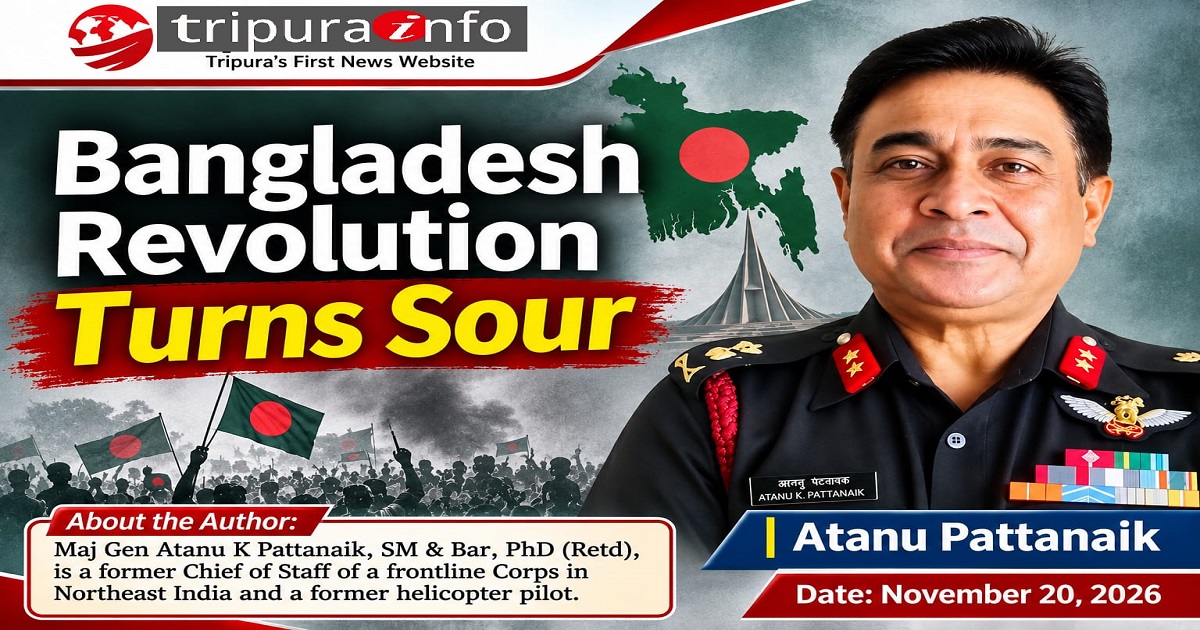
Bangladesh Revolution Turns Sour
Atanu Pattanaik
November 20, 2026
“You showed us the way”, so said the All India Students' Association (AISA) president Neha Bora, praising Bangladesh's Gen-Z movement for inspiring the Indian youth, claiming to draw inspiration from the youth-led movement in Bangladesh that led to the ousting of Prime Minister Sheikh Hasina in 2024. Joining forces with the Cockroach Janata party (CJP), she claimed that the July 2024 movement in Bangladesh was for democratic and voter rights and supposedly a fight against religious fundamentalism in their country.
Nothing can be farther from the truth as far as narratives go. The revolution of July-August 2024 which apparently inspires the likes of Neha Bora essentially benefitted two parties, the Jamaat and the Bangladesh Nationalist Party (BNP). Founded by Sayyid Maududi in 1941, Jamaat was associated with Muslim Brotherhood and is credited with popularising the concept of Hakimiya, i.e. sovereignty belongs to God and not human beings, thereby, necessitating an Islamic governance. Due to this, Maududi was against the idea of secularism and democracy, terming them “western” concepts.
Jamaat was against the idea of creation of Bangladesh and fought alongside the Pakistani Army against the Awami League and its military outfit, Mukti Bahini. After the humiliating surrender of the Pakistani Army on 16 December 1971, Jamaat leaders fled to Pakistan to wait for the right opportunity.
It didn’t take very long. Sheikh Mujibur Rahman along with family members were brutally assassinated in a coup on 15 August 1975 by the Army led by Lt Gen Ziaur Rahman who launched the BNP to legitimise his rule. Secularism was removed from the constitution, Fridays were observed as the weekly holiday instead of Sundays and Jamaat made a triumphant return. Now the new BNP government is headed by Tariq Rehman, the son of Lt Gen Ziaur Rahman.
Over years Jamaat has established thousands of Qawmi madrasas with millions of students who are unfit to take up any meaningful jobs, getting sucked into the whirlpool of Jamaat as its faithful foot soldiers for establishing Hakimiya.
The August 2024 revolution itself needs a revisit to put the records straight. At the heart of the student protests was the demand to scrap a quota system that reserved up to 30 per cent of government jobs for relatives of veterans who fought in Bangladesh’s war of independence in 1971 against Pakistan. In reality, Sheikh Hasina’s government had halted the job quotas following mass student protests in 2018 but was first reinstated by a High Court order and further pared down to 5 per cent by the Supreme court on 21 July 2024. It should have logically halted the agitation. But the context was now used as a pretext by Jamaat-e-Islami and its students wing, Islami Chatra Shibir to launch all out attacks across the country, including vandalism and arson targeting government buildings, offices of the ruling Awami League party, police stations and houses of public representatives. It was a rerun of August 1975.
What followed is interesting. Financial systems don’t fall from lack of money. They fall from lack of discipline. Under Sheikh Hasina (2009-2024), the average GDP growth rate hovered around 6.5%, making it a poster child in South Asia. Under American poster boy banker Md Yunus, Bangaldesh slipped into a cocktail of bad loans, no reforms and poor management. The GDP growth fell to 3.8% in 2025.
The wars in Ukraine and the Middle East have further magnified Bangladesh’s woes. High fertiliser costs as well as shortages is creating a severe food crisis. Then there is the issue of 1.5 million Rohingyas cramped into filthy crime-infested camps with a Myanmar-Bangladesh border now under the control of the rebel Arakan Liberation Army that’s funds itself from proceeds of smuggling arms, gold and drugs. It is unimaginable if any neighbourhood can get more toxic.
Two years since, Bangladesh is up in flames again. Garments industry employs around 40 lakh workers and remain Bangladesh’s dominant merchandise export accounting for 80% of national goods export earnings and accounts for around 10% of the country's total GDP.
Bangladesh's apparel industry supplies clothes to major global brands, including H&M, Primark and Zara. Workers' representatives say factory owners and global retailers have profited from their exploitation while employees have borne the cost for years. Beginning 1st November 2026, labour unrest have disrupted operations at 529 garment factories with a million workers leaving their workplaces in Dhaka, Gazipur, and Mymensingh as workers demanded a minimum monthly wage of Tk30,000, over double the present minimum wages. The government has formed a six-member wage board the same day, but protests continues with nearly 150 garment factories shut down.
There would be readers who would chaff at what might appear as incendiary and intolerance for Islam in the way the contours of events in Bangladesh are portrayed here. To them, let me remind that there are no parallels to tolerance exhibited by the Hindu society, particularly the region besotted to Lord Jagannath. We just need to remind ourselves about the liberal ethos of Odishan culture in embracing the bhajans and jananas of seventeenth century Muslim poet Salabega, who himself never wrote down his deeply devotional poems but were scripted later on palm leaves by admirers.
But tolerance must have boundaries and threat to the core values of a society must be confronted with force. The progressive, liberal, secular and tolerant intelligentsia must sometimes question what happened to the Hindus of Bangladesh. According to the census of 1942 in British India, Hindus constituted 28% of East Bengal. In the run up to the partition and the period till the birth of Bangladesh (1947-71), the total number of Hindus ousted from East Bengal, subjected to mass destruction, eviction, arson, pillage, murder, bestiality, mayhem and massacre, and especially rape and brutalisation of their womenfolk, is estimated at around eight million. Over the past 55 years since 1971, the number of Hindus in the country has dropped by another 7.5 million to under 8%. Dispossession of property, intimidation, abductions, rape and forced marriage of Hindu girls and conversions continue but go largely unreported.
The rising inferno in Europe is a timely reminder that radical left-liberalism combined with vote-bank politics can lead to catastrophic consequences, snuffing out the very ideals of human values, of society and way of life as we know it. A destabilised, chaotic and radicalised Bangladesh poses a more proximate danger to India than any expansionist designs of China or cross-border Jihadi terrorism being waged by Pakistan. Vigilance is the key and every righteous citizen must act as a frontline soldier to protect our sovereign and our culture.
(About the Author: Maj Gen Atanu K Pattanaik, SM & Bar, PhD (Retd), is a former Chief of Staff of a frontline Corps in Northeast India and a former helicopter pilot. A graduate of the US Army Aviation Centre, Fort Rucker, Alabama, and an alumnus of the Near East South Asia Centre for Strategic Studies (NESA), Washington, DC, he has also headed the China and Neighbourhood Desk at the Defence Intelligence Agency (DIA). He previously served as Chief Humanitarian Officer of the United Nations Mission in Lebanon.)
(Tripurainfo)
more articles...