Allegations of Arbitrary Judicial Procedures Trigger Concern Among Lawyers in Gomati District
By Our Correspondent
Agartala, October 2, 2026
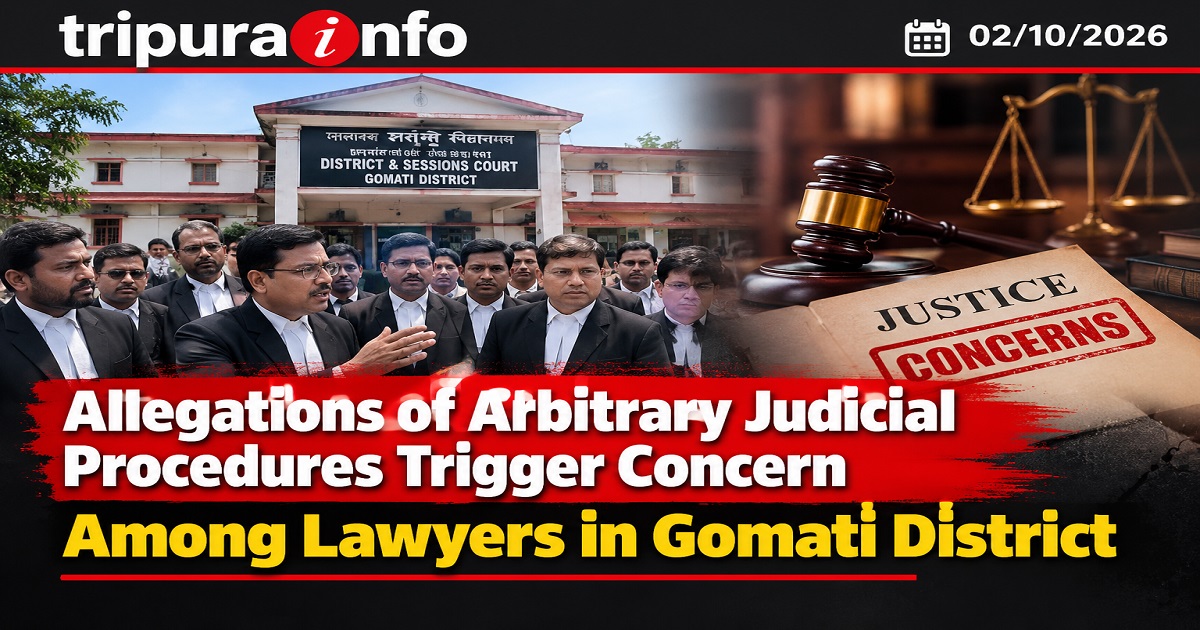 Serious concerns are being raised by sections of the legal fraternity in Tripura, particularly in Gomati district, over the alleged functioning and procedural practices in the court of District Judge Rabi Dhiya.
Lawyers have alleged delays in proceedings, repeated postponement of hearings, concerns over the examination and recording of witnesses, and delays in the delivery of judgments. They claim that such practices are causing hardship to litigants and affecting the smooth functioning of the judicial process.
According to lawyers practising in the Gomati District Court, proceedings in some cases allegedly do not begin at the scheduled time, resulting in complainants, witnesses, accused persons and other litigants having to wait for extended periods before their matters are taken up. Those travelling from distant parts of the district may be required to make repeated journeys when hearings are postponed or matters are not taken up as expected.
Lawyers have also raised concerns about the manner in which witness testimony is recorded, particularly in cases involving witnesses who speak Bengali or Kokborok. They allege that testimony may sometimes be translated before being typed or incorporated into the court record and argue that errors in interpretation or transcription could affect the accuracy of a witness's statement.
According to members of the legal fraternity, the issue is significant because the accuracy and integrity of the court record can have a direct bearing on the adjudication of a case. They have therefore called for any complaints concerning interpretation, translation or transcription to be examined with reference to the original testimony, court records and applicable procedural safeguards.
Similar concerns are reportedly being raised by some lawyers practising in Agartala. They allege that, in certain cases, witnesses are not examined on scheduled dates and that judgments or other proceedings are delayed over what they consider to be procedural or relatively minor grounds, sometimes without adequate prior notice.
Lawyers say repeated adjournments can impose substantial financial and personal costs on litigants. People involved in property disputes, family matters, criminal cases, employment disputes and other proceedings may lose working days, incur additional travel and legal expenses and be required to remain in court for long periods or return repeatedly.
Some litigants have also alleged that they have been treated in a manner they consider disrespectful during court proceedings. They claim that certain interactions have made them feel as though they were being treated like accused persons or criminals, even when appearing before the court in other capacities.
A senior advocate in Agartala, speaking on the basis of his professional experience, said the concerns extend beyond inconvenience and relate to the accessibility and efficiency of justice. He said litigants involved in long-pending cases can be particularly affected when hearings are repeatedly postponed and the final outcome remains uncertain.
The lawyers' concerns also extend to what they describe as instances in which procedural or judicial powers are allegedly being exercised in ways they believe are inconsistent with established procedure. They say that ordinary citizens and, in some cases, advocates may find it difficult to raise such grievances before an appropriate institutional authority and seek an independent examination.
Members of the legal fraternity have also pointed to the difficulty advocates may face in openly protesting against procedural decisions. According to some lawyers, advocates may hesitate to raise strong objections before the concerned court because they fear that confrontation could adversely affect their clients or their professional relationship with the court.
Another concern raised by lawyers is the availability of an accessible institutional mechanism for reporting procedural grievances. They argue that complaints supported by court records or other documentary evidence should be capable of being examined objectively by the competent authority while preserving judicial independence.
The concerns have prompted a wider discussion within sections of the legal fraternity about the impact of prolonged proceedings on public confidence in the justice system. Lawyers say that where litigants perceive hearings to be repeatedly delayed or procedural requirements to be applied inconsistently, it can increase the financial and personal burden associated with litigation.
At the same time, lawyers have emphasised that criticism of judicial procedures must be distinguished from allegations of misconduct against individual judicial officers. A judicial order or procedural decision with which a litigant or lawyer disagrees does not, by itself, establish wrongdoing. Judicial officers are entitled to due process and protection of judicial independence, while litigants and advocates have legally established appellate, revisional and supervisory remedies against orders they seek to challenge.
The central demand from sections of the legal fraternity is that the concerns be examined at the appropriate institutional level on the basis of documented facts, court records, orders, procedural history and applicable legal provisions. They have called for genuine grievances to be addressed while maintaining the independence, dignity and authority of the judiciary.
more news...