Tripura CM Reviews School Education Sector, Key Structural Challenges and New CBSE Curriculum Concerns Remain Outside Discussion
By Our Correspondent
Agartala, June 9, 2026
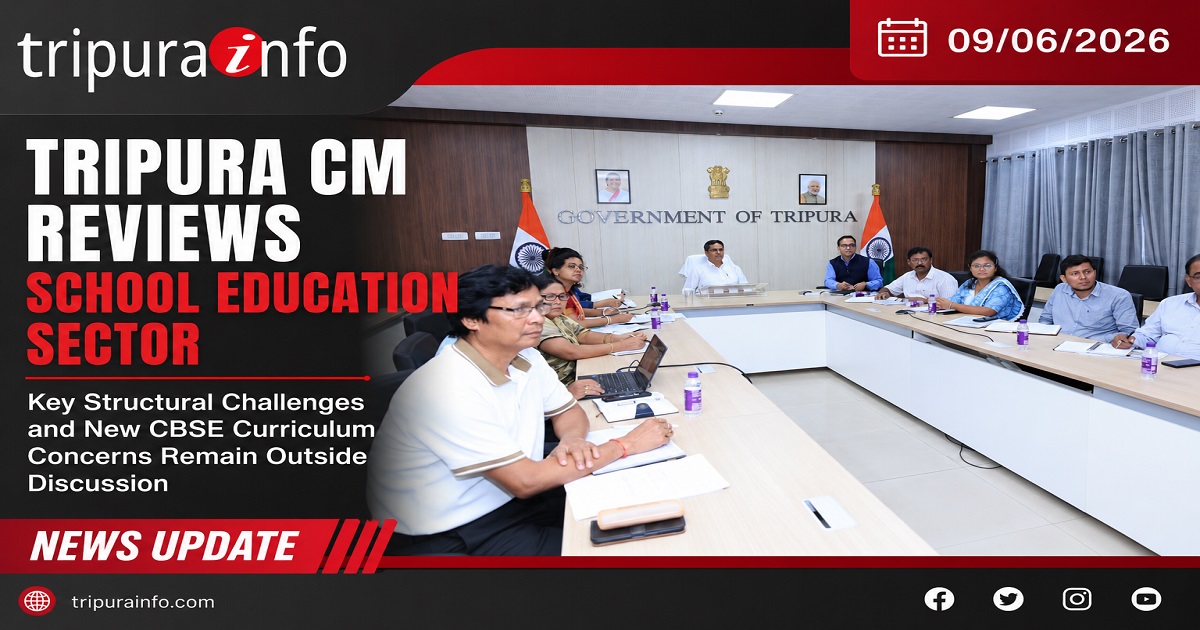 Chief Minister Dr Manik Saha on Monday chaired a comprehensive review meeting at the State Secretariat to assess the ongoing programme, progress, challenges and future roadmap of Tripura's School Education Department. The meeting was attended by School Education Secretary Milind Ramteke, IAS, departmental directors, deputy directors and District Magistrates through virtual mode. District officials highlighted various issues and challenges faced by schools across the state.
Addressing the meeting, the Chief Minister reiterated that ensuring quality education for every child remains one of the foremost commitments of the Tripura Government. He emphasized that the government is continuously working to improve the teacher-student ratio, strengthen educational infrastructure and enhance the overall quality of education.
"Only through quality education can a strong and prosperous future be built for the next generation," Dr. Saha said while stressing the need for continuous improvement in the state's education sector.
During the review, Education Secretary Milind Ramteke presented an overview of the condition of schools from the pre-primary to secondary levels. The presentation highlighted several structural challenges confronting the state's education system.
According to the presentation, many schools across Tripura continue to suffer from inadequate infrastructure facilities. A significant number of institutions do not have sufficient teachers in proportion to student enrolment, while several schools have reported very low student admissions, raising concerns regarding the effective utilisation of educational resources.
District-level administrative and academic issues affecting the delivery of education were also discussed during the meeting.
Data and assessments conducted over the years by various government and private agencies engaged in educational development initiatives in Tripura continue to indicate worrying trends in school dropout rates.
According to available reports, nearly 50 percent of students enrolled at the primary level fail to reach Class XII, highlighting a serious retention challenge. Educational assessments also suggest that a considerable number of schools in the state are still functioning with only a single teacher, despite repeated efforts to improve staffing levels.
Despite detailed discussions on infrastructure and administration, several critical educational issues reportedly remained outside the scope of the review meeting.
One such issue is the recent Supreme Court ruling concerning Teacher Eligibility Test (TET) qualifications. The judgment reportedly requires teachers who entered service without TET certification and have more than five years of service remaining before retirement to clear the examination within the next two years or face possible termination.
Many teachers have questioned why educators appointed before the implementation of the Right to Education (RTE) Act, 2009 should now be required to qualify through TET. However, no discussion on this issue was reported during the review meeting.
The meeting also reportedly did not address the implementation challenges associated with the new CBSE curriculum, which has already come into force across the country from the current academic session.
Several schools are yet to receive all textbooks aligned with the revised curriculum. Concerns relating to Artificial Intelligence education, vocational courses, coding education, skill-based learning, and implementation of the three-language policy under the new CBSE framework were also absent from the discussions.
Education stakeholders believe these issues require immediate attention as schools are already expected to implement the revised curriculum.
Another significant concern relates to Bengali-medium schools operating under the CBSE system in Tripura.
No discussion reportedly took place regarding the availability of Bengali-language textbooks for these schools. Educational experts point out that the State Council of Educational Research and Training (SCERT) has not yet initiated the translation of CBSE textbooks into Bengali, despite the nationwide rollout of the revised curriculum.
The absence of translated learning materials could create academic difficulties for thousands of students studying in Bengali-medium government schools.
The Tripura Government has introduced Nursery, KG-I and KG-II classes from the current academic year as part of its efforts to strengthen foundational learning.
However, concerns have emerged regarding the absence of dedicated teachers, insufficient classroom infrastructure and the lack of separate facilities for these newly introduced pre-primary sections. Observers noted that these implementation challenges did not find a place in the review discussions.
The issue of job security for teachers working under the Samagra Shiksha Abhiyan (SSA) also remained outside the scope of the meeting.
These teachers have been playing a vital role in sustaining the state's education system, particularly in rural and remote areas. However, many continue to face uncertainty regarding their future, while some reportedly experience delays in salary disbursement.
The matter has become more significant as approximately 4,500 SSA teachers continue to await regularisation. Teacher representatives point out that the Tripura High Court has reportedly delivered judgments on more than one occasion supporting the regularisation of SSA teachers. However, implementation remains pending.
Educationists argue that resolving the issue would not only provide relief to thousands of teachers and their families but would also strengthen educational stability and improve classroom outcomes.
Concerns relating to ICT instructors and computer teachers also remained absent from the discussions.
Stakeholders have long demanded the introduction of Computer Science and Artificial Intelligence as compulsory subjects in line with the new CBSE curriculum. There have also been calls for the expansion of vocational education and for conducting TET examinations twice annually to address teacher shortages more efficiently.
However, no deliberations on these issues were reported during the review.
Another important issue that did not come up for discussion was the proposed teacher transfer policy, which has been under consideration for several years.
The policy is expected to facilitate the transfer of teachers serving for extended periods in urban areas to backward and remote regions, while allowing teachers posted in difficult locations opportunities to move closer to developed areas.
Education experts believe a transparent and well-planned transfer policy could significantly improve equity in educational service delivery and ensure a more balanced distribution of teaching resources across the state.
more news...