Police Raid at Agartala Hotel Sparks Debate Over Privacy, Moral Policing, and Rights of Consenting Adults
By Our Correspondent
Agartala, May 24, 2026
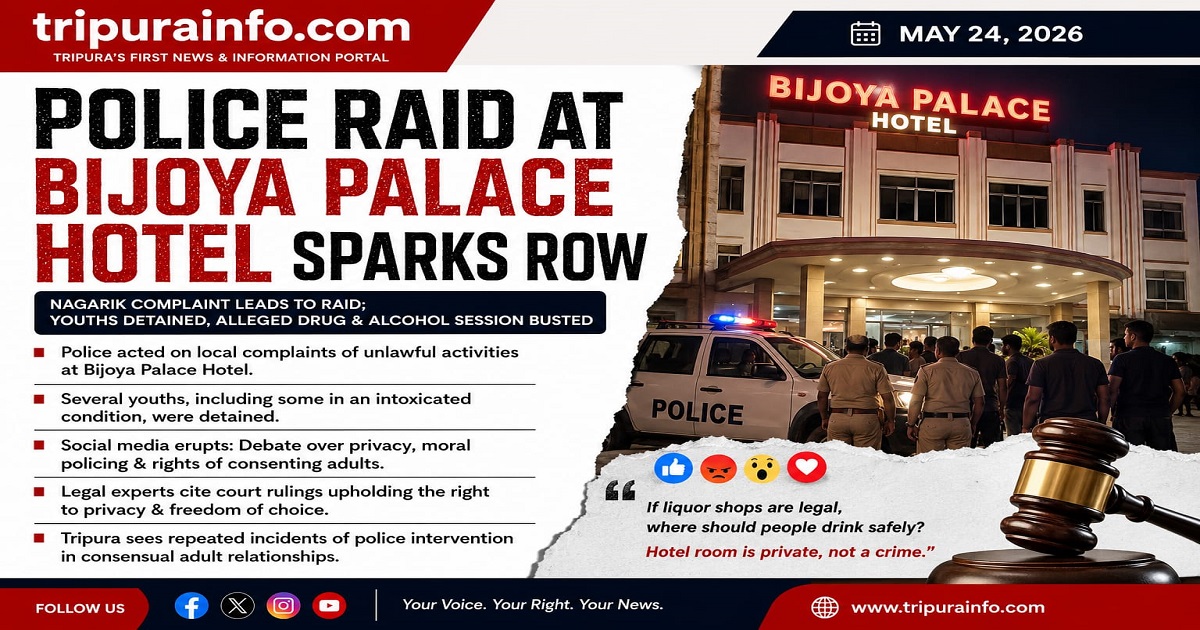 A police raid conducted at Bijoya Palace Hotel in Agartala following complaints from local citizens has triggered widespread public debate across Tripura regarding privacy, personal liberty, and the role of police in matters involving consenting adults.
According to sources, police carried out the operation after receiving allegations that unlawful activities and substance abuse sessions were taking place inside the hotel premises. During the raid, several youths were reportedly detained, and police allegedly found individuals in an intoxicated condition inside a room.
The incident quickly spread across social media platforms, where citizens expressed sharply divided opinions over the police action, with many questioning whether adults consuming alcohol privately inside hotel rooms could legally be treated as offenders.
The operation has sparked intense reactions online. While some citizens supported the police action and demanded stricter monitoring of illegal activities inside hotels and home stays, many others criticized what they described as moral policing.
Several social media users argued that if licensed liquor shops are legally permitted to operate, then adults consuming alcohol privately inside a booked hotel room should not automatically be treated as criminals.
“If liquor shops are legal, where are people supposed to drink safely if not in a private hotel room?”
“Police cannot catch bike thieves, but they can raid hotel rooms.”
“Two consenting adults staying together in a hotel is not a crime.”
“People also spend personal time in hotels. That does not mean illegal activities are happening.”
Others questioned why the identities and faces of some detained individuals were allegedly exposed publicly despite the matter potentially involving personal privacy.
Legal observers pointed out that in most Indian states, including Tripura, adults above the legal drinking age are generally permitted to consume self-purchased alcohol inside private hotel rooms unless specific hotel policies prohibit it.
India currently enforces complete prohibition only in states such as Bihar, Gujarat, Nagaland, Mizoram, and the Union Territory of Lakshadweep. Outside these regions, private consumption of alcohol by adults is generally not illegal, subject to state excise laws and hotel regulations.
Many citizens therefore questioned whether mere alcohol consumption inside a hotel room could justify police intervention unless there were clear allegations of criminal activity, trafficking, coercion, narcotics, or public disorder.
The latest incident comes months after another controversial police operation at a home stay in Haradhan Sangha area of Agartala during Valentine’s Night.
In that case, police acted following complaints from local youths alleging illegal flesh trade activities at the establishment. Several young men and women were detained during the operation.
However, the owner of the home stay, Sanghamitra Dey, strongly denied the allegations. She stated that the establishment strictly followed government rules, accepted only verified online bookings, and did not provide rooms to minors.
She further clarified that only three of the thirteen rooms were used for online bookings, while the remaining rooms were occupied by permanent residents. According to her, all guests submitted proper identification documents before check-in.
That incident also triggered heated debate regarding privacy, hospitality business regulations, and the extent of police intervention in private accommodations.
Over recent months, several incidents across Tripura have reportedly involved police questioning unmarried or pre-marital couples found together in hotels, lodges, rented accommodations, or private residences.
In many cases, no criminal complaint was reportedly filed by family members or by the individuals involved. Critics argue that repeated interventions by law enforcement in consensual adult relationships may amount to unnecessary harassment and violation of constitutional freedoms.
Civil society members and legal experts have increasingly raised concerns over what they describe as a growing culture of moral policing.
Another controversy recently emerged from Kanchanpur in North Tripura district.
According to local sources, some women residing inside the police station complex allegedly detained a young man after suspecting his presence inside the residential quarters of a woman constable. Police personnel later conducted a search operation in the quarters.
Sources claimed that a youth identified as Sujon Debnath from Teliamura was found inside the room of woman constable Sebika Chakma.
No official statement was issued by police authorities regarding the matter, further intensifying public discussion across the state.
Legal experts point out that Indian courts, including the Supreme Court and various High Courts, have repeatedly upheld the constitutional rights of consenting adults to choose their partners and cohabit without interference.
Observers also referred to a recent Tripura High Court judgment in which the court acquitted a man previously convicted in a rape case after observing that a consensual relationship within a subsisting marriage could not constitute rape under Section 375 of the Indian Penal Code.
The division bench comprising Justice Dr T Amarnath Goud and Justice S Datta Purkayastha held that the prosecution failed to prove the charge beyond reasonable doubt and emphasized the consensual nature of the relationship.
The judgment once again highlighted the judiciary’s consistent emphasis on personal liberty, privacy, and freedom of choice under Article 21 of the Constitution.
The recent hotel raid and similar incidents have renewed demands for clearer operational guidelines regarding police intervention in cases involving consenting adults.
Many citizens believe police should act firmly against genuine criminal activities such as trafficking, narcotics, coercion, exploitation, or organized illegal operations. However, they also argue that consensual relationships or private activities of adults should not automatically invite public humiliation or detention in the absence of criminal evidence.
As public debate continues, many residents are now demanding greater transparency from law enforcement authorities regarding the legal basis and procedures followed during such raids.
So far, no detailed official clarification has been issued regarding the Bijoya Palace Hotel incident.
more news...