Tripura Becomes First State in India to Implement Massive Digital Governance Network, Over 1,694 Offices Brought Under NextGen HRMS, But Faces Acute Manpower Challenges
By Our Correspondent
Agartala, May 24, 2026
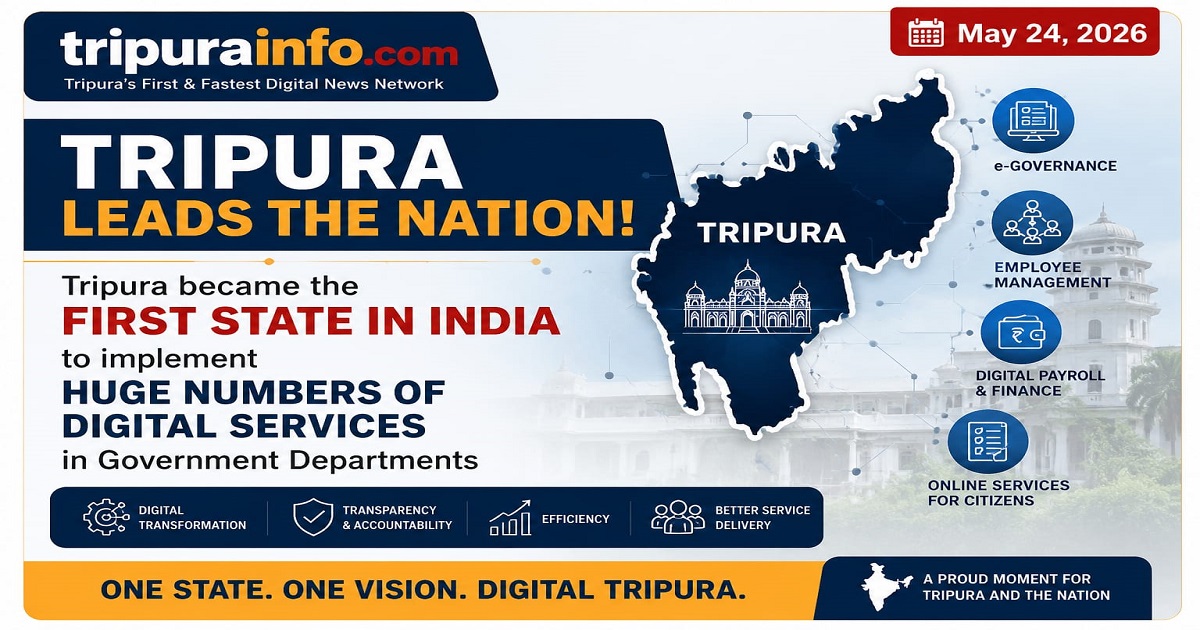 The Government of Tripura has emerged as one of the leading pioneers of digital governance in India with the successful implementation of the ambitious NextGen Human Resource Management System (HRMS), making the state one of the first in the country to introduce such a massive range of digital services across government departments.
Developed in collaboration with the National Informatics Centre (NIC), the advanced digital ecosystem currently covers 68 Directorates, more than 1,694 government offices, and over 88,300 employees across the state administration. The centralized platform has transformed traditional government functioning by automating critical services including attendance management, payroll processing, pay fixation, employee verification, allowance monitoring, and treasury integration.
By replacing outdated legacy systems with an intelligent, automated, and centralized framework, the platform has significantly strengthened transparency, accountability, efficiency, and financial discipline within the state government machinery. The system has also helped eliminate various irregularities by introducing strict digital verification and real-time data validation mechanisms.
Officials associated with the project describe the NextGen HRMS as one of the most advanced e-governance initiatives ever undertaken in the state, positioning Tripura at the forefront of digital administrative reforms in India.
However, despite the remarkable technological achievement, the rapid expansion of digital governance has simultaneously exposed a serious and growing challenge, the shortage of adequately trained manpower across government departments.
Many offices are reportedly struggling to handle the increasing workload generated by large-scale digital systems due to limited technical expertise and insufficient trained staff. Employees who were previously dependent on conventional manual procedures are now required to manage sophisticated digital platforms involving real-time data entry, verification, payroll integration, online approvals, and financial compliance monitoring.
The sheer scale of the HRMS infrastructure itself highlights the complexity of the challenge. Managing over 88,300 employee records while ensuring flawless treasury integration, financial validation, and continuous system monitoring requires highly skilled technical manpower at every administrative level.
In several departments, a limited number of employees are handling multiple digital responsibilities simultaneously, creating operational pressure and delays in processing. Officials believe that while the software architecture is highly advanced, the success of such an extensive digital transformation ultimately depends on the availability of sufficient trained personnel capable of operating and maintaining the system efficiently.
The situation has intensified demands for large-scale digital capacity building, regular staff training, and recruitment of specialized technical manpower within government offices. Experts feel that technological modernization alone cannot ensure smooth governance unless equal attention is given to strengthening human resources and digital skills among employees.
Recognizing these difficulties, the Finance Department and NIC have already introduced several support mechanisms, including live video conferencing sessions, technical assistance teams, real-time monitoring dashboards, and dedicated troubleshooting facilities. An integrated User Manual module with audio-visual guidance is also expected to be launched soon to assist employees in handling the platform more effectively.
Despite the manpower challenges, the NextGen HRMS continues to be viewed as a landmark governance reform that has transformed Tripura into a major example of digital administration in India. The initiative is being regarded as a bold step toward transparent, efficient, and technology-driven governance, even as departments continue to seek stronger manpower support to sustain the rapidly expanding e-governance ecosystem.
more news...